

One less hitch for wedding venues and those getting hitched
With easing of some curbs, hotels and restaurants are taking bookings further ahead and offering more deals, flexibility

Annabeth Leow
Singapore
GRAND wedding dinners are still a no-no, under safe-management rules for Singapore's gradual reopening amid the deadly Covid-19 pandemic.
But with receptions set to resume on a limited basis from next Tuesday, hotels and other venues that had earlier opened their calendars for pre-bookings are now ready to meet pent-up demand from wedding couples.
While some are still cautious about big receptions, Cinn Tan, chief sales and marketing officer for Pan Pacific Hotels Group (PPHG), said its five hotels here have already seen interest for wedding slots next year.
Virtual wedding fairs in recent months have yielded more than 150 leads and more than 20 confirmations, Ms Tan told The Business Times.
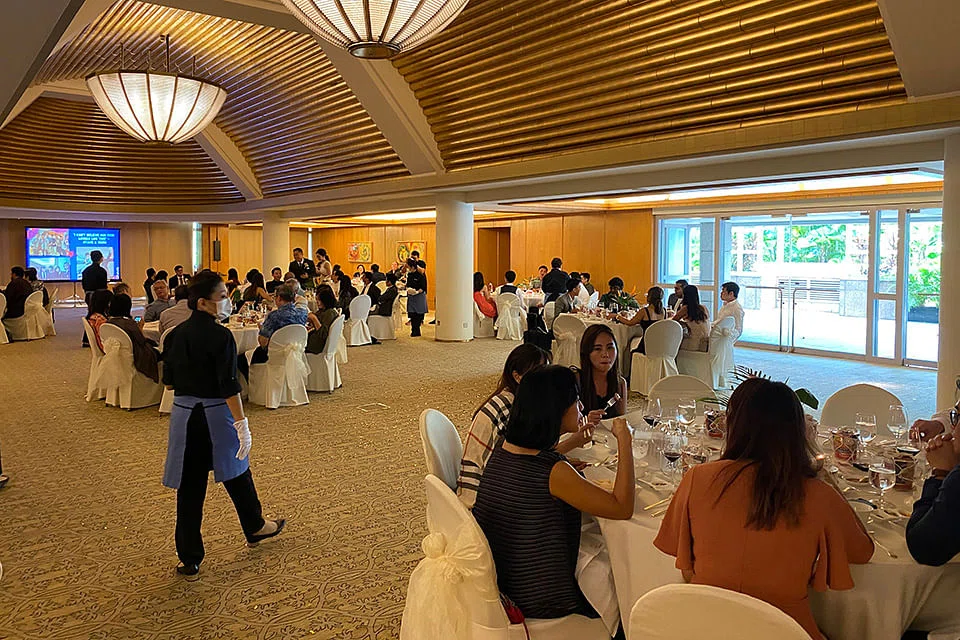
The resumption of such events is expected to offer a slight uplift for a sector reeling from a fall in domestic consumption. Still, with masked waiters, individual portions and limited guest lists, the "new normal" will be a far cry from the galas of the past.
A Hilton Singapore spokesperson, who called enquiries encouraging so far, said: "We are receiving wedding enquiries into a year ahead and will prioritise date selections for those who have booked with us this year but had to postpone their weddings."
Honeymoon deals
While in-person marriage solemnisations could take place with restrictions, pre- and post-event receptions were still barred - even after restrictions started to ease from mid-June.
For instance, the Singapore Tourism Board lets hotels host solemnisations with up to 20 attendees, but any post-event meal in the function space must be booked separately and involve no more than five people.
These restrictions will be eased even further from Aug 4 onwards, with as many as 50 attendees allowed - albeit in fixed groups of five, the authorities said on Thursday night.
Yet, even before the change was announced, hotels and restaurants were rolling out promotions over the last few weeks - for weddings that may not be held until late 2020 onwards.
One such hotelier, Millennium Hotels and Resorts, has introduced a package at its Grand Copthorne Waterfront property that is valid only from January to September next year.
Such a move encourages couples to secure a date early - avoiding a surge in demand later, group chief operating officer Kieran Twomey said.
Similarly, PPHG's Parkroyal on Beach Road launched a deal in June that dangles savings on each table sold. The offer is valid until 2021 - but bookings must be by Sept 30.
Discounts and a longer validity for bookings have been a key part of venues' approach to locking in guests.
The Tung Lok group of Chinese restaurants is throwing in rebates of up to S$888 when at least eight tables are booked for wedding banquets.
Meanwhile, MUCE @ Downtown East has dropped its rate for a Muslim wedding rental package to S$9,999 - from a usual price of S$13,000 - for event dates up until the end of 2021.
But, given the uncertainty of the pandemic, operators also recognise that customers are prioritising contract flexibility as they pick venues.
Lawmakers had to step in with temporary relief, such as a block on automatic forfeits of deposits, after disputes arose as events earlier this year were thrown into disarray by fast-changing limits on social gatherings.
"Due to the uncertainty during this period, our clients have the flexibility to postpone their events, subject to the availability of venue, or utilise their non-refundable deposits at our various facilities for up to a year," said Lindy Chia, events and sales director for Downtown East operator NTUC Club.
Sherri Kimes, a visiting professor in analytics and operations at the National University of Singapore Business School, thinks locking in bookings could work "as long as hotels provide attractive pricing and flexibility".
"If (couples) know they can rebook to a later date without much in the way of a penalty, they are more likely to make their banquet booking," said Prof Kimes, who specialises in revenue management and hospitality.
Even so, couples, guests and planners can expect weddings in the Covid-19 era to look very different.
"When a person eats or drinks, it is inevitable that the face mask has to be taken off and it further increases the risk of infection," said workplace safety and health auditor Roy Yeo, director of Bond International Consultants Pte Ltd. "It is difficult to avoid socialising in banquets and weddings."
A Chinese New Year dinner function in February ended up seeding one of Singapore's biggest community clusters, with 47 cases.
In April, another cluster emerged at The Orange Ballroom, a wedding venue at Tanjong Katong Complex.
"For the sector to recover, the key priorities for hospitality players would be the need to instill consumer confidence, and the ability to introduce national safety protocols for consumers and employees across the industry," said Teh Seng Leong, who is global real estate, hospitality and construction mergers and acquisitions leader at consulting firm EY.
Operators who spoke with BT have already put in place practices such as replacing family-style communal dishes with plated service, and even handing out individually-packed sanitising wipes to clean eating utensils before diners dig in.
Hilton Singapore has also priced safe-distancing caps into its wedding dinner packages: Its headcount quotations factor in five guests at each table, rather than the usual 10, for events until end-March 2021.
On the staffing front, "there are concerns around how to ensure employees feel supported and protected by businesses as they return to work and face increasing crowds," said Kulapalee Tobing, career products leader for Singapore and frontier markets at human resources firm Mercer.
She recommended adopting measures such as applications that track inattention and flag safety measures to workers during food and beverage (F&B) service.
But organisers and operators may have to be prepared for the long haul.
Just as the Sept 11 terrorist attacks against the United States in 2001 changed airport security forever, Mr Yeo believes that safety measures which could eliminate shared dishes from menus and see clear partitions installed between attendees will remain "for a very long time".
Income boost
Despite the tough restrictions, the return of wedding bells is expected to cheer up the beleaguered industry.
After all, events can add 30 per cent to 50 per cent to hotel room revenues in normal times, depending on the size of the conference facilities, DBS analyst Derek Tan estimated.
Such contributions may be even more urgent now, as Prof Kimes told BT that "the slowdown in weddings has had a major impact on hotels, particularly with large ballroom spaces".
With business as usual still a long way off, operators have also had to adjust the usual offerings to cope.
Tung Lok is tempting couples with menu upgrade options, as banquet revenue from smaller-scale events could come in lower than expected.
Millennium Hotels and Resorts expects to see lower margins from smaller-scale weddings. Its venues are hosting other small events, such as skills training sessions, which Mr Twomey told BT will "assist in balancing out the revenue margins".
There were 396 new coronavirus cases confirmed as of Friday noon, taking Singapore's total to 52,205, said the Ministry of Health. Among the new cases, three were in the community, three imported, while the rest are migrant workers living in dormitories.
TRENDING NOW

China recruited exec at Singapore data centre firm to spy on Nvidia CEO Jensen Huang: US intelligence
DBS, OCBC, UOB’s big sell-off: Was it their Q3 numbers or a broader market de-rating?

Could Japan trigger the next global financial crisis?

Philippines’ FDI slowdown exposes uneven investment prospects across S-E Asia

