Oslo-listed Barramundi Group considering dual listing on SGX
Singapore sustainable fish farming company eyeing profitability for its operations in Singapore and Australia
Singapore
SINGAPORE-BASED Barramundi Group went public this month on the Euronext Growth Oslo, and the company is looking to use the proceeds to drive its expansion.
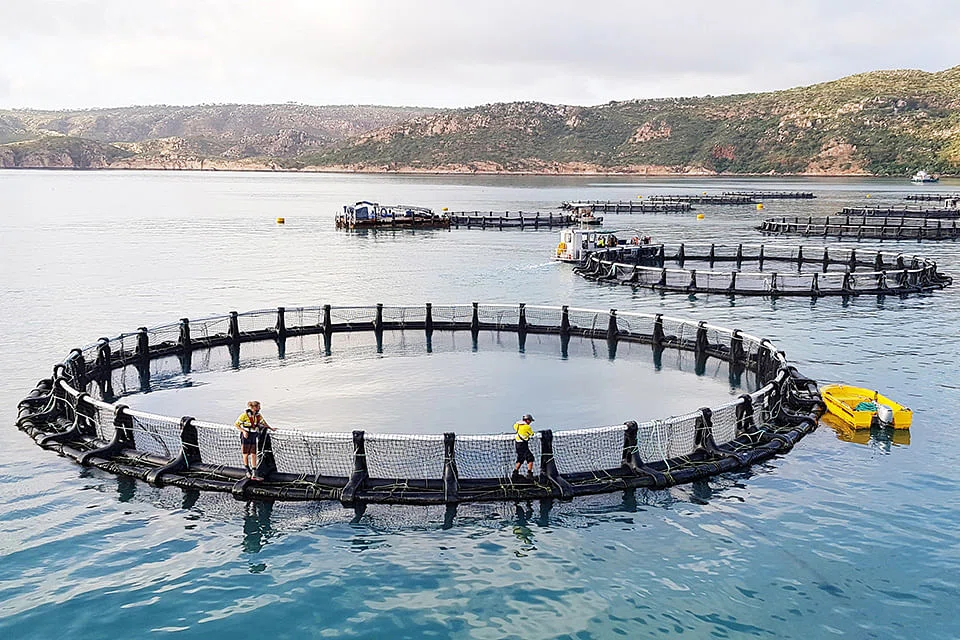
The sustainable fish farming company wants to more than treble its production output over the next five years and is eyeing profitability for its operations in Singapore and Australia, chief executive Andreas von Scholten said.
Speaking to The Business Times, he said: "Sometimes, people see an (initial public offering) as sort of the end goal. To me, this is the beginning.
"We can really start to create the company in a really exciting way."
A dual listing on the Singapore Exchange is something he would like to do as well, he added.
Previously known as Barramundi Asia, the company established its first farm site in Singapore in 2008 with a focus on growing that eponymous species of fish.
Last year, the company - which markets its fish under the Kühlbarra brand here - produced almost 2,000 tonnes of fish across its Singapore and Australia operations, with the latter site accounting for nearly 80 per cent of the output.
Barramundi Group hopes to raise its output to 7,000 tonnes by 2026.
Annual output targets for Singapore and Australia are 1,000 tonnes and 3,000 tonnes, respectively. The group's new farm in Brunei - which is expected to deliver its first harvest in the next three years - would make up the remainder.
The bulk of production is currently sold domestically - with some exports to China, the United States and Hong Kong - but the Brunei facility is expected to mainly serve the export market.
Mr von Scholten sees barramundi as a potential "salmon of the tropics", given the large market opportunity in the premium white fish category.
Earlier this month Barramundi Group carried out a private placement of 8.9 million shares at 14.70 Norwegian kroner (S$2.25) apiece to raise S$20 million. The shares were admitted for trading on the Euronext Growth Oslo on Aug 12, with a market capitalisation of around S$90.9 million based on the placement price.
It had also, in February, raised S$15 million mainly from existing shareholders, Mr von Scholten said.
Barramundi Group's revenue for the financial year ended December 2020 rose to S$28.4 million, from FY2019's S$23.1 million. In the first half of this year, the company clocked revenue of S$17.1 million.
Net loss for FY2020 stood at S$8.8 million, an improvement from the S$31.1 million loss recorded in the prior year. This was partly thanks to a fair value gain on biological assets of S$4.3 million, compared to a fair value loss of S$5.8 million in FY19. For the first half of 2021, net losses stood at S$6.4 million.
Mr von Scholten said the company has been in a "capability building process" since it first started.
"Investing into genetics, into vaccines, into husbandry, is a long-term play," he said. "Having had that investment done early (and) being the experts now on barramundi, firmly puts us on that map to be benefiting significantly from that expertise in the future as revenue is expected to grow exponentially."
Scaling up the operations is also something that could help the company.
"You need to have a certain harvest that justifies all of your fixed costs (and) then start to make money," Mr von Scholten said.
He added that the company is close to achieving these levels in Singapore and Australia, and aims to see profit at the operating level in these markets in the next 12 months or so. But he cautioned that there may still be uncertainties as the business involves live animals.
The expected profitability at some of its operations has also been a factor behind its decision to go public, although the overall company may not be profitable yet as it is still investing for growth in newer markets such as Brunei.
By 2026, Barramundi Group is targeting for its three production facilities to have gross margins of between 30 per cent and 50 per cent.
The company chose to list in Oslo partly because some of its directors and founders hail from the Nordic region. There are also a number of companies with a similar business listed there, and the Oslo bourse has a seafood index with companies such as salmon farmers among its constituents. Over the past year, the index has gained around 28 per cent.
Several companies on the bourse have a similar investment profile to Barramundi Group, Mr von Scholten added, as they are still on their journey towards profitability. He said: "The investors, they know very well the aquaculture space - that you need to invest first, to then be able to reap the profits."
Being listed in Europe also brings exposure for the company, which is currently better known in Asia.
"We do think that we have opportunities in Europe, one way or the other, whether it be in sales, production, etc," Mr von Scholten said. The listing there would be "a good springboard" to create more awareness for both the company and fish species.
Barramundi Group is the first tropical-species-focused company to list in Oslo. But he added that a dual listing in both Oslo and Singapore would be "a big milestone . . . that I would really like to do".
In the longer term, the group hopes to be able to grow production to 75,000 tonnes.
The bulk of this is likely to come from Brunei, where it has a large sea lease; and Australia, where it is seeking new leases.
It will also consider raising additional funds for expansion, seeking joint venture partners or taking on debt as the company now has a "more robust capital structure".
In the near term, however, Mr von Scholten said he hopes to "make good value out of the funds we've just raised, avoid unnecessary dilution, and reach some of the short-term goals we have".
TRENDING NOW
UOB found ‘grossly negligent’ over Stamford Land rights issue advice, to pay S$1.9 million
MAS allocates S$1.45 billion to five asset managers in third EQDP batch: Chee Hong Tat
He built the Vingroup empire. Now South-east Asia’s richest man is handing some key roles to his sons
NoMad Singapore marks brand’s arrival in Asia