UOB outlook lags that of DBS, OCBC amid spotlight on asset quality in Q3
Analysts remain positive on DBS and OCBC given resilient results supported by strong non-interest income

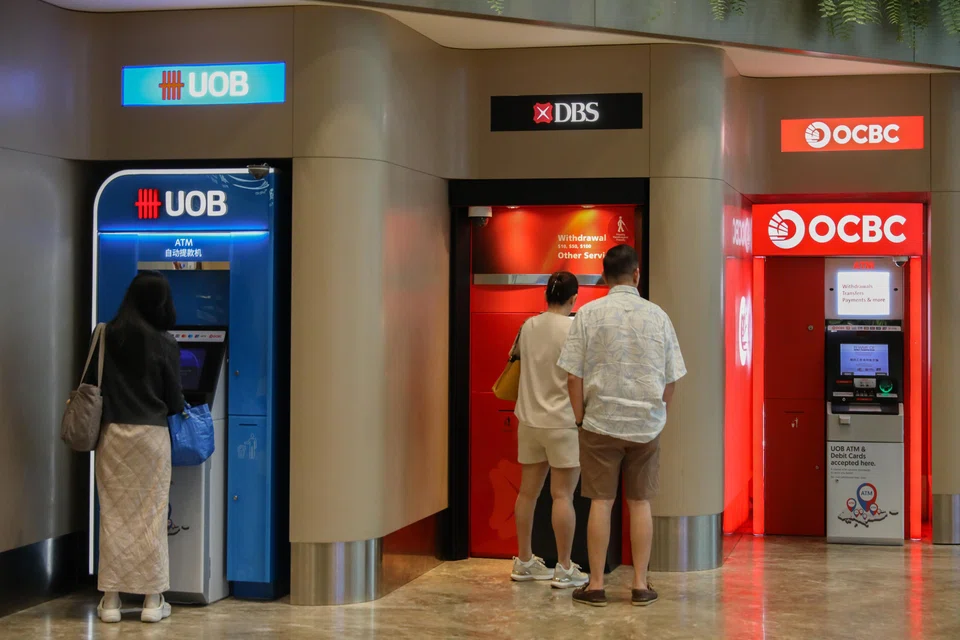
[SINGAPORE] The market outlook for UOB has turned cautious compared with that for DBS and OCBC, amid greater concerns over the former’s asset quality.
This came after UOB missed expectations when it posted a 72 per cent fall in its net profit to S$443 million for Q3, driven largely by pre-emptive provisions.
Analysts remained positive on DBS and OCBC , however, given resilient results supported by strong non-interest income in the quarter.
The two banks beat market expectations in Q3 – DBS’ net profit fell 2 per cent to S$2.95 billion, while OCBC’s was flat at S$1.98 billion.
In Q3, UOB took S$1.4 billion in provisions, of which S$615 million were general allowances to account for macroeconomic uncertainties and sector-specific headwinds.
UOB chief executive Wee Ee Cheong said the move was “very positive” because it was akin to “buying insurance”.
UOB likely made the move to bring its coverage ratio closer to that of its peers, said Lorraine Tan, director of Asia equity research at Morningstar.
“(But) the increase in provisions, while prudent, comes as a negative surprise, as UOB had not previously indicated a need to do so,” she added.
UOB would have also missed the S$1.43 billion Bloomberg consensus without the provisions.
Its chief financial officer Leong Yung Chee said Q3 net profit would have been around S$1 billion without the allowances – a steep decline from the net profit of S$1.61 billion in Q3 the year before.
Citi analyst Tan Yong Hong added that UOB’s specific credit costs also rose to 55 basis points in the quarter, from 34 basis points in the same period the prior year.
While the non-performing loan (NPL) ratio remained stable at 1.6 per cent, the lender saw S$838 million in new non-performing assets in Q3 2025, compared with S$212 million in Q3 2024.
Furthermore, UOB’s NPL coverage – now at 100 per cent – still lags that of DBS (139 per cent) and OCBC (160 per cent).
“Focus is likely to be on asset quality despite kitchen sinking due to elevated non-performing assets formation and high specific provisions,” Tan said.
In contrast, the other two banks said they were comfortable with their allowances.
DBS CEO Tan Su Shan said her general allowance reserves are “more than adequate”, while OCBC’s CEO Helen Wong also said her allowance levels are “quite satisfactory”.
In fact, CGS International (CGSI) analyst Tay Wee Kuang expects there is scope for DBS to continue writing back allowances given stabilising macroeconomic conditions.
Thilan Wickramasinghe, head of Singapore research at Maybank Securities, also thinks that OCBC’s high coverage gives a significant buffer for negative provisioning surprises.
He added: “It is too early to conclude whether (UOB’s move) is a sufficient ‘kitchen sink’ to mitigate overall risks.”
Non-interest income, capital returns
Analysts were also more positive on DBS and OCBC, considering strong non-interest income in Q3.
DBS’ non-interest income was up 9 per cent at S$2.35 billion in the quarter, amid record fee income and treasury customer sales.
OCBC’s non-interest income was up 15 per cent at S$1.57 billion, from broad-based fee, trading and insurance income growth.
This included record wealth-management performance that led to a 34 per cent rise in fee income to S$683 million.
Morningstar’s Tan said DBS had the stronger wealth management business, which supports a higher return on equity, going forward.
Analysts also liked the certainty that DBS gave regarding its dividends.
The bank has reiterated commitments towards capital returns, giving dividend visibility until 2027, and yields of more than 6 per cent in 2026 and 2027, Maybank’s Wickramasinghe said.
“Overall, DBS’ scale, strong execution, and safe-haven beneficiary status give it a significant advantage over peers,” he said.
The outlook for OCBC has also improved, with several analysts raising their calls and target prices on the stock.
DBS Group Research upgraded OCBC to a “buy” from “hold”, and raised its target price to S$19.80 from S$15.80. Meanwhile, CGSI upgraded the counter to “add” from “hold”, and increased the target price to S$19.50 from S$17.20.
Maybank also upgraded OCBC to “buy” from “hold”, and raised its price target to S$20.52 from S$17.78. Citi likewise upgraded the counter to “buy” from “hold”, and hiked its price target to S$20.30 from S$17.78.
Wickramasinghe said OCBC’s non-interest income was also significantly above expectations, while its loans also grew the fastest among its peers.
CGSI’s Tay noted that OCBC should still have S$600 million in excess capital that can be returned to shareholders after paying out its special dividends and conducting share buybacks, suggesting potential upsides.
Meanwhile, UOB’s non-interest income fell 17.5 per cent to S$1.13 billion in Q3, on higher card rewards expenses and lower trading and investment income.
Citi’s Tan expects underperformance with UOB shares, as the downgrade to its 2026 guidance likely translates to lower earnings per share and, consequently, decreased dividends per share.
Nevertheless, Morningstar’s Tan expects the card rewards scheme to be one-off, and net fee income growth should help cushion a lower interest rate in the medium term.
At the close on Tuesday (Nov 11), the share prices of all three banks were higher. DBS gained 1.5 per cent to S$55.08, OCBC was up 2 per cent at S$18.55, and UOB rose 1 per cent to S$34.03.