Pandemic heightens Singapore workers' anxiety about future: survey

Singapore
SINGAPORE'S workers have a much bleaker view of their future than many others around the world, said a PwC survey out on Monday - a finding which the professional services firm ascribed to the disruption wrought by the global pandemic.
Many in Singapore are, however, keen to embrace the challenges and opportunities ahead, though a significant number feel discriminated against and that they do not have equal access to such opportunities.
PwC's survey covered 32,517 people around the world, including workers, business owners, contract workers, students, and people who were unemployed or laid off. It polled workers in 19 countries: Australia, Canada, China, France, Germany, India, Japan, Kuwait, Malaysia, the Netherlands, Poland, Qatar, Saudi Arabia, Singapore, South Africa, Spain, the United Arab Emirates, the United Kingdom, and the United States.
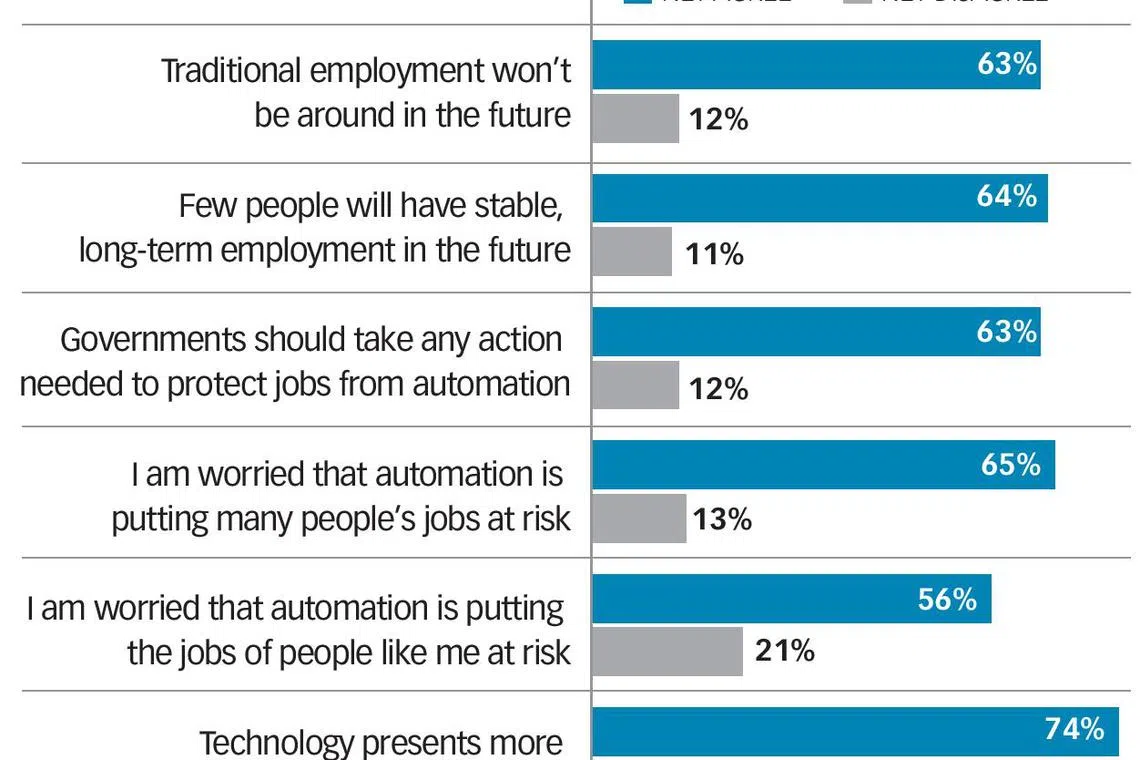
Half of the 2,000 respondents surveyed in Singapore said they believe their jobs would be obsolete within five years, compared to 39 per cent globally. Some 63 per cent, compared to 48 per cent globally, believe that traditional employment will not be around in the future, and that workers will have to sell their skills on a short-term basis to those who need them.
Almost two-thirds (65 per cent) are worried that automation is putting many jobs at risk, which is just slightly higher than the global average of 60 per cent; 64 per cent think few people will have stable, long-term employment in the future, compared to 58 per cent globally.
A sizeable 63 per cent of Singapore respondents think their government should act to protect jobs, with that feeling being most acute among 25-34 year olds (67 per cent). Globally, 61 per cent feel that way, with the feeling being more acute among 18-34 year-olds (66 per cent).
PwC said these findings reflect the fact that the pandemic has accelerated a number of workforce trends, including digitalisation.
The effects have not all been negative, however. The bulk of Singapore workers seem to have made the best of their situation to prepare themselves for the trends they foresee happening; and a greater proportion of Singapore workers, when compared to the global average, are more enthused about embracing the challenges and opportunities of the future.
PwC's survey found that 51 per cent of Singapore workers believe their digital skills have improved through the prolonged period of lockdown, and these say they will continue to embrace training and skill development; this is compared to 40 per cent globally.
Eighty-one per cent of Singapore respondents - compared to 77 per cent globally - are "ready to learn new skills or completely re-train", while 79 per cent - versus 74 per cent globally - see training as a matter of personal responsibility.
PwC said that, encouragingly, 80 per cent of Singapore respondents - compared to the same percentage globally - are confident they can adapt to new technologies entering their workplace. And, slightly more than half (52 per cent) - compared to 49 per cent globally - are focused on building entrepreneurial skills with an interest in setting up their own business.
But, of concern were findings that Singapore workers felt discriminated against or not given equal access to upskilling opportunities.
Sixty-two per cent, compared to 50 per cent globally, said they have faced discrimination at work which led to them missing out on career advancement or training, with almost a third (29 per cent) being passed over because of their age; 17 per cent said they missed out on opportunities as a result of ethnicity, while 15 per cent said they have experienced discrimination on the grounds of gender.
And, while 39 per cent of those in Singapore - versus 46 per cent globally - with postgraduate degrees said their employers gave them many opportunities to improve their digital skills, only 22 per cent of those with school-leaver qualifications - compared to 27 per cent globally - said the same. A hefty 75 per cent of unskilled manual workers said there are no opportunities for digital upskilling at all.
"If we want to shift to a model of high productivity, innovation and growth, open collaboration, transparency and inclusion are crucial factors that government and business leaders need to collaborate to ensure are translated into the workplace in the form of equal opportunities," said Martijn Schouten, workforce transformation leader, PwC South East Asia Consulting. "People in the most at-risk industries and groups may need additional interventions to ensure that existing gaps are addressed."
The survey also found that people the world over want to work remotely or have a hybrid of in-person and remote working, with only 4 per cent in Singapore and 9 per cent globally wanting to go back to a traditional commute and work environment full time.
"While the world of work is disrupted like never before, there is an opportunity to design a new normal and emerge stronger," Mr Schouten said.
READ MORE: Cleaners in Singapore to enjoy higher wages from 2023 under latest review