

PayNow eyes merchant, business payments in next growth phase, puts heat on card networks
The upgrades promise to make PayNow cheaper, faster, more intuitive and efficient for this segment of users: observers

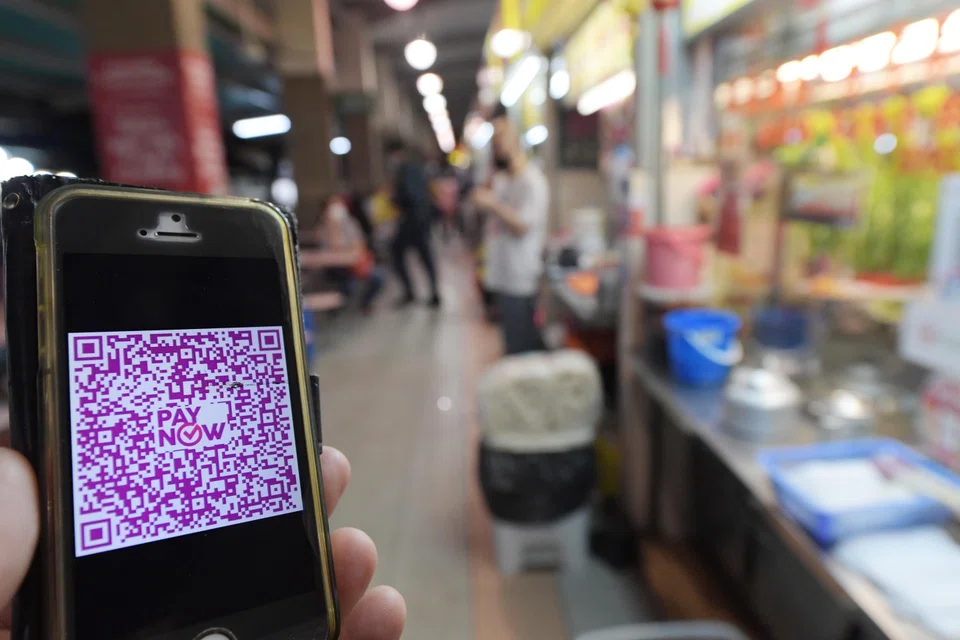
[SINGAPORE] PayNow’s next growth phase is expected to come from merchant and business payments, as the latest upgrades to Singapore’s national payment system enable it to compete more directly with card networks in a wide range of transactions.
Industry observers said that the changes will make PayNow more attractive as a payment rail for this segment, even as credit cards retain their dominance in consumer spending.
Liu Meng, principal analyst at market research and advisory firm Forrester, said: “PayNow Gen 2 could move PayNow from ‘a convenient way to pay someone’ to ‘a low-cost, real-time payment layer embedded in Singapore’s digital economy’.”
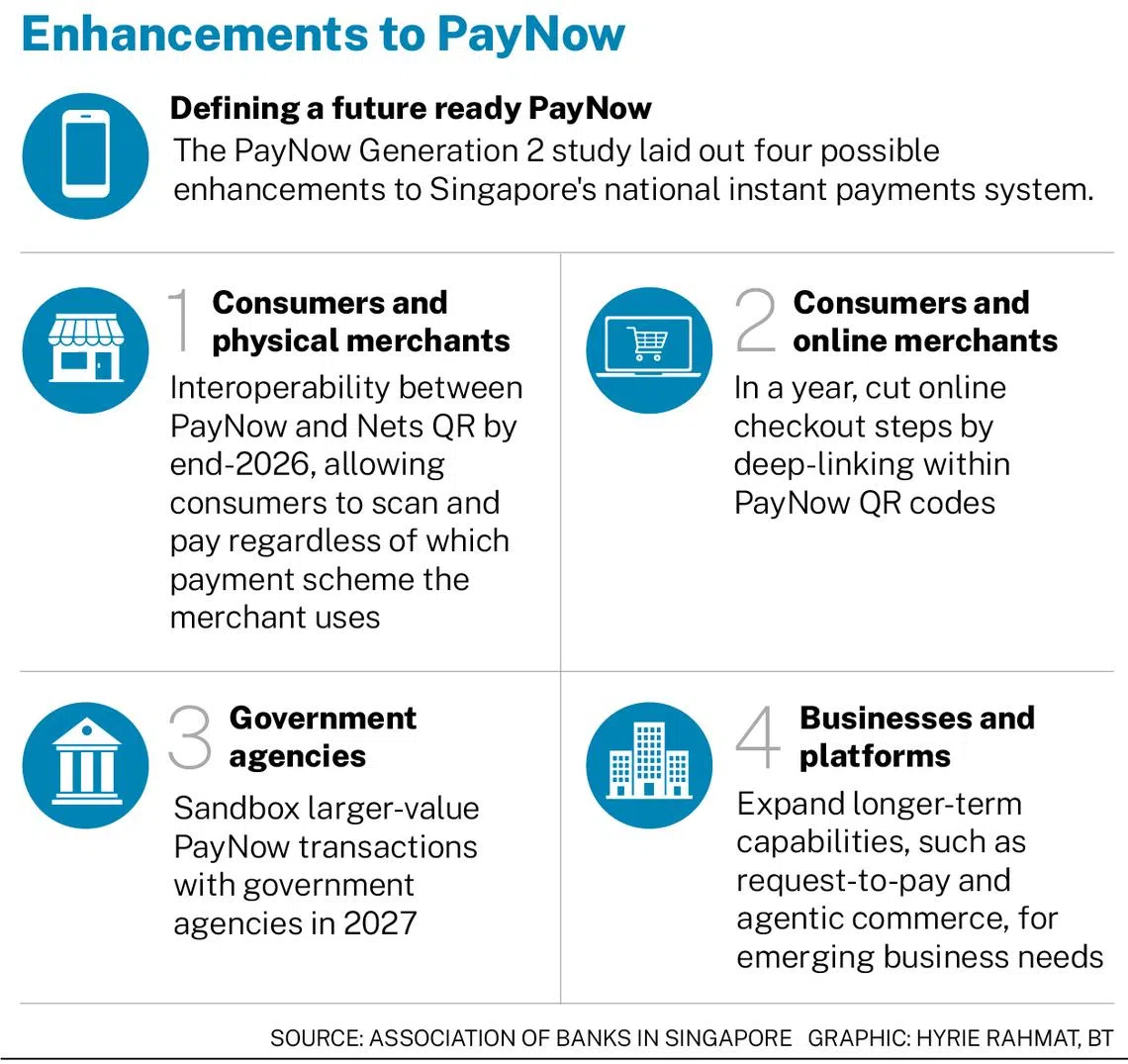
In June, the Monetary Authority of Singapore (MAS) said it would add features to PayNow under a next-generation study on meeting payment trends and demands.
These include interoperability between PayNow and Nets QR – which are now separate payment rails – and deep-linking within PayNow QR codes to reduce friction during online shopping.
Singapore is also looking to enable larger-value public-sector PayNow transactions for government agencies, as well as to expand capabilities for emerging business needs.
Competition with cards to intensify
Liu expects PayNow to become a stronger low-cost merchant acceptance rail, relative to cards.
While cards are highly convenient for consumers because of the rewards, charge-back protections and credit features they offer, merchants have to pay for that convenience through card acceptance costs, he noted.
This is “the most winnable role” for PayNow, said Zennon Kapron, director of fintech consultancy GL Insight.
“QR interoperability with Nets removes the reason a shopper hesitates at checkout, and Singapore already has the QR habit. That should move quickly,” he said.
PayNow also “sits in a useful middle ground” between cards and traditional bank transfers, Liu said.
Compared with cards, PayNow gives business sellers a lower-cost account-to-account rail without interchange economics.
Compared with standard bank transfers, PayNow can be faster, more intuitive, and easier to link to invoice, request-to-pay, and reconciliation workflows, he said.
News of the planned upgrades to PayNow comes even as account-to-account transactions already dominate payment flows in Singapore. These improvements include transfers between individuals and with merchants.
Anton Ruddenklau, partner and head of financial services at KPMG in Singapore, said account-to-account transactions make up 40 per cent of payment flows, while cards account for around 35 per cent.
Some 15 per cent of payments are from digital wallets, 5 per cent are pure QR payments through Nets, and another 5 per cent are from cash.
Multi-rail system
To be sure, observers do not expect PayNow to displace cards in consumer payments.
Kapron noted that countries such as China and the Philippines leapfrogged cards, in that card penetration in those two markets was low before digital wallets became popular.
“Singapore is the opposite,” he said. “Card penetration is close to universal, contactless (payments) work almost everywhere, and consumers feel no pain that a wallet needs to solve.”
Credit cards also have a certain degree of stickiness due to their well-established loyalty programmes, the ease and availability of credit, and wider international credit acceptance when transacting overseas, said Wong Wanyi, fintech leader at PwC Singapore.
Ruddenklau added: “Singapore has had a love affair with cards, whereas the other Asian nations never really had that opportunity.
“It was aspirational at one stage in a Singaporean’s life, in the 80s, 90s and into the 2000s, to have a credit card.”
Instead, Singapore’s future payments landscape will likely be multi-rail.
Ruddenklau expects cards will continue to dominate where they build connections with users, such as through rewards and loyalty programmes.
“Cards companies and the banks that offer cards are going to have to work harder on building the affinity, and be a lot more focused and targeted than they have been previously,” he said.
But PayNow will become increasingly attractive to consumers due to its cross-border use cases, with regional efforts to link up countries’ instant payment systems, such as Project Nexus and the Regional Payment Connectivity (RPC) initiative, he said.
Meanwhile, QR interoperability and better checkout processes will put PayNow into the merchant lane cards that have owned.
Once Singapore expands PayNow’s business-to-business functions – which is currently narrower – there may also be higher-value transactions and broader adoption of PayNow for more corporate transactions, PwC’s Wong said.
The result is that the two will overlap without fully converging: Cards will keep credit, rewards, dispute protection and global acceptance, and PayNow will compete on cost and speed, Kapron said.
“Expect the two to fight transaction by transaction, with neither simply replacing the other,” he said.
Infrastructure upgrade
More importantly, observers expect PayNow Gen 2 to be an infrastructure upgrade for Singapore’s digital economy, instead of simply being a payments enhancement.
Forrester’s Liu suggested that PayNow can become the foundational infrastructure for future agentic and programmable payments.
Its low-cost, real-time, account-to-account nature could make it attractive as a domestic execution rail for certain AI-assisted business-to-business workflows, he said.
The move also signifies that Singapore is doubling down on public payment infrastructure as a utility, controlled by no single platform, and that private players can build on, Kapron said.
This is unlike the Chinese path, where two private wallets – Alipay and WeChat Pay – effectively became the payments system, he said.
“Singapore is betting that an open, interoperable rail beats a closed, dominant wallet, and the next two years of pilots will test that bet.”
TRENDING NOW

Singapore identifies 7 firms responsible for haze fires, notices issued urging action: Grace Fu

Could stablecoins be the future of money?

Singapore should prepare for prolonged haze until November, says Grace Fu

High Court rules against Julius Baer’s Singapore trust arm in US$50 million family trust dispute

