

Pension segment and new licence to grow wealth management business: iFast CEO
NII is a key growth driver for its digital bank, iFast Global Bank

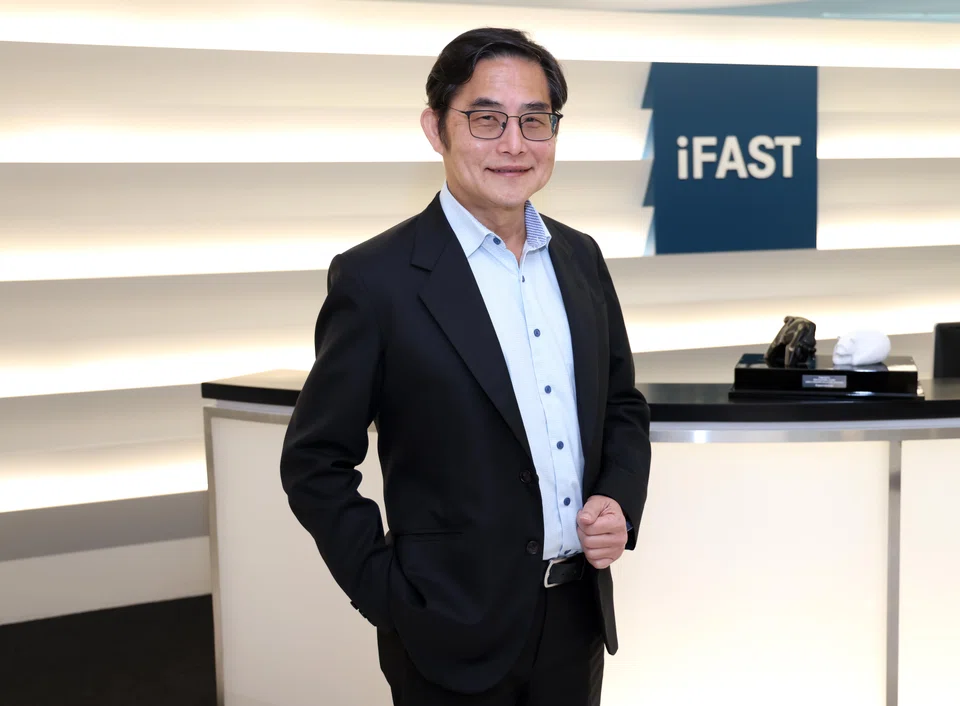
THE core wealth management business of iFast recovered in 2024, with net inflows of S$3.3 billion compared to S$2 billion the year prior.
Gross unit trust subscription increased to S$7.4 billion compared with S$4.5 billion in 2023, and fixed income turnover reached new highs in Q4 2024 of more than S$1 billion over the last seven years.
Now, iFast aims to hit assets under administration of S$100 billion by 2028 to 2030, up from S$25 billion at the end of 2024, said Lim Chung Chun.
“If we continue that 26 per cent annual growth, we will hit S$100 billion by 2030, if we grow at 32 per cent, we will do so by 2028-2029,” added the chief executive.
The company’s ePension services has contributed significantly to iFast’s increase in revenue and profitability for 2024. This contribution is expected to increase in 2025 as the business onboards more customers and the Occupational Retirement Scheme Ordinance (ORSO) business begins to contribute sometime in Q2 2025.
The delay in rolling out ORSO, which was previously slated for Q1 2025, has been chalked down to the need for more testing to ensure smooth service at launch. There are also preparations for the potential expansion of iFast’s pension services into Macau through collaboration with a partner.
In Hong Kong, the company has consistently exceeded its gross revenue and profit before tax targets for 2023 and 2024. In 2024, gross revenue stood at HK$866 million (S$150 million), higher than the target of HK$800 million, and net profit before tax for the same period was HK$309 million, higher than a targeted HK$250 million.
Over in Malaysia, iFast has scored a registered market operator licence, allowing the company to trade bonds there. “We will be going live sometime this year, and that is something that we expect will steadily allow our overall bond business to grow,” said Lim.
In Singapore, one of iFast’s biggest markets, the China desk was recently launched in December 2024. This was an effort to capture a higher share of the Chinese money in Singapore, said Lim, with an aim to improve services to Chinese clients with a dedicated desk.
“Including having Chinese colleagues based here, it will allow us to better serve the Chinese clients,” he said.
Banking on growth
iFast Global Bank (iGB) turned profitable in Q4 2024, with Lim expecting the digital bank to remain profitable through 2025. It took less than three years (since iFast acquired the UK bank in 2022) to become profitable.
Costs for iGB were managed, with Lim attributing the profitability drive to iFast’s capabilities. IGB also crossed S$1 billion in deposits at the end of 2024.
Net interest income (NII) will be a growth driver for the bank. The metric has consistently grown since Q2 2023 from £293,060 (S$492,000) to £2.1 million in Q4 2024. Only fees from EzRemit, iGB’s remittance service, of £2.2 million, were higher than the NII.
As iGB grows its deposit base, NII is expected to grow along with it.
“We do expect that the NII will be the biggest driver going forward,” said Lim.
Even as interest rates fall, he is confident that NII will continue to grow, citing iGB’s different starting point. Unlike traditional banks, iGB has passed on more rates on the savings and current accounts initially as their services were not as developed.
Now as services have matured more, iGB expects to make better margins, and when rates are cut, rates for accounts can also be cut correspondingly.
In response to questions about any plans to potentially add another bank in Europe or Singapore, Lim said that the company does not intend to acquire another bank. Instead, it will apply for a banking licence in the European Union to expand its market.
On the dividend front, iFast expects that it would not pay out up to 50 per cent of profit like in the past. With its ambitions to grow as well as higher capital needs for its banking operations, dividend distributions will not be at the same level.
But Lim still expects to continue growing dividend per share each year.
“In 2024, we paid about 26 per cent, I think that can probably be taken as a ballpark pay out ratio for 2025,” he said.






