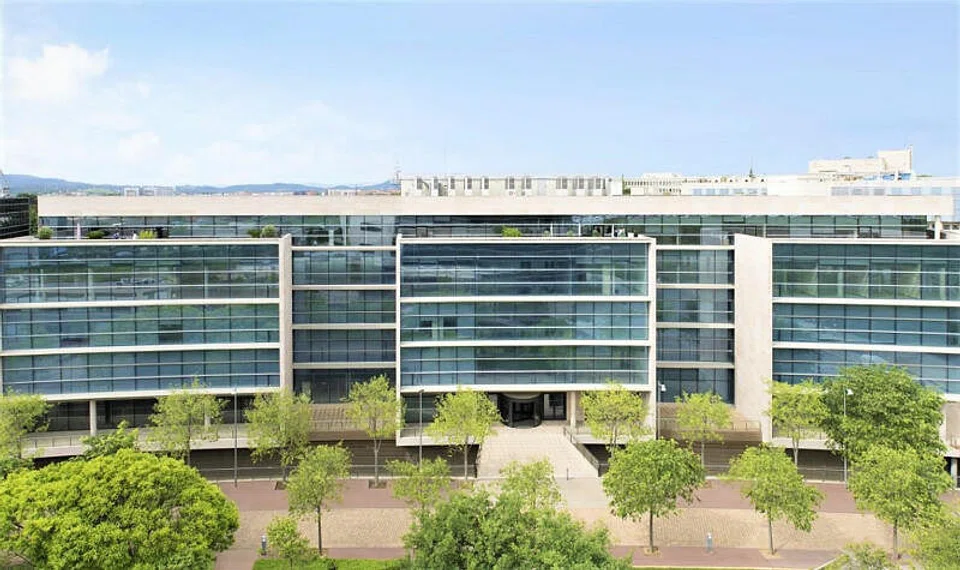
Peter Viens, new CEO of IReit Global’s manager, aims to diversify assets to attract institutional investors
The trust’s DPU is expected to drop as its Berlin property undergoes repositioning

PETER Viens, the new chief executive officer of the manager of IReit Global , plans to diversify the trust’s assets – which he considers “too small” and lacking visibility – to attract institutional investors.
The manager of the Europe-focused real estate investment trust (Reit) currently has 44 retail and nine office properties. All of its retail assets are in France, while the office assets are in Germany and Spain.
It intends to acquire assets in Western Europe and increase its exposure in retail and hospitality assets in the next three to five years, said Viens, who took the helm on Nov 5.
“You need to grow IReit so that it can enter Reit indices… so that we can open the road to institutional investors getting in (on) the unit-holding of the Reit,” he said at the trust’s third-quarter business update briefing on Nov 13.
Viens, who was previously a fund manager at European real estate manager Sofidy, said that IReit Global’s manager is eyeing assets in the Netherlands and Italy. It is also looking at the United Kingdom, which has the biggest real estate market in Europe and is highly liquid.
Retail and hospitality assets will also provide “a mix of good resilience and good yield”, as well as longer lease commitments from tenants, he added.
Ultimately, investors stand to gain from the Reit’s diversification plan as it will make the counter more liquid. Diversifying will also help to improve the Reit’s financing credit, allowing the manager to raise money for the trust more easily, said Viens.
He believes there are opportunities in the next few years to buy good assets at attractive yields.
Signs of recovery in Spain market
Earlier this week, IReit Global announced that its portfolio occupancy for Q3 ended Sep 30 stood at 89.6 per cent – a “marginal” decrease of 0.2 percentage point from the previous quarter. It attributed the decrease to lower occupancy rates among the properties in its Spanish portfolio.
At the briefing on Wednesday, Viens said that lease contracts in Spain tend to be short – between two to three years long. Therefore, it is “a more difficult exercise” to retain existing tenants and attract new ones in that market.
“That is why we struggle to maintain and significantly increase the occupancy ratio, which is around 70 per cent today,” he said.
However, he noted that the manager has received more interest in its Spanish assets in the last few months, with more potential tenants requesting to view the properties.
“And so we have the impression that the Spanish market is showing good signs of recovery,” he said. He expects the occupancy rate to increase to 77 per cent in the coming months.
Transforming IReit Global’s biggest asset
The Reit manager’s biggest project for 2025 will be repositioning its portfolio’s largest asset, the Berlin Campus, said Viens. The campus will be transformed from a single-use property to a mixed-use, multi-let asset at the end of its existing tenant’s lease on Dec 31.
The move will diversify the tenant base and reduce the risk of the asset, he said.
Two hospitality operators will sign on as new tenants in the coming weeks, he added. Collectively, they will take up around 17,000 square metres, or about a quarter of the property’s lettable area.
Their rent will also comprise half of the asset’s previous rental income, said Viens.
Overall, he is positive on the outlook for IReit Global.
“(With) the start of the decrease in interest rates, we feel that the worst is over and we now have good prospects.”
However, the Reit will experience a “significant drop” in its distribution per unit (DPU) for the duration of the Berlin repositioning project, he said. The trust posted a DPU of 0.96 euro cent for the first half ended Jun 30, 2024.
Anne Chua, the chief financial officer of the Reit manager, explained that while the Reit’s occupancy rate is expected to go up, this increase will not be enough to offset the loss of income from the repositioning of the campus.
Dilapidation costs of about 15.5 million euros (S$22 million) awarded by the Berlin Campus’ vacating tenant will also not be used to top up the DPU. Instead, they will go towards capital expenditure for the campus’ repositioning, she added.
Units of IReit Global closed flat at S$0.285 on Friday, after the business update was released.
TRENDING NOW
He built the Vingroup empire. Now South-east Asia’s richest man is handing some key roles to his sons
Quarter of Singtel special discounted shares sold ahead of CPF Board transfer
Why Tan Aik Keong of digital solutions specialist Agmo wants to make himself less indispensable
Asia needs new energy security architecture