

Philadelphia Semiconductor Index’s bullish momentum stalling

THE Philadelphia Semiconductor Index (SOX) is a modified capitalisation-weighted index which tracks the performance of US-listed equities in the semiconductor sector. Following a 27 per cent rebound from Jul 29 to Oct 6 this year, the SOX index has pulled back more than 8 per cent at the time of writing. The recent weakness in the index could be attributed to several factors.
Firstly, investors assessed intensifying competition from China’s CXMT Corp, which said it has achieved a breakthrough in chip technology that rivals such as Samsung Electronics had pursued for years, sending shockwaves through the semiconductor sector.
Secondly, the chief executives of Intel and Broadcom warned that access to capital could emerge as a major headwind to the AI boom, even as demand for computing infrastructure continues to outstrip supply. Thirdly, recent news also indicated that banks such as JPMorgan and Goldman Sachs are limiting their exposure to AI startup Volta Infrastructure’s US$5 billion loan deal. The debt is marketed with a yield of about 11 per cent, one of the highest borrowing costs in the leveraged loan market, which reflects investor caution.
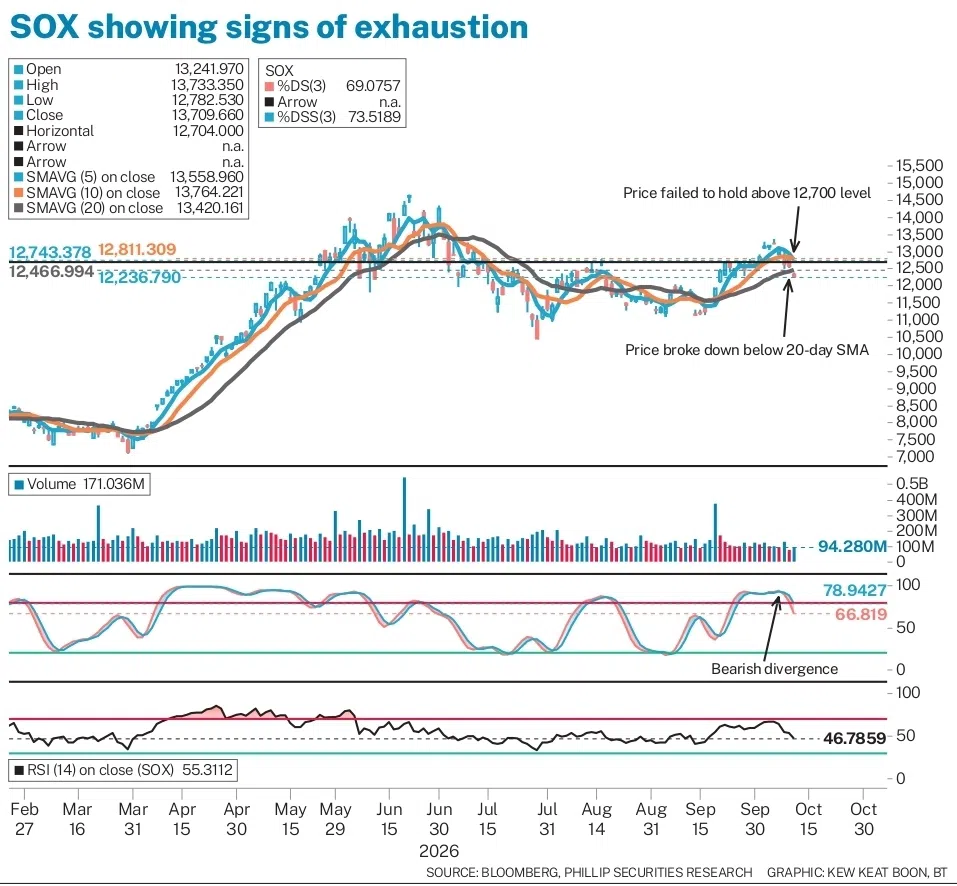
From a technical perspective, the Philadelphia Semiconductor Index is displaying signs of weakness in its recent price action. The price has failed to hold above the 12,700 level, which was a key swing high resistance level formed back in mid-August, for consecutive trading sessions since Oct 8, after climbing above it on Oct 1. This suggests that the buyers were unable to hold the breakout above a key resistance level, leaving long-position traders with mounting losses as sellers subsequently stepped in. In addition, the rebound since end-July also saw the SOX face resistance at the 61.8 per cent Fibonacci retracement level of 13,047, using the swing high of 14,655 formed on Jun 22 and the swing low of 10,445 formed on Jul 29.
Looking at the moving averages, the price has also fallen below the 5-day, 10-day and 20-day Simple Moving Averages, which indicates a loss of short-term bullish momentum since Oct 8. Looking at the stochastic oscillator, the price displayed a bearish divergence signal where the indicator did not form a higher high when the price was trending up from late September to the beginning of October. This showed signs of fading upward momentum prior to the pullback.
Lastly, the Relative Strength Index (RSI) indicator has fallen below the neutral 50 threshold, indicating that sellers have taken intermediate control. This could leave room for additional downside given recent pullbacks in July and August when the SOX saw the RSI reaching the 32 to 42 area before a short-term bottom was formed.

To conclude, the recent weakness in the Philadelphia Semiconductor Index came after growing concerns over potential intensifying competition, capital constraints and tightening lender exposure. The 11,900 level is an important support for the index to hold; a breakdown would trigger further weakness and lead to a retest of the 11,300 level.
The writer is a senior research analyst at Phillip Securities Research
Decoding Asia newsletter: your guide to navigating Asia in a new global order. Sign up here to get Decoding Asia newsletter. Delivered to your inbox. Free.
Share with us your feedback on BT's products and services
TRENDING NOW

Far East Organization’s The Serra Residences sells less than a quarter of units released at average S$3,460 psf

Once staunchly pro-China, Malaysian Chinese businesses are now distancing themselves from Beijing

Ageing in Asia: Huge potential for the consumer economy

DBS, OCBC, UOB face rate hike reality check

