Phillip Securities picks banks, property and construction sectors to ride out Q4 volatility

Yong Jun Yuan
AS investors head into what is likely to be a volatile final quarter, analysts at Phillip Securities sees banks, property stocks and construction players as good bets.
Speaking at a webinar on Saturday (Oct 8), Phillip Securities head of research Paul Chew said the research house’s strategy for the coming quarter is “hibernating for winter” as macroeconomic conditions continue to weaken.
“The macro setup for the fourth quarter, we think, is very weak because we are going to have rising interest rates. At the same time, (we see) decelerating economic growth and recession risks.
“This is probably the period where it’s like we’re in the casino…and you just need to take a coffee break,” he said.
The research house has a target of 3,500 points for the Straits Times Index (STI) over the next 12 months. The STI closed at 3,145.81 on Friday.
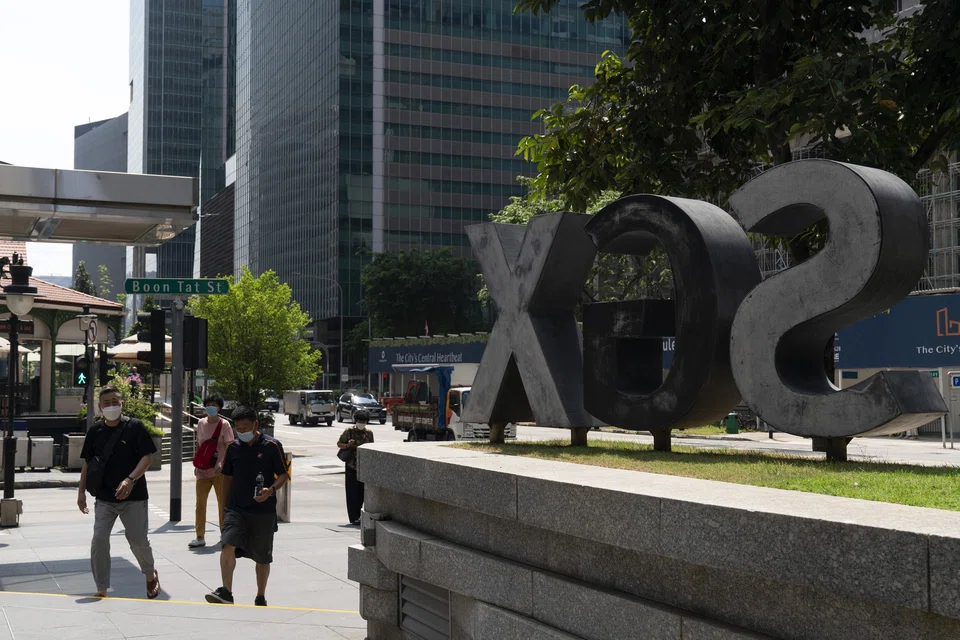
As markets remain volatile, the research house included Singapore Exchange (SGX) as a yield-generating play in place of Asian PayTV within its Absolute 10 Model Portfolio. Chew said SGX should see increased trading volumes in the next few months.
In addition, analyst Glenn Thum noted that SGX’s derivatives daily average volume (DDAV) closely tracks the CBOE Volatility Index (Vix) and similarly represents the market’s expectation of volatility.
“Assuming that there will be increased volatility in the market, as we can see that the Vix increased recently, we can expect that the DDAV will also increase and SGX will also be a beneficiary from the increase in their derivatives volume, which will flow down to the bottom line,” he said, adding that, like banks, SGX is likely to see treasury income recover with rising interest rates later in the year.
Thum has a “buy” rating on the bourse operator and a target price of S$11.71. It closed at S$9.42, down 0.4 per cent or S$0.04, on Friday.
As for the banks, DBS and OCBC are two banks that made it into the model portfolio.
Thum likes DBS as it had the highest current account savings account (CASA) ratio of 72 per cent among the trio of local banks as at the second quarter of this year.
“The positive impact from the rising interest rates will be felt most by the bank because they have this low funding cost for cash that they have,” he said.
While OCBC’s CASA ratio is lower at 60.9 per cent, Thum noted that this is still higher than UOB ’s 54.7 per cent. Additionally, the lender had the highest net interest margin in Q2 this year at 1.71 per cent.
Thum has a “buy” rating on both DBS and OCBC, with target prices, respectively, of S$41.60 and S$14.22. DBS closed on Friday down 0.4 per cent or S$0.12 at S$33.47, while OCBC closed down 0.1 per cent or S$0.01 at S$11.93.
Looking at the property sector, the research house likes City Developments (CDL) for its strong pipeline of more than 2,000 units to be launched in the next 12 months.
Chew said that because the volume of new launches is down due to a shortage of supply, “he who has the most inventory is the winner”.
Senior research analyst Terence Chua also noted CDL’s Newport Residences, a development to be built at the site of the former Fuji Xerox Towers.
CDL had a small amount to get a plot ratio uplift. “That is really just pure profit for them; We estimate that the profit margin will be the higher end of 40 to 50 per cent,” he said.
Chua has a “buy” rating on CDL with a target price of S$9.19. CDL shares closed up 0.6 per cent or S$0.05 at S$7.83 on Friday.
As for the construction sector, Chua noted that construction contracts awarded for the first half of this year declined 11 per cent year on year. He attributed this to a number of workplace accidents that led to suspensions of up to three months by the Ministry of Manpower, as well dengue outbreaks at some worksites that disrupted work.
Still, he noted that demand in the construction sector remains healthy as the government looks to beef up the supply of HDB build-to-order (BTO) flats. He further expects there to be upside bias to the Building and Construction Authority’s estimates of between S$27 billion and S$32 billion in forecasted demand from 2022 and 2025.
Within the sector, he pointed to steel solutions provider BRC Asia as a key beneficiary from the building of more BTO flats. The counter is trading at six times his projected FY22 earnings and has an 8.9 per cent forward dividend yield.
Already, Chua noted that the company has seen net profits rise by almost 300 per cent to S$60.2 million in the nine months ended June this year.
He has a “buy” rating on the stock, with a target price of S$2.26. BRC shed 0.6 per cent or S$0.01 to close at S$1.64 on Friday.
While bright spots remain among Singapore real estate investment trusts (S-Reits), the research house rated the sector “underweight” as their spreads over other risk-free assets such as the 10-year Singapore Government Securities (SGS) declined to slightly over 2 per cent on interest rate hikes.
Research analyst Darren Chan noted that S-Reits may only rebound when the Federal Reserve indicates that interest rates have peaked, which could be some time in the first quarter of next year.
He is nevertheless bullish on Prime US Reit , with a “buy” rating and a target price of US$0.88 or an estimated distribution per unit yield of 12.5 per cent. He noted that the Reit is trading at 60 per cent of its book value and that 86 per cent of the Reit’s loans are hedged, shielding it from interest rate hikes to some extent.
“They are well-diversified from the geographical as well as the tenant sector diversification standpoint,” he said, adding that 74 per cent of its tenants are from established as well as technology, advertising, media and information (TAMI) and science, technology, engineering, and mathematics (STEM) sectors.
Prime US Reit closed at US$0.51 on Friday, down 7.3 per cent or US$0.04.