

PhillipCapital sets sights on new growth areas, diversification
Its aspirational entry into digital banking by teaming up with two other firms is part of continuing efforts to 'move with the times'.
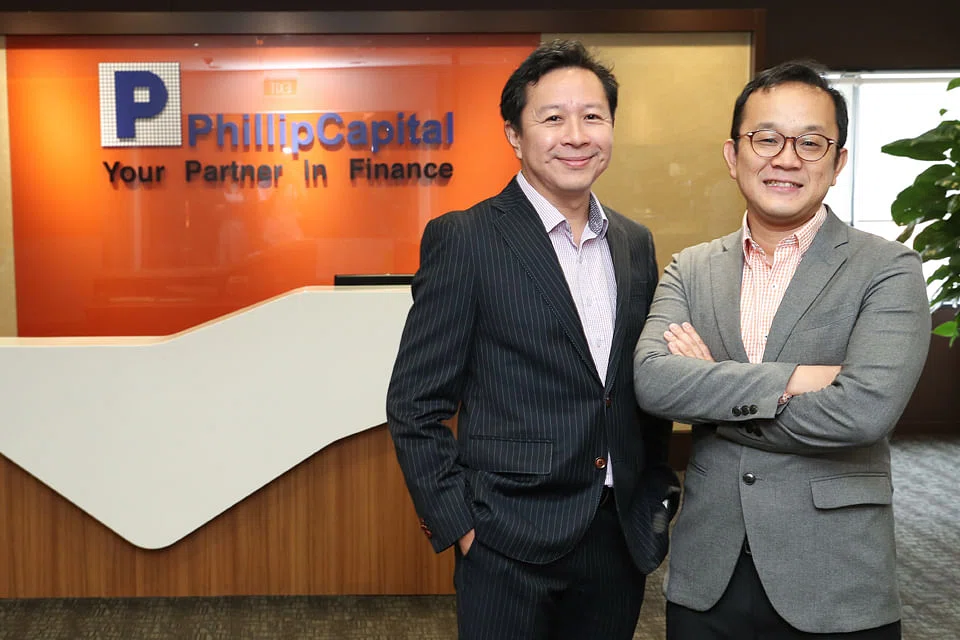
FINANCIAL house PhillipCapital wants to wade deeper into the small- and medium-sized enterprise (SME) space from its current largely retail clientele through its application for a wholesale bank licence in Singapore.
It was reported earlier this month that it had teamed up with Hong Kong-listed Sheng Ye Capital, a supply chain finance company founded by Singaporean Jeff Tung, and fintech Advance.AI.
PhillipCapital has been on a quest to shed its "old-fashioned" image, which is rather aptly captured in the story of how its company logo was designed by its founder and executive chairman Lim Hua Min through a now-obsolete practice.
"He was a chartist and he basically just drew it on graph paper. This was pre-Bloomberg days. That's the true origin," Linus Lim, co-chief investment officer at PhillipCapital told The Business Times in an interview.
The company has moved a long way since its founding in 1975, making technological leaps from phone broking to online broking in 1996, and growing the firm from a single home market to now 15 markets globally in Australia, Cambodia, China (and Hong Kong), France, India, Indonesia, Japan, Malaysia, Singapore, Thailand, Turkey, United Kingdom, United Arab Emirates, USA and Vietnam.
Once best known for its stockbroking business, it has diversified over the last decade from the sunset business segment to new businesses such as fund management and real estate consultancy. Stockbroking, which used to contribute 90 per cent of company revenue, has now shrunk to just three-fifths of the revenue pie.
Luke Lim, executive director at Phillip Securities and the younger brother of Mr Linus Lim, said the company, a family business, has been bringing on board people with dual licences and expertise in multiple products to help investors with financial planning and protection as well as retirement planning as an extension of what it had been doing before.
Mr Linus Lim added that conversations with investors today have also changed - from promoting the highest-return investments, to understanding their financial needs and prescribing the right product for them.
With the rise of robo-advisers, he still believes that "high touch, high tech" is the way to go. This explains why PhillipCapital still has 10 investor centres islandwide that hold weekly events such as seminars to engage investors.
"We still have a part to play but our role may change from just providing an execution service to curation, presenting investment ideas and actionable plans that people can work off."
For instance, responding to the preference of ageing investors for high-dividend stocks and passive income, it launched the Phillip SING Income ETF two years ago. Since its launch, the fund has generated total returns of about 16 per cent, compared to the Straits Times Index ETF's return of 14.4 per cent.
Its fund management side of the business has 15 strategies, with close to S$3 billion of assets under management.
PhillipCapital has also set up a network of property valuation agencies across Asean in countries such as Indonesia, Cambodia and Thailand, and plans to launch real estate funds to invest in properties.
In the short period of 30 years since it expanded beyond the shores of Singapore, PhillipCapital has managed to broaden its presence so rapidly mostly through inorganic expansion.
For example, in 2002, its entry into Japan was marked by its acquisition of a Tokyo Stock Exchange brokerage firm. It entered Thailand also by taking over a life insurance firm, Finansa Life Assurance, through capital injection, while in India, it bought a majority stake in the Indian unit of the beleaguered US futures brokerage firm MF Global in 2012.
Mr Linus Lim said: "The initial step may have been through inorganic acquisition, but there was an extreme amount of effort put into growing the business locally. The growth didn't just come from the acquisition per se, but was organic as well."
In each jurisdiction, PhillipCapital allows the local management to make the call in business decisions to cater to the localised needs and context of the region.
The company's aspirational entry now into digital banking is part of its continuing effort to move with the times, while leveraging on its relationships with SME towkays, many of whose investment portfolios it manages.
Mr Luke Lim said PhillipCapital had met many potential partners before Sheng Ye Capital and Advance.AI which it was not comfortable with, because their mindsets were not aligned.
He believes the trio now has the right recipe to offer to SME customers - PhillipCapital with the local branding and clientele as well as regional network, Sheng Ye with its expertise in supply chain financing, and Advance.AI with its know-your-customer capabilities.
While the brothers declined to provide numbers on the company's financial performance, they said that the company has been profitable from day one. The firm has assets under custody and management in excess of US$35 billion, with shareholders' funds of more than US$1.5 billion.
Four years ago, PhillipCapital started a small corporate innovation fund targeting to invest S$20 million in startups, ranging from fintech to edutech and proptech companies.
Mr Linus Lim said its aim was to offer entrepreneurs advice to "smoothen out" their learning curve. As the next generation of leaders for the family business, they also wanted to grow the company in a manner befiting of the times, and one of the ways they thought of was to stay attuned to young founders by investing in them.
"A lot of the chats we have with the business owners are quite enriching, because we had also faced many of the same issues before," he said.
TRENDING NOW
KKR founders among investors buying 42% of Peter Lim’s Valencia; club valued at US$1.4 billion
Singapore’s central gas buyer affirms Indonesia’s role as ‘important partner’ amid export review warning

Why the biggest business decision about AI isn’t which model to choose

NEA issues notices to 10 Singapore-based companies, including Wilmar and APP, over haze

