

Plunging oil prices add to headwinds for SIA

Nisha Ramchandani
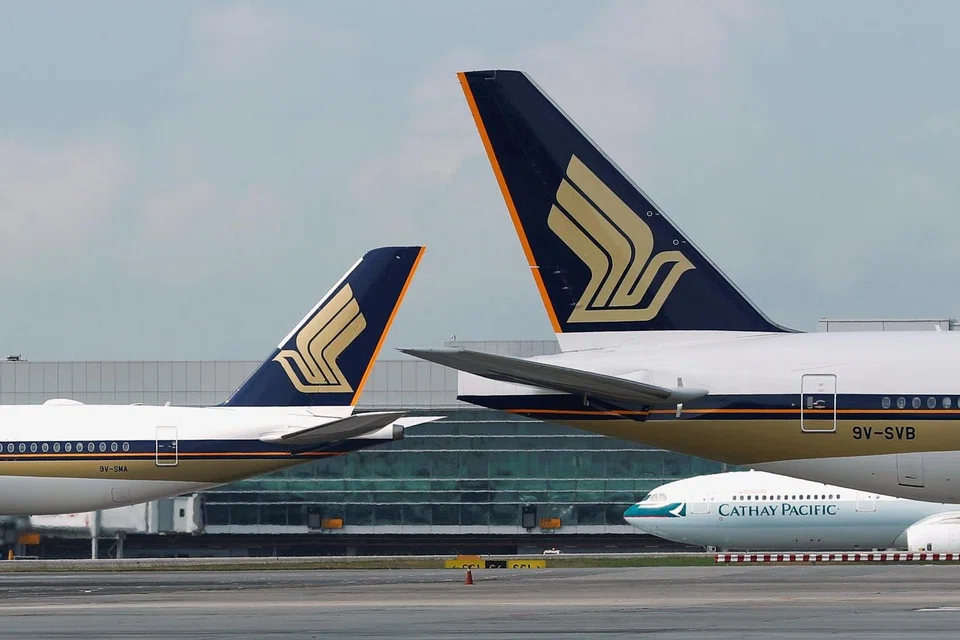
AS COUNTRIES tighten their borders, travellers hunker down and oil prices tumble, Singapore Airlines (SIA) is flying into something of a perfect storm.
While cheaper fuel normally spells relief, depressed oil prices represents a double whammy for the airline group, which has already been forced to temporarily cut over 15 per cent of capacity as demand evaporates in the wake of the Covid-19 outbreak.
For the financial quarter ending March 31, 2020, it has hedged 79 per cent of its fuel needs in MOPS at US$76 per barrel (/bbl), suggesting that a fuel hedging loss is likely for this quarter as long as oil prices remain low. Oil prices plunged last week as a breakdown in talks between the Organization of the Petroleum Exporting Countries (Opec) and Russia led to Saudi Arabia slashing prices and ramping up production, inciting a price war. Since the beginning of the year, jet fuel prices have dropped sharply from US$81/bbl to US$46/bbl at the time of writing.
With SIA's fuel hedges extending beyond FY19/20, analysts are also expecting hefty mark-to-market losses in Q4FY20 which will hit its balance sheet.
In May 2019, SIA reported that it had Brent hedges in place with maturities extending to the financial year 2024/25 at average prices ranging from US$58-63 per barrel.
This could affect the book value of the group, and in turn its share price. Meanwhile, IHS Markit expects SIA to slash its FY20 final dividend by 45.5 per cent to 12 Singapore cents per share.
CGS-CIMB analyst Raymond Yap expects SIA to take a S$1.9 billion hit to the balance sheet in Q4FY20 owing to mark-to-market losses on SIA's outstanding fuel hedges. With the expected mark-to-market losses, CGS-CIMB's estimate for SIA's end-March FY20 book value of equity per share comes down to S$8.71, from S$11.22 a year ago. As such, Mr Yap cut his target price to S$8 per share, down from a previous target of S$8.46. The counter shed 46 Singapore cents to close at S$6.74 on Monday.
DBS Group Research analyst Paul Yong reckoned that SIA will likely report a hedging loss in the current fiscal quarter as long as oil prices remain low, also pointing out that the percentage of fuel requirements hedged could actually go up from the current 79 per cent owing to the recent capacity cuts.
"The magnitude of the marked-to-market losses depend on where oil prices end up at the end of the quarter," he told The Business Times. "In the long term, the impact of marked-to-market fuel hedging losses will fade as hedges unwind or as oil prices recover."
UOB Kay Hian's transport analyst K Ajith estimated a hedging loss to the tune of US$200 million for Q4FY20, while mark-to-market fuel hedging losses could impact the balance sheet by S$2.2 billion, assuming Brent crude costs US$34/bbl and using the Brent crude forward price curve; this would translate to a book value of S$8.29 per share at end March. Should Brent crude prices go up by 10 per cent, mark-to-market losses would narrow to S$1.8 billion.
Other carriers may also feel the burn from fuel hedges that they had previously put in place to protect against volatility. Malaysia-based budget group AirAsia has hedged over 72 per cent of its fuel needs for FY20 at about US$60/bbl, while Hong Kong's Cathay Pacific has hedged about 40 per cent of jet fuel requirements for 2020 at about US$63/bbl. But with its capacity cuts, Cathay Pacific's effective hedge could rise to at least 50 per cent, notes Mr Ajith, who projects that jet fuel will cost the airline industry US$72/bbl on average this year, or nearly US$12/bbl less.
On the other hand, the big three Chinese carriers - Air China, China Southern and China Eastern - are likely to come out the winners owing to their policy of not hedging, market watchers suggest.
Europe is now seen as the epicentre of the outbreak - which the World Health Organization has officially deemed a pandemic - prompting the closure of borders and the lock down of cities in a bid to arrest the spread of the virus.
As at Monday, Singapore's authorities have also stopped letting passengers who have travelled to France, Germany, Italy and Spain in the last two weeks enter, or transit through, the city-state. Meanwhile, in the United States, the number of cases has topped 3,000, sparking widespread panic.
Under siege
For Asia's carriers, already reeling from the events of the last few weeks, revenue is under siege as demand nosedives for both short-haul and lucrative long-haul routes.
In particular, demand for premium seats - which has traditionally accounted for a sizeable portion of SIA's revenue - will wane, assuming that it has not already. Passenger traffic across the airline group's network could slump by 70 per cent in March and April, Mr Ajith estimated. According to Mr Yong, over 50 per cent of the parent airline's revenue comes from routes outside Asia.
On its part, the airline group has been taking steps in recent weeks to stem the bleed and contain costs - such as cancelling scores of flights, instituting pay cuts for senior management and rolling out a voluntary no-pay-leave scheme for staff. The fall-out from the Covid-19 pandemic has echoes of the Severe Acute Respiratory Syndrome (Sars) outbreak in 2003, but in other ways, this crisis might be unprecedented.
Battered by the sharp drop in bookings in recent weeks, airlines worldwide - from Qantas to Air France-KLM - have had to slash capacity drastically and rein in costs. Some, such as Air New Zealand, are even warning of potential job cuts.
The Centre for Asia Pacific Aviation (CAPA) flagged on Monday that most airlines globally would be bankrupt by end May, calling for swift co-ordinated action by governments and the industry to circumvent disaster.
With the short-term outlook deteriorating rapidly, the world's airlines will need governments to extend support measures to help them weather the storm ahead.
TRENDING NOW

Knight Frank’s Tan Tee Khoon leaves firm, Nicholas Keong takes over auction business
Keppel Energy, Sembcorp Utilities and Tuas Power to supply biomethane in pilot project

GovTech retrenches another 38 staff in second round of layoffs
Take-up of new private homes dives 45% in Q3 as prices accelerate with 1.4% rise

