

Poor trading conditions driving founder-led privatisations
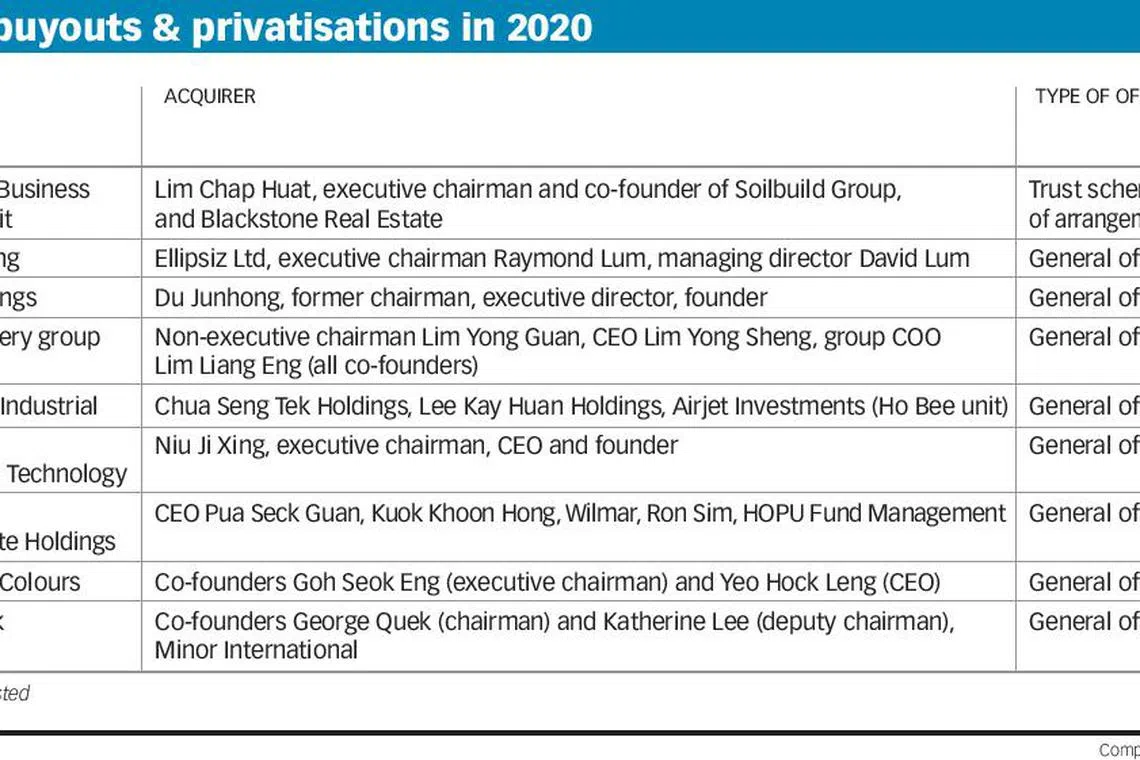
THE proposed privatisation of Soilbuild Business Space Reit on Monday marks the latest in a string of founder buyouts of Singapore-listed businesses that have found their share prices pressured by Covid-19 challenges this year.
There have been about nine such transactions in 2020, spread across a range of sectors including real estate, construction, consumer retail, industrial, commodities and food & beverage. Perhaps this shows the pandemic is no respecter of industries.
BreadTalk co-founders, husband-and-wife pair George Quek and Katherine Lee, started the ball rolling in February when they made a S$0.77-per-share offer for the company, which reported FY19 losses hampered by poor performances in its China, Thailand and Hong Kong units.
Then there was a deal drought during the "circuit breaker", after which privatisation deals followed in quick succession.
Some notable ones included that of Perennial Real Estate Holdings by a consortium which CEO Pua Seck Guan was part of; Teckwah Industrial by a consortium which includes an entity involving executive chairman and managing director Thomas Chua; SK Jewellery by siblings Lim Yong Guan, Lim Yong Sheng and Lim Liang Eng who all hold senior positions in the firm; and Lum Chang, by Singapore-listed Ellipsiz and certain members of the Lum family.
Most of the offerors proceeded or planned to delist the companies, except for those of Lum Chang who have said that they plan to keep it listed, and may conduct a review of the business after the offer closes.
Persistent undervaluation and poor trading liquidity have been the biggest reasons these companies delist, evident from the mostly huge premiums to historical trading prices that offerors dangle before shareholders.
Furthermore, the low share prices have made it more challenging for some of these listed companies to operate or raise capital. In Soilbuild Reit's case, it found itself between a rock and a hard place - unable to make yield-accretive acquisitions given its limited debt headroom and languishing unit price.
This was not the first time Soilbuild's chairman and co-founder Lim Chap Huat has taken a company private; he had also privatised Soilbuild in 2010 for more flexibility to manage the group's businesses. At that time, Soilbuild shares also suffered from poor trading liquidity.
The narrative of founders swooping in to buy back their companies is not new. Homegrown businesses in Singapore that have chosen the private route due in part to poor trading performances have included traditional Chinese medicine retailer Eu Yan Sang, lifestyle product retailer Osim International, and property developer Sim Lian Group.
Business owners naturally feel attached to the companies they have built, but Choe Tse-Wei, head of strategic advisory at DBS Bank, says founders cannot afford to cling to sentimentality at the risk of business failure in a crisis.
In an article in The Business Times in September, he noted the need for mergers and acquisitions to "rationalise industry capacity" to respond to permanently changed lifestyles in a post-Covid world.
He said that founders know the intrinsic value of their companies and so will likely make the decision to buy over their companies when their market valuations fall below a certain threshold.
Consolidation, cost-cutting and unlocking capital from idle assets will all become new realities for industries facing structural challenges and a long-term decline in demand, he added.
Even with a vaccine available, consumption patterns could have changed for good. Therefore, more privatisations may come down the road, whether the global economy recovers fully or not.
TRENDING NOW

Cracks emerge in AI borrowing boom as CoreWeave, Oracle and SoftBank debt worries grow

Could stablecoins be the future of money?
‘How many will survive?’: Bubble fears arise as China’s humanoid robotics face reality check

Philippine power giant First Gen rebuffs foreign offers, plans up to US$2.6 billion in expansion

