

POSH eyes fleet expansion as O&M contracting rebounds
Singapore
PACC Offshore Services Holdings (POSH) is seeing a rebound in its average offshore support vessel (OSV) fleet utilisation, a telling sign that contracting activity is returning to the beleaguered offshore and marine sector.
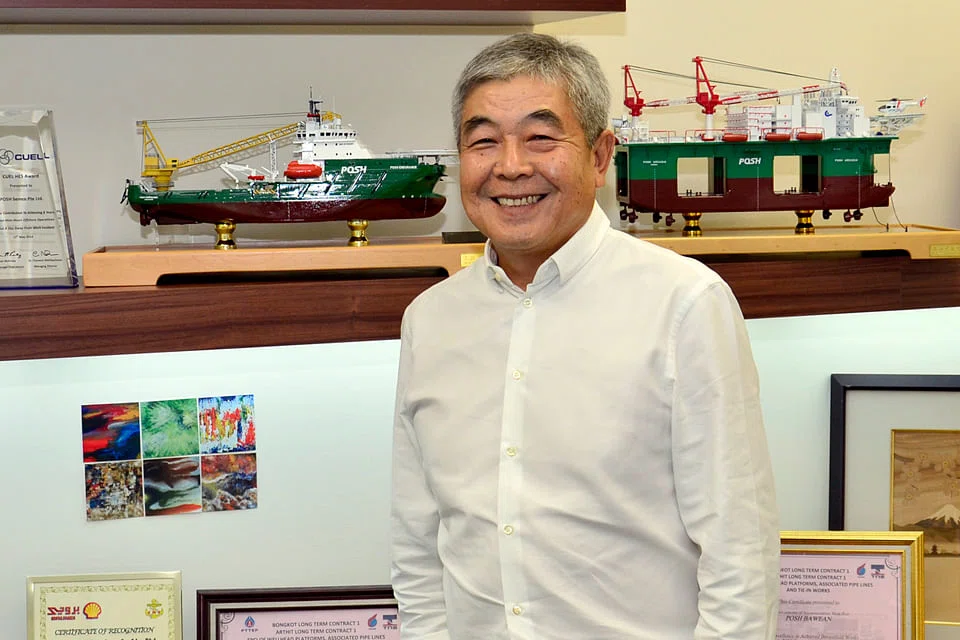
The Robert Kuok-controlled group is getting more enquiries for offshore accommodation (OA) and other business segments and is now even looking to charter in third-party vessels, chief executive Gerald Seow said in an exclusive interview with The Business Times.
But he acknowledged that with charter rates still remaining under pressure and several vessel resale transactions recently changing hands at distressed values, POSH would have to raise more impairments over and above those it had already provided for its fixed assets.
POSH's OSV fleet utilisation for the third quarter has rebounded to 72 per cent, up from 64 per cent for the second quarter and outperforming an industry average of 50 per cent in August, as reflected in a Pareto Securities estimate.
This year, POSH has helped deliver some of the biggest offshore production structures in the sector, including Shell's Prelude floating liquefied natural gas unit, Inpex's Ichthys production semi-submersible and floating production, storage and offloading vessel (FPSO).
These have cemented POSH's position with the oil majors - Total has selected the Singapore-listed group for the delivering of yet another large FPSO for the Egina field development off Nigeria.
"The fact that we won the Egina contract against other contractors is testimony they (the oil companies) trust us to do the job."
In bidding for contracts, POSH can draw from one more advantage - the ability to project-manage and provide a full suite of services, towing of production structures, supply runs and offshore accommodation, to name a few.
That said, contracting activity and vessel charter rates are still far off pre-crash levels. Mr Seow noted that charter rates of large tugs were lately fixed at between US$10,000 and US$12,000, down from US$30,000 at the peak.
Among POSH's four business segments, only harbour services and emergency response posted a gross profit of US$1.33 million for Q3. Three others - OSV, T&I (transportation and installation) and OA slipped into the red on gross losses of US$198,000, US$850,000 and US$4.62 million respectively though a turnaround is in sight from the fourth quarter, particularly for the OA segment.
Mr Seow said that of the light construction vessels and multi-purpose support vessels on the OA fleet, three are now working compared to just one at the start of 2017. POSH is mobilising two other vessels of these classes for work soon, including one for a five-year fixed term charter plus an option for a two-year extension.
This, he explained, came on the back of a pickup in field maintenance activity as oil companies revisit deferred projects with oil stabilising at above US$50. He went further to suggest that POSH is now looking at chartering in vessels though there are not many options in the market that are of suitable quality.
He also clarified that even amid an environment of low charter rates, POSH has stayed cash flow positive because it has refrained from "operating below cost". The group's net cash from operating activities stood at US$10.78 million at the end of Q3, up from US$8.45 million a year ago.
But POSH had to wrap Q3 with a net loss of US$9.76 million, albeit narrowing by 25 per cent compared to the year-ago period, mainly due to depreciation costs, he said.
That is despite the group having written down its fixed assets twice by US$198.9 million and US$21.4 million for FY16 and FY15 respectively.
Against a backdrop of depressed charter rates, resale of O&M vessels has also been transacted at close to or below scrap values - the judicial managers of distressed OSV group Swissco Holdings are looking to wrap a US$28.5 million deal involving the divestment of 26 vessels.
POSH would have to further raise its impairments in the fourth quarter, but Mr Seow emphasised that these are non-cash in nature.
The group also stands a better chance compared to most of its Singapore-listed peers to stomach these non-cash impairments, with US$648.62 million of total equity on its books as at Sep 30.
The increase in impairments is necessitated by persistently lower charter rates, which Mr Seow considered to be "a short-term anomaly". He suggested that a rebalancing between supply and demand would eventually come after "sub-standard and inefficient" vessels exit the marketplace.
Like many of its peers, POSH has also aggressively cut costs - its nine-month general and administrative expenses were down 35 per cent year-on-year.
Nonetheless, Mr Seow claimed that this has not compromised the group's service standards. People, he said, remain as POSH's "number one asset". POSH has started rehiring of late even though it had trimmed 10 per cent of its headcount compared to that of 2014.
TRENDING NOW
CapitaLand, Far East, Sing Holdings team up for S$1.8 billion bid at S$910 psf ppr for Jurong Lake District site

‘If there’s a price to be paid, so be it’: George Yeo says Singapore must safeguard its reputation

Demand, tech capabilities position Apac and AI as Skyscanner’s next growth frontiers: CEO Bryan Batista

US agents, Singapore officials conducted Megaspeed check in June 2025; Alice Huang interviewed: US agencies

