

Potential listing of Sea on MSCI Singapore will bring tech exposure and visibility to Republic
Allowing foreign listings in the index in line with other global indices that factor in new economy sector
Singapore
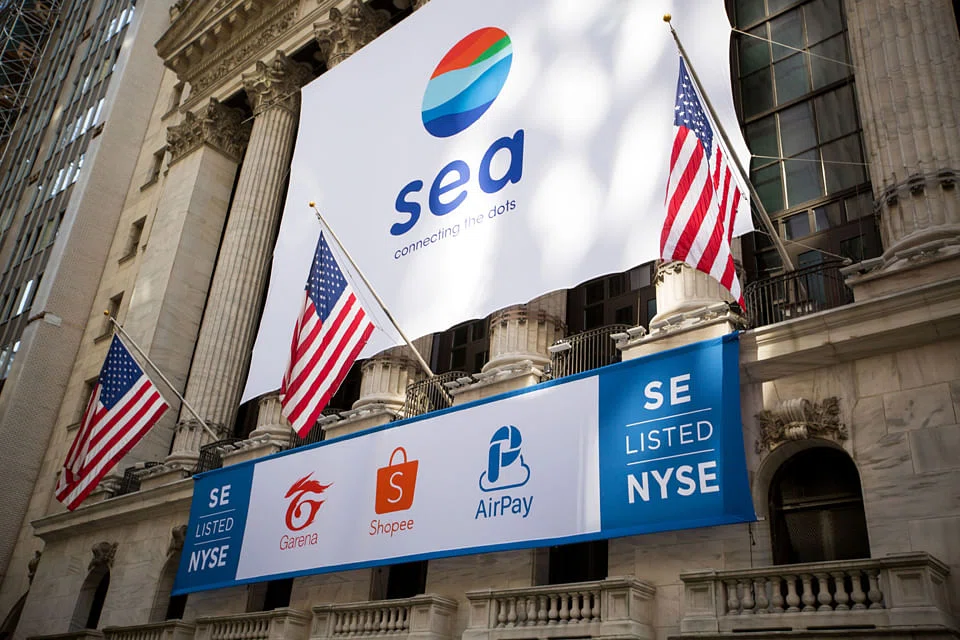
US-LISTED Sea will be eligible for inclusion in the MSCI Singapore Indices from the May semi-annual index review (SAIR). The inclusion of a large tech counter could be positive news for Singapore, as it brings the index in line with other global indices that already have exposure to the new economy sector, said analysts The Business Times spoke to.
"It's almost a sure thing that Sea will be included in the MSCI Singapore in May," said Brian Freitas, an analyst who publishes on Smartkarma, adding that the tech giant would likely be the largest index weight.
Thilan Wickramasinghe, head of research at Maybank Kim Eng, noted that most of the current MSCI Singapore Index consists of old economy stocks, such as banks and properties. The lack of tech components is one reason for its underperformance compared to regional peers.
"This adds a little bit more dynamism, and brings it more to present day and makes it a bit more relevant and more representative of Singapore, as well as how businesses have evolved," he said.
MSCI announced in November that foreign listings will become eligible for the MSCI Singapore Indices from the May 2021 SAIR, after the Singapore market met the foreign listing materiality requirements.
This requirement is calculated by MSCI based on an Investable Market Index (IMI), which measures the performance of the large-, mid- and small-cap segments of each country's market.
Foreign listings become eligible when the aggregate market capitalisation of such companies grows to at least 5 per cent of the free-float-adjusted market capitalisation of the country IMI, and 0.05 per cent of the All Countries World Index IMI.
Other markets that have met this materiality threshold include Hong Kong, China and Israel.
Simulated weights in MSCI's February quarterly review showed Sea's American depositary receipts (ADR) accounting for 20.9 per cent of the MSCI Singapore IMI, and 25.8 per cent of the MSCI Singapore Index.
Shares of Sea have risen from around US$40 in end-2019 to nearly US$200 by end-2020. They have since continued their ascent, closing at US$250 on Tuesday.
Apart from Sea, MSCI said two other foreign-listed counters - Hong Kong-listed Razer and US-listed Maxeon Solar Tech - would be eligible for the MSCI Singapore Indices as of the February index review.
They are much smaller, however, with simulated weights of under 0.5 per cent in the MSCI Singapore IMI as of the latest review, and were classified as small caps.
Mr Freitas noted Singapore's situation was rather unusual, as it was largely a single stock contributing to the rise in the market capitalisation of stocks listed outside Singapore.
"In cases like China, there are overseas stocks which are included in the MSCI China, but it's not just one stock," he said. Examples of such counters are Alibaba Group and JD.com.
Sea's potential inclusion in the MSCI Singapore has several implications for those who regularly trade index futures and/or use them for hedging purposes. For one, it could reduce the index's correlation with the Straits Times Index (STI).
In past years, the two Singapore stock indices have largely moved in tandem.
Of MSCI Singapore's current 19 components, 18 can also be found on the STI. These rank among the 23 largest STI counters, and constituted roughly 80 per cent of the STI's weight in February.
If Sea has more than a 20 per cent weight in the MSCI Singapore Index, the index could also see larger swings.
"On a relative basis, it could potentially make MSCI Singapore more volatile," said Adrian Loh, head of research at UOB Kay Hian. Nevertheless, he believes the inclusion of new economy stocks would make the index more relevant.
Mr Freitas said Sea also adds diversification to the index, being in a different sector from the current counters. He said: "The volatility should increase, but it shouldn't be a huge change in volatility."
Finance and real estate currently make up almost three-quarters of the sector weights of the MSCI Singapore Index, while the information technology (IT) and communication sectors make up roughly 11 per cent. Of the latter category, Singtel makes up around 8.7 per cent.
The MSCI Singapore's largest index weight is DBS, at about 20 per cent.
Mr Freitas added that arbitrage trades for index futures and index components might be hampered by the difference in trading hours. There is no overlap between the opening hours of the New York Stock Exchange and the Singapore Exchange (SGX) for equities trading
The arbitrage traders are generally risk averse, as their margins on the trades are usually small, he said. "This blows their risk wide open, so what you could see is lower volumes on the MSCI Singapore futures," he noted.
But SGX said the inclusion of American depositary receipts in equity indices is common practice and its institutional clients expect diversity in indices.
The bourse added that much of the trading activity on the MSCI Singapore futures is driven by portfolio risk-management and hedging, as well as the taking of market positions in a "quick and cost-effective way".
"Institutions may increase their use of futures to risk-manage their larger portfolio of Singaporean companies," SGX said.
"An inclusion of high-growth Sea would complement the growing stable of high-quality, blue-chip companies currently listed on SGX."
For the affected stocks, the change to the MSCI is generally expected to be positive.
Sea's eligibility would be a "near-term re-rating catalyst", said CGS-CIMB analysts in a research note last month. They estimate US$2.5 billion in passive inflows post-inclusion.
Current index constituents could see some outflow during any rebalancing to include Sea.
But Mr Freitas said this is unlikely to be huge, as the monies flowing into Sea would be spread across funds that also track other MSCI global indices.
In the longer term, analysts believe that allowing foreign listings could lead to greater interest in Singapore with larger inflows.
"Obviously, it's great for Singapore's visibility that they have a large-cap tech stock, which has a very high weight in the index," Mr Freitas said. "I think definitely a lot more people would look to the MSCI Singapore exchange-traded funds (ETFs) listed in the US, especially to get exposure to Sea and the overall index."
Maybank KE's Mr Wickramasinghe added: "It's a good thing that you have these listings coming in. I think it will drive more interest in the market, which will bring, obviously, all the passive funds and things like that and also bring in a lot more momentum."
The results of MSCI's May SAIR are scheduled to be announced on May 11.
READ MORE: HSI's facelift sparks calls to revamp STI to include key growth sectors
TRENDING NOW

Grab CEO’s wife Chloe Tong on life with Anthony Tan and finding her purpose

Hwa Seng Builder, two China companies win S$1.2 billion Tuas Road Viaduct phase two contracts

Deal between tycoon friends sparks scrutiny of Philippine power sector

Canada is upping oil flows to Asia, but South-east Asia’s refineries aren’t ready to handle them yet

