Private equity money finding sweet deals in mid-market
Healthcare, tech-related services are popular investment themes


THE middle market is becoming the space to watch as private equity (PE) deal-making picks up, industry players said. Targets are plentiful and there is no shortage of exit options.
Within Asia, the developed markets of Japan and South Korea are top investment destinations; but emerging market interest is picking up. By sector, investors appear to be most bullish on healthcare and tech.
Definitions of what constitutes a mid-market company vary, starting at an enterprise value of US$50 million and going all the way up to US$3 billion.
The larger deals tend to be in North America, said Kerrine Koh, South-east Asia head at Hamilton Lane. “In Asia, we tend to see more deals or company sizes that are closer to that US$1 billion mark or slightly smaller.”
Michael Hu, Asia head at HQ Capital, said ticket sizes and valuations are a reflection of market size and maturity. Valuation multiples in the United States and Europe tend to be higher, he added.
A better means of defining a mid-market investment would be the stage of the company. These are profitable, small to mid-sized businesses operating in markets with room to expand.
Edmund Buckley, global co-head of private equity at Pictet and head of its direct private equity unit, said Europe’s energy transition and digitalisation are throwing up many opportunities.
“There are large numbers of businesses that don’t have successors lined up and are having to think about selling to outside investors,” Buckley added.

South Korea and Japan have become good hunting grounds for mid-market deals for the same reason, said Koh of Hamilton Lane. Inheritance taxes in both countries are also among the highest in the world.
There is less of such behaviour in emerging markets, and companies in these regions also tend to be less mature – making mid-market targets harder to come by.
South-east Asia, for instance, tends to be better for venture capitalists than PE funds, she said. The companies also tend to be smaller, which means it is the smaller funds that tend to play in this arena.
The exception in emerging Asia is India, which HQ Capital’s Hu said has been profitable for PE thanks to the country’s large domestic market, stable economy and vibrant equity markets.

Smaller funds and deal sizes can, however, produce better returns. “There is less room for outperformance when you’re already buying such big companies,” said Hu. “A lot of the general partners (GPs) we are backing are now selling their companies to the bigger GPs.”
Indeed, the relative smallness of deals is also what makes the mid-market space an attractive one.
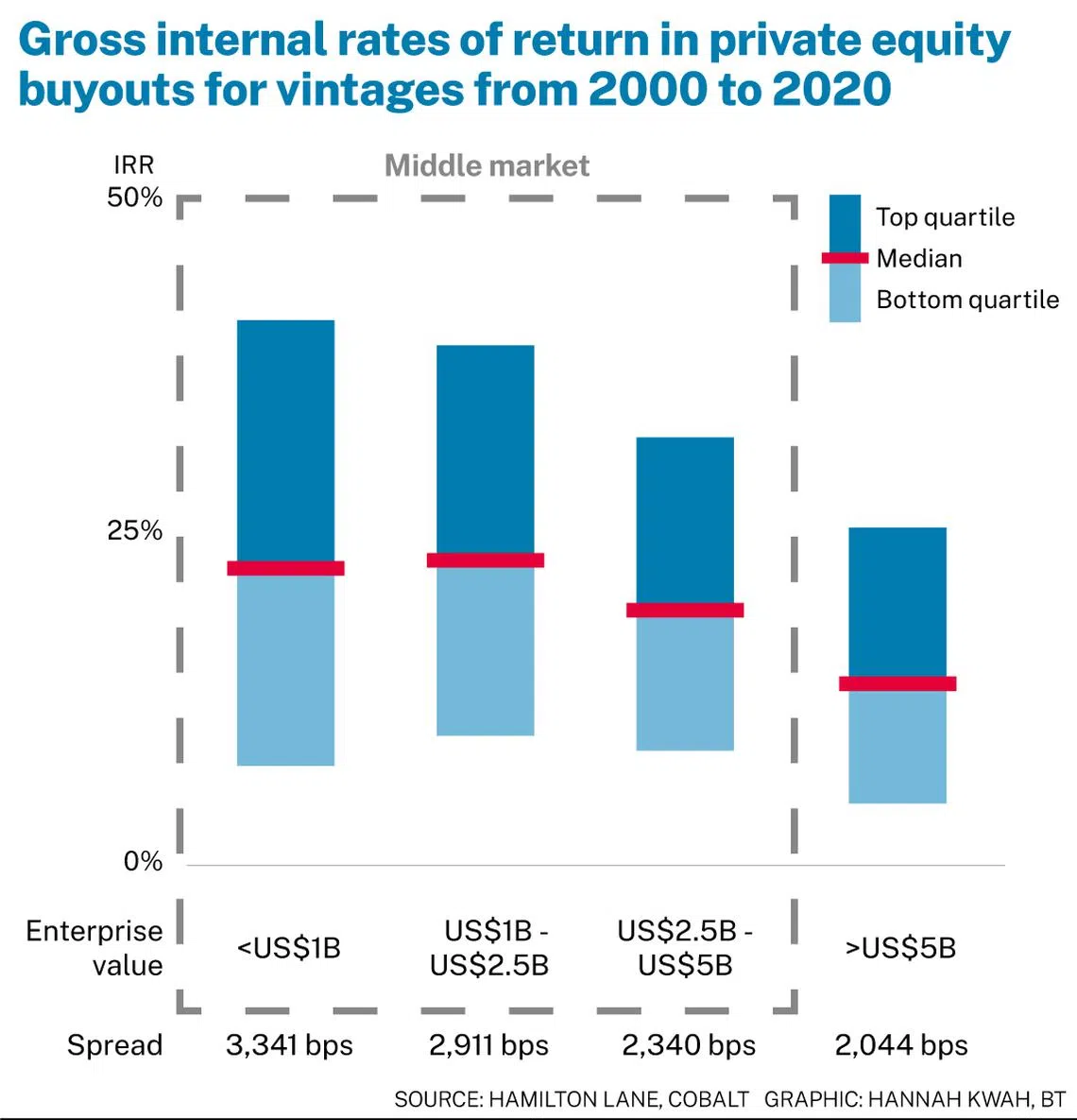
Koh of Hamilton Lane noted that mid-market returns are a few percentage points higher than large-cap deals. “The other side of the coin is basically that dispersion is also wider,” she added. “You can outperform more easily but you can underperform more easily as well.”
Calvin Ng, managing director of Aura Group, said South-Asia is an attractive investment destination for his firm’s PE fund partly because of favourable demographics that support business prospects, but also because of the entry of a new generation of entrepreneurs.
“Many of them are South-east Asians who have studied or worked offshore, in multinational companies, and have exposure to Western governance practices. At the same time, their local understanding of the market and networks are important ingredients for success in South-east Asia,” he said.
Many of South-east Asia’s industries are also highly fragmented, Ng added. “There is often room to consolidate and win market share as a larger brand.”
His fund has invested in a chain of dental clinics in Vietnam as well as a chain of gyms across the region – both investments that are tapping the growing affluence of South-east Asia’s consumers to scale up.
It is a good time in the cycle for mid-market deals, said Bank of Singapore investment strategist Neo Bee Leng.
“The recent popularity of the mid-market buyout strategy has a cyclical element, but it is the structural attributes of this segment of private equity that we believe will serve investors well,” she said.
High financing costs, low liquidity and low risk appetite make smaller commitments more attractive. There is also “greater scope for PE managers to bring their skills to bear” on transformation and growth.
Steven Tran, a partner at law firm Morrison Foerster who has been covering the PE space for 25 years, said he is seeing “massive amounts” of deal activity in mid-market.

One of the hottest spots for deal activity is healthcare. “We’re talking about hospitals, advanced medical services, pharmacies,” he said.
Hamilton Lane’s Koh said healthcare is an attractive space as it has a complex and fragmented value chain. “For that reason, there are more opportunities within the industry for disruption and increase in efficiency.”
Roll-ups of dental clinics, for instance, can benefit from a lower cost of consumables, more efficient backend administration, greater ability to attract the right manpower, and the creation of higher barriers to entry for competitors, she added.
Another big theme is technology. “Everybody wants to jump onto the artificial intelligence wagon,” Tran said.
“(That could be) anything with an intersection between health and tech, or insurance and tech, or just tech coupled with some sort of service.”