Property development no longer offers healthy returns for shareholders

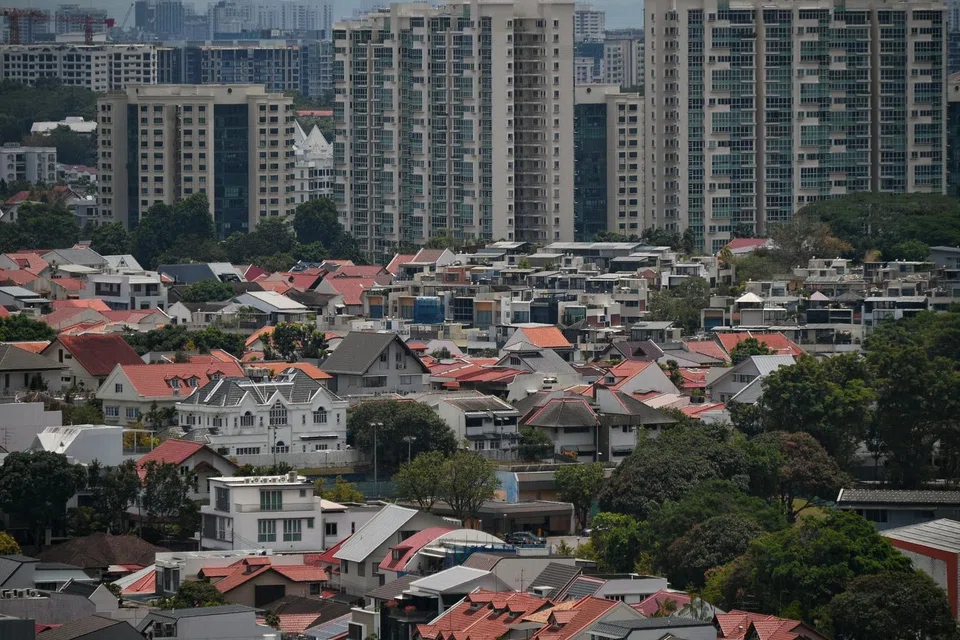
DEVELOPERS' profit margins from Singapore private housing development projects have thinned so much that shareholders may well ask management if engaging in this activity makes business sense.
It would not be surprising if the top brass at some companies are asking themselves the same question.
Pre-tax profit margins for some private housing projects are down to around 10-12 per cent, or even sub-10 per cent.
Assuming a period of five years from the time of the land purchase to the completion and sale of the project, this works out to a meagre return on investment averaging a compounded 2 per cent a year.
A tough environment
Margins from property development have shrunk over the years in the face of rising land prices and construction costs. The commissions developers pay to property agents have also increased.
Meanwhile, property cooling measures aimed at keeping property price increases "in line with economic fundamentals" have limited developers' pricing power. Developers' home sales volumes last year were resilient, despite the pandemic and recession, but much of that demand has been in the price-sensitive market - upgraders and those seeking smaller units with affordable absolute pricing.
Land prices, which account for 70-75 per cent of the gross development cost for a typical private housing project today, have risen partly on competition from new players.
About two decades ago, several local construction groups diversified into property development: Chip Eng Seng, Lian Beng Group and Sim Lian Group, among others.
Many were lured into the sector by the then attractive profit margins. New entrants also emerged from foreign construction companies. Examples include MCC, Qingjian Group and China Construction. These foreign developers have posed particularly tough competition, able to bid aggressively because they are vertically integrated and are backed by large, overseas parents.
Negative consequences
Some local property groups - such as Ho Bee, Keppel Land and CapitaLand - have sought better returns overseas. But most, including local contractors-turned-developers, are likely to remain rooted here.
Investors may be better off whittling down their portfolio exposure to property. Indeed, many stock market investors have already done so.
Over a five-year period, the FTSE ST Real Estate Holding and Development Index (FSTREH) has gained 6.9 per cent - underperforming the 9.2 per cent gain of the Straits Times Index (STI). Including dividends, the FSTREH has returned 22.7 per cent and the STI 31.8 per cent.
But there may be unintended negative consequences if the operating environment does not improve. For instance, the market may attract developers that do things in a cheaper and quicker fashion or that adopt a very short-term approach.
Some observers also fear that if local companies reduce their residential development activity, foreign developers will have a bigger share but may not have the same commitment as local developers to uplift quality standards for the whole industry.
The bottom line is: Quality developers will participate less and less in a low-margin environment.
Time for some relief?
Any suggestions of government relief for the local real estate sector, however, are likely to be met with concerns about a still heated property market. Property prices have continued to rise this past year even as income levels for large segments of the population have fallen.
One option is for the government to step up its land sales programme, which might alleviate competition.
But there is no guarantee that this tactic would work, as seen during much of the 15-month period prior to the July 2018 cooling measures when land-starved developers were buying sites at successively higher prices.
Observers point to one key driver of land prices: ABSD.
To qualify for upfront remission of the 25 per cent additional buyer's stamp duty (ABSD) on residential site purchases, developers have to complete and sell all units of a development within five years.
"Developers who have bought sites around the same time rush to sell their projects to meet this five-year sales deadline, and then become hungry and start bidding aggressively for land," a seasoned developer told The Business Times. This tends to perpetuate the cycle of high land bids and thin margins.
It may be time, therefore, to consider reducing the ABSD on residential land purchases by developers. As it is, developers have to pay 5 per cent non-remittable ABSD on residential sites in addition to the 4 per cent buyer's stamp duty.
The ABSD is useful to discourage hoarding of land. Without it, developers may be incentivised to slow down their launches to create scarcity and push up selling prices.
But perhaps the ABSD rate for developers' residential land purchases could be cut or pro-rated in proportion to the unsold units in projects.
The upside of a more flexible system might mean some developers sell quickly to reduce risk while others take longer. This may alleviate the current boom and bust situation in which developers race, often together, to exhaust their unsold inventory, before feeling famished and starting a fresh round of land binging.