

Push-pull factors driving deals for telco assets amid global boom
Sellers looking for cash while buyers hunting for yield; communications business running hot as pandemic sparks surge in online activities
Singapore
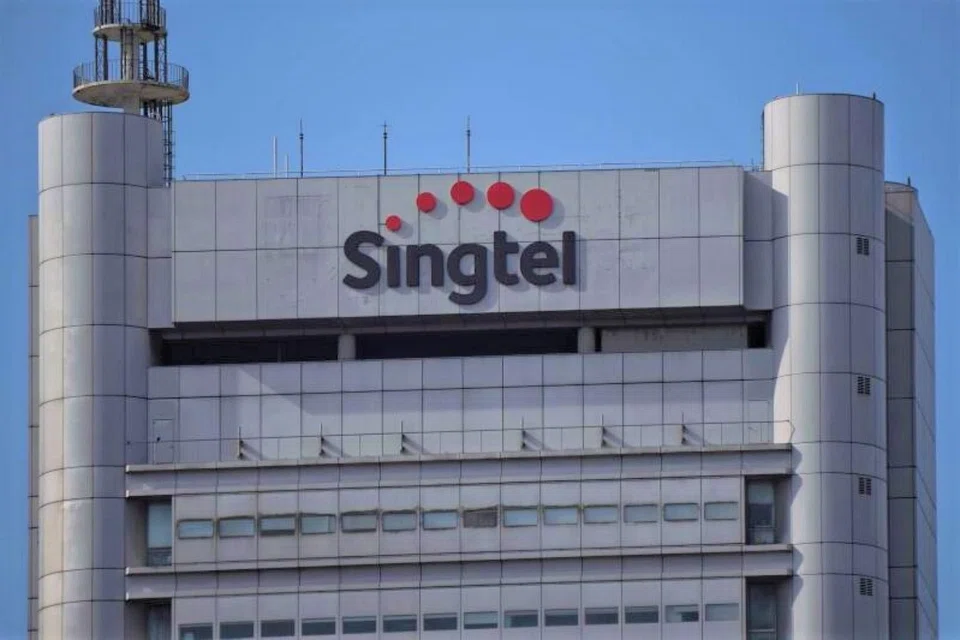
SINGTEL'S recent announcement that it intends to unlock the value of its infrastructure asset portfolio comes amid a booming market for telecommunications assets around the world.
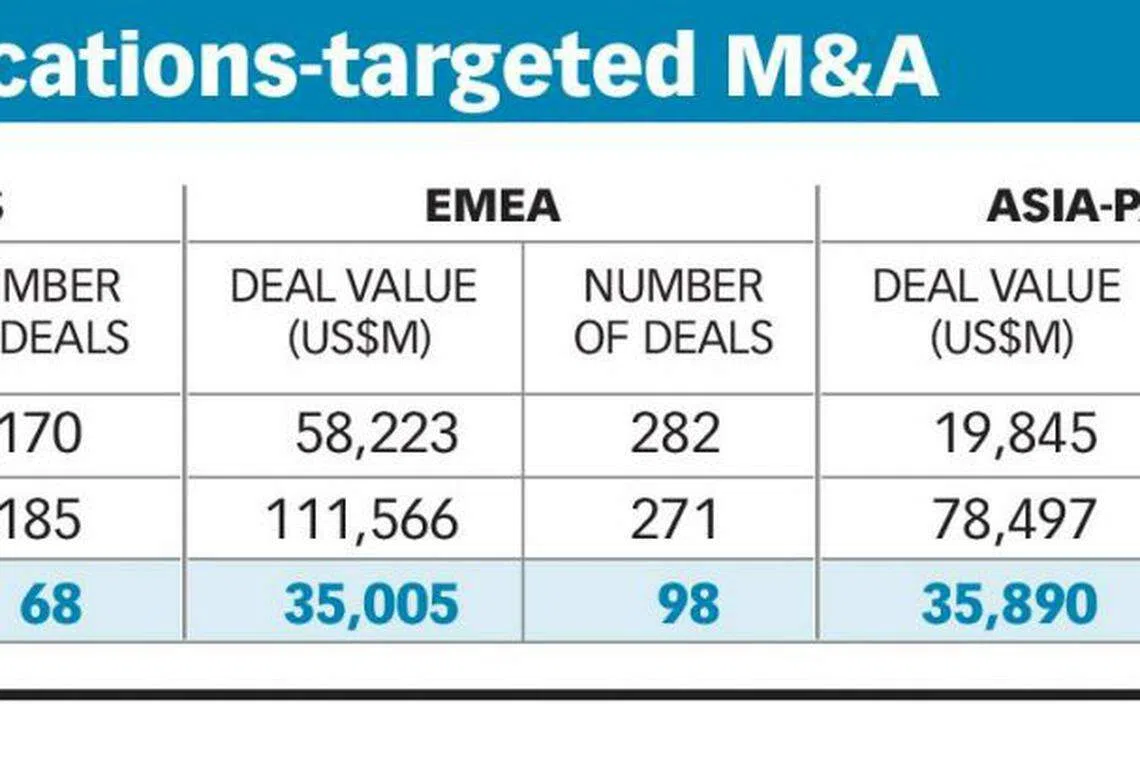
Data compiled by Dealogic showed 629 telecom-targeted mergers and acquisitions (M&A) deals announced last year, up from 607 in 2019.
The total value of these deals also increased, from US$161.57 billion in 2019 to US$263.42 billion last year. So far this year, 231 deals have been announced with a total value of US$200.76 billion.
Some of those deals reflect a long-term trend of consolidation across the industry.
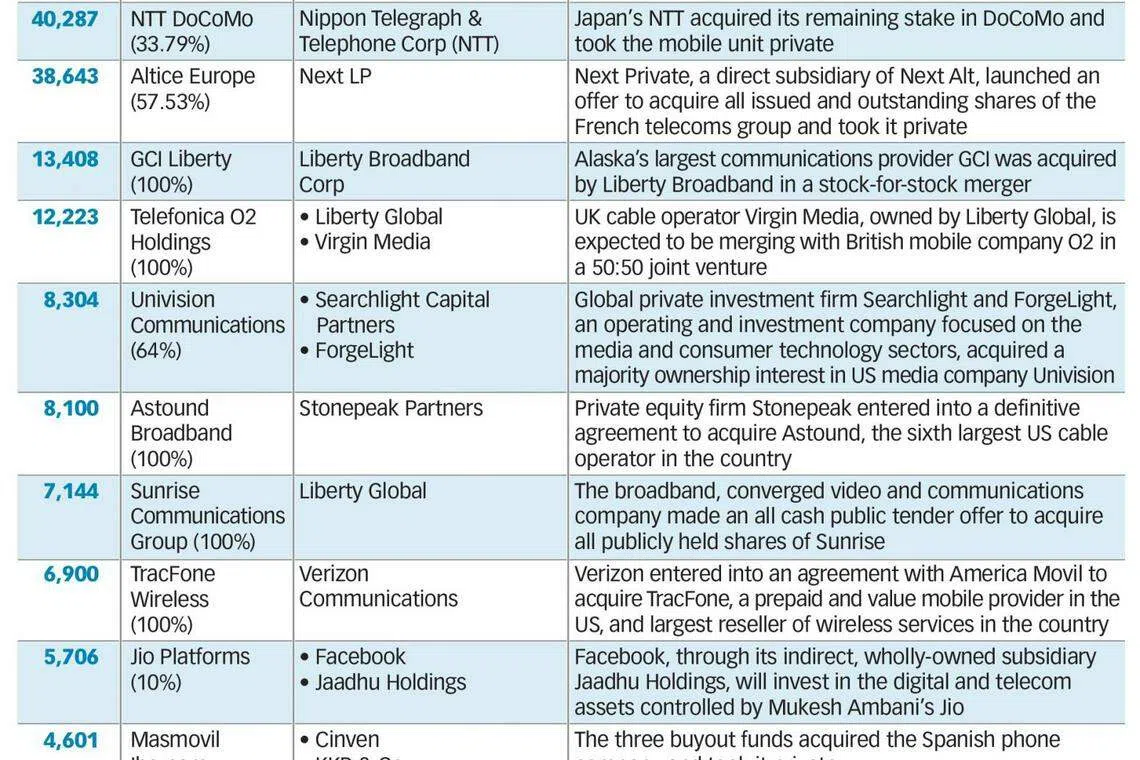
Japan's NTT DoCoMo, for instance, was acquired by its parent Nippon Telegraph and Telephone Corp.
And US telecoms group GCI Liberty was merged with related company Liberty Broadband.
But quite a few of the deals have been the result of greater investor demand for telecoms assets. American Tower, a New York-listed real estate investment trust focused on telecoms assets, and Spanish telecoms infrastructure group Cellnex have both been big buyers of assets over the past year.
The attraction may be partially pandemic-related. Lim Chong Kin, Drew & Napier's managing director for corporate & finance and head of telecommunications, media & technology, said Covid-19 has "unleashed tremendous interest in communications business including such related assets" because all online activities, whether social or business-related, are carried over telecom assets.
His firm has been "tremendously busy" advising clients on all spectrum of work relating to communications - from existing market players launching new services to new entrants backed by funds moving into the communications business.
The increased activity in the telecommunications sector has been significant in regional emerging markets, according to Toby Grainger, managing partner at the Singapore office of law firm CMS and head of its corporate group.
He said, for instance, that there have been more deals involving telecom towers. There is also appetite for data centres, although in this space there remains a lack of available assets due to constrained capacity in many parts of Asia-Pacific.
"With the current low interest rates, investors are chasing yield and the asset class generally offers this," said Mr Grainger. "More so in emerging countries where we're seeing some of the large fund investors looking at diversifying into - from the more developed markets - and tying this to the longer term growth prospects of the underlying economies."
Certainly, the communications demands of South-east Asia's fast-growing economies are expected to generate plenty of economic activity in the telecoms space.
In April, private equity investment manager Partners Group announced it had jointly established a telecommunications infrastructure platform in the Philippines on behalf of its client.
Partners Group will acquire a joint lead equity stake in the platform, called Unity Digital Infrastructure, alongside Philippine conglomerate Aboitiz Group's infrastructure arm Aboitiz InfraCapital. Unity will build and operate telecom towers in the Philippines.
Kevin Lu, a partner at Partners Group and chairman for Asia, said rising data consumption, a "significant transformative trend", has driven demand for tower infrastructure in the Philippines. Unity is therefore well-positioned to capitalise on this, he added. "Our thematic research shows demand for tower infrastructure is particularly high in the Philippines due to its large and growing mobile Internet user base but low tower density by global standards."
The returns, meanwhile, are expected to be attractive. On top of the "strategic importance" of such assets in providing essential services to end users, Mr Lu noted the high barriers to entry for new players. And, contracts are "typically contracted on a long-term, availability-based payment basis with protection from inflation, providing stable and predictable cash flows".
Telecom assets have generally performed well for the past 10 years, according to Andrew Thompson. The partner and head of private equity for Asia-Pacific at KPMG in Singapore said telcos typically provide the "picks and shovels" for the digital gold rush.
"Installed physical telco assets such as transmission towers, data centres and fibre networks have also been consistently attractive assets to infrastructure and private equity investors due to the reasonably consistent cash flows and generally lower business risk profile," he added.
Deal flow is also being fuelled by the growing number of telecoms assets being put up for sale. Sai Tunuguntla, partner at McKinsey & Company, said telcos are "finding that 5G requires significant investments... yet the path to monetisation for these investments is currently unclear".
He said: "The return on invested capital for existing assets has been challenging and there is a clear need for higher asset productivity".
He added that the Covid-19 pandemic has "not been a particular tailwind" for telcos. Even as they spend more to support increased traffic, they have had to worry about consumer sensitivity to price hikes and the loss of roaming revenues. "Given that the valuation multiple of these assets, such as towers, can be three to four times that of the overall telco, it is compelling for telcos to unlock value through separating or selling them."
KPMG's Mr Thompson expects to see sustained interest for investments in the telco space, given that such investments are an indirect bet on the future of the global digital economy continuing to disrupt traditional businesses at an accelerating pace.
He said: "The global digital economy is fundamentally enabled by telco infrastructure assets. And while some industry segments will remain under pressure from change, it's hard to imagine the number of global connected devices and the amount of bandwidth that each device uses doing anything other than continuing to grow for many years."
TRENDING NOW

Singapore bars Alice Huang, woman tied to affair with Nvidia’s Jensen Huang, for misleading police

Nvidia prepares to oust Jensen Huang after news of second affair, with executive: reports

Higher rates, weaker spending: Is the Philippines entering stagflation?
Nvidia’s market value sinks below US$4 trillion after CEO Jensen Huang resigns

