

Q3 corporate profits show signs of recovery amid rebound in economic activity
Outperformers for quarter include pandemic beneficiaries; coronavirus seen continuing to be key market driver
Singapore
FOR the third-quarter ended September 2020, earnings for Singapore-listed companies, while still weaker than a year earlier, point to signs of a recovery as economies start to open up, said analysts.
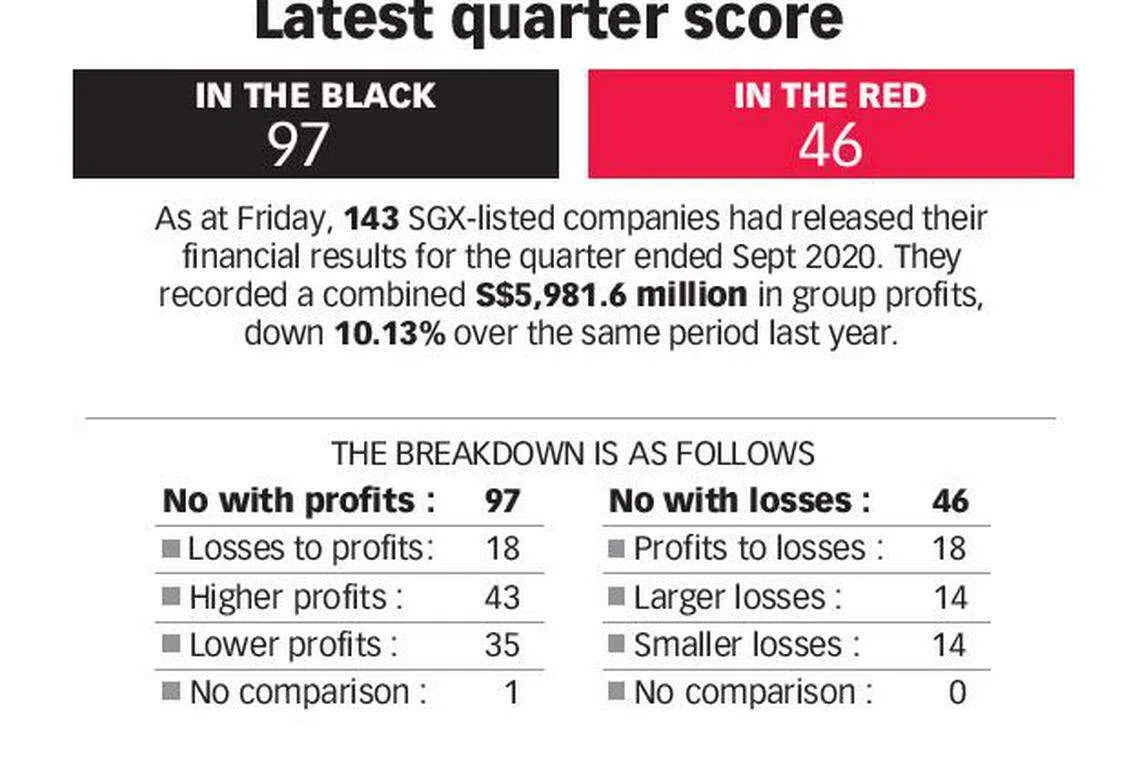
As at Nov 27, the 143 companies listed on the Singapore Exchange (SGX) that had issued their quarterly scorecards recorded a combined S$5.98 billion in group profits, with 97 companies in the black and 46 companies incurring losses, according to data compiled by The Business Times.
While total earnings were down 10.13 per cent as compared to a year ago, 57 companies had better bottomlines, including 18 that swung into profitability. That outnumbered the 49 companies that posted weaker results, including 18 that sank into the red from the previous year.
Jeffries equity analyst Krishna Guha said that the results are "reflective of a recovery economy which is yet to achieve full potential", noting that "with (the) economy opening up, sequential recovery has been witnessed for most stocks but still the bottomline is below on year-on-year (y-o-y) comparison".
Outperformers for the quarter include pandemic beneficiaries such as Medtecs International and UG Healthcare, which saw their net profits jump 1,115 times and 73.3 times respectively, compared with the previous year. Top Glove, similarly, booked a y-o-y increase in net profit of over 1,600 per cent.
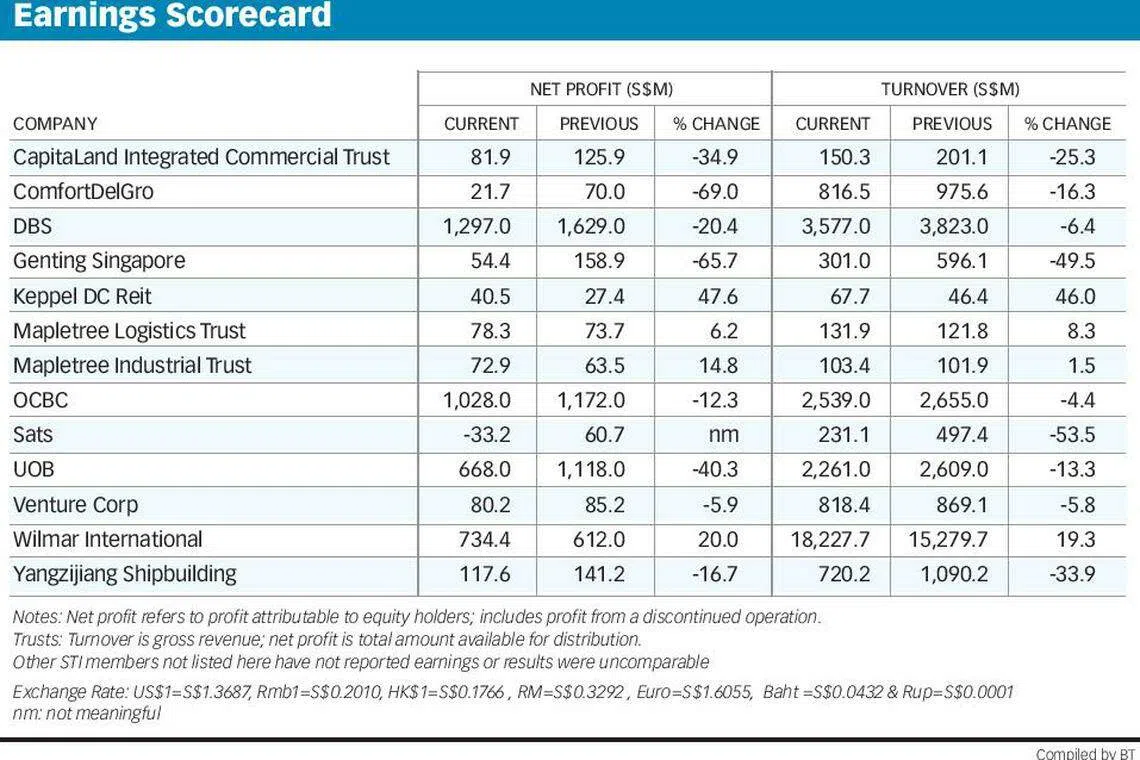
Among the Straits Times Index (STI) constituents, the trio of banks saw smaller profit margins for the quarter. Net profit for DBS slid 20.4 per cent to S$1.3 billion from S$1.63 billion a year earlier, while OCBC's fell 12.3 per cent y-o-y from S$1.17 billion to S$1.03 billion.
As for UOB, the bank saw a larger decline in net profit of 40.3 per cent, from S$1.12 billion a year ago to S$668 million.
Jeffries' Mr Guha said that the lower profits are "reflective of increased provisioning", though he noted that for DBS and OCBC, profits improved sequentially whereas for UOB, profit declined due to "increased pace of provision build-up".
"Looking forward, asset quality remains unclear and dependent upon subsequent level and type of growth, fiscal measures and regulatory forbearance," he added.
That said, in a report dated Nov 17, CGS-CIMB said it had upgraded the banking sector to "overweight", as book value risks "dissipate" and as the market "focuses on ROE (return on equity) enhancement towards FY22F".
CGS-CIMB analyst Lim Siew Khee said that the Q3 results "offer hope that sell-side estimates have been too conservative", adding that there were a larger proportion of positive surprises led by banks, commodities, gaming and transport.
On the other hand, retail real estate investment trusts (Reits) fell short of expectations.
Based on the companies that CGS-CIMB covers, 20 of them beat the research house's forecasts, and 21 were in line with expectations. Of the 11 companies that fell short of expectations, five of them were retail Reits.
Ms Lim attributed this to the slower-than-expected resumption of travel, which "has added to the woes of retail Reits/property companies".
Nonetheless, OCBC Investment Research said in a note on Monday that positive developments over the vaccine front have provided the much beleaguered hospitality and retail Reits with some "light at the end of the tunnel, although volatility in share prices are expected and the road to recovery ahead is likely to be bumpy".
Over the coming quarters, as the Covid-19 pandemic rages on, profit margins of businesses will boil down to how well they are able to adapt to the changing environment.
SGX market strategist Geoff Howie said: "The coronavirus will continue to be the key market driver. While the market is pricing in vaccine deployment, ramifications on the growing resurgence remains the key risk.
"Throughout the recent earnings season, common narratives in the corporate outlooks included intentions to continue building resilience by containing costs, boosting productivity, and where possible, continue to pursue operational excellence. Vigilance was a word used multiple times and mostly applied in the context of matching balance sheets with opportunities to enhance value."
TRENDING NOW

Philippine power giant First Gen rebuffs foreign offers, plans up to US$2.6 billion in expansion

Cliff Tan has 7 million followers and a 4-month waitlist. Why won’t he expand his business?

Could stablecoins be the future of money?

From finance aspirant to Asean CEO: TUV SUD’s Jonas Strahberger on finding people who believe in you

