

Raffles Medical jumps 6.7% on 100 million share buyback plan; posts 4.3% rise in H2 profit to S$31.6 million
The board proposes a final dividend of S$0.025 per ordinary share


PRIVATE healthcare provider Raffles Medical Group posted a 4.3 per cent rise in net profit to S$31.6 million for its second half ended Dec 31, 2024, from S$30.3 million in the previous corresponding period.
The group also intends to buy back up to 100 million shares, representing 5.3 per cent of its total ordinary issued shares, over the next two years, it said in a bourse filing on Monday (Feb 24).
Following the news, the counter jumped 6.7 per cent to peak at S$0.88 as at 10.24 am, and closed at this price on Monday.
In an earnings briefing after the results, executive chairman Dr Loo Choon Yong said the share buyback plan comes as the company’s cash flow is still strong.
He added that the group’s China operations continues to improve, and will eventually add to Raffles Medical’s cash flow.
“We want to grow the company, but if the cash is accumulating faster than we have opportunities to invest, then we will to distribute to shareholders,” he said.
The group has S$343.7 million in cash and cash equivalents, as at Dec 31. Dr Loo estimated that with Raffles Medical’s current share price, the amount spent would be less than S$100 million over the two years.
The group is also open to borrowing if necessary, and letting its cash flow catch up after, he added.
The board has proposed a final dividend of S$0.025 per ordinary share, up slightly from S$0.024 the year before. Once approved by shareholders, the dividend will be paid on May 23, after books closure on May 15.
The group also revised its dividend policy to pay out at least 50 per cent of its sustainable earnings annually. Dr Loo also did not rule out an occasional special dividend “when there’s a lot of cash”.
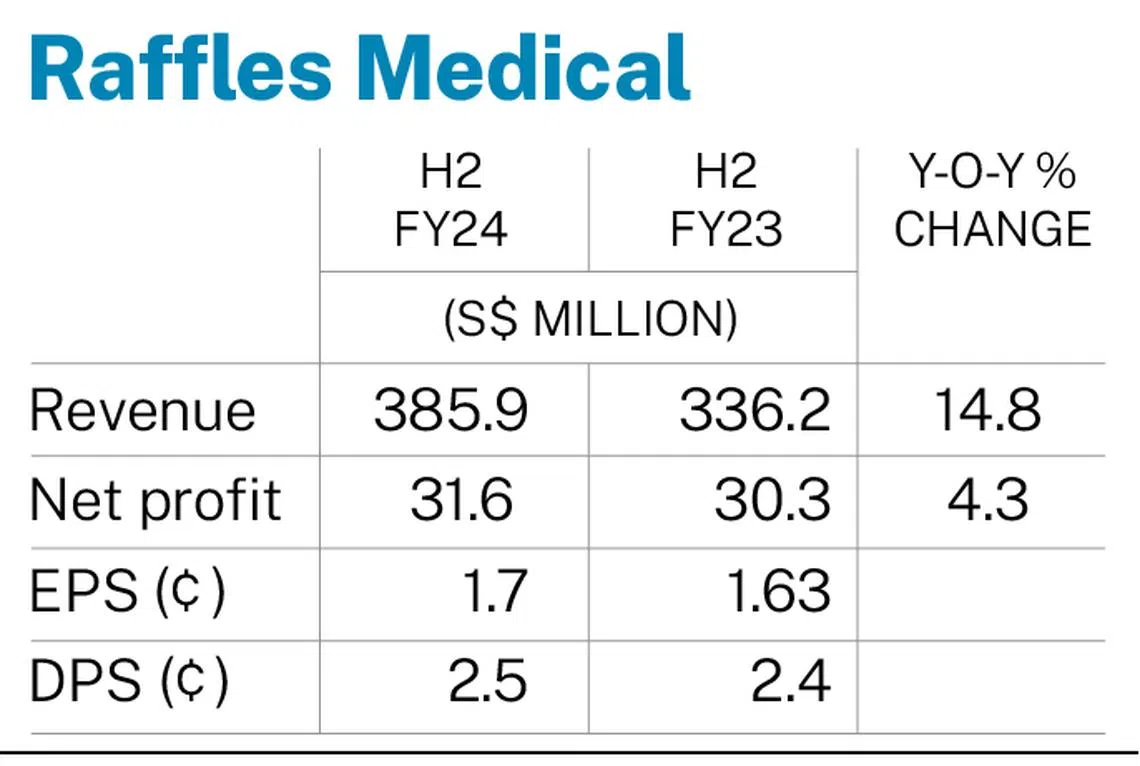
For the second half, earnings per share (EPS) was S$0.017, against an EPS of S$0.0163 previously.
Revenue for H2 climbed 14.8 per cent to S$385.9 million from S$336.2 million in the year-ago period.
For the full year, net profit was down 31 per cent year on year at S$62.2 million from S$90.2 million, translating to an EPS of S$0.0335 against S$0.0485 previously.
Revenue for the full year was up 6.3 per cent at S$751.6 million from S$706.9 million.
Stronger revenue for financial year 2024 came as the group’s hospital services division performed well for the year, the company said.
The division registered revenue growth of 4.6 per cent on the year to S$345.7 million, and a 9.5 per cent increase in profit before tax to S$35.7 million.
Its healthcare services division logged revenue growth of 4.1 per cent from S$283.4 million to S$295.1 million. However, its profit before tax declined 33 per cent to S$45.1 million due to fewer government grants, and the cessation of Covid-19 services in 2024 compared with 2023.
Views on China, SEZ
Dr Loo expects the group’s China hospitals to break even in one to two years, noting that its Beijing hospital has been profitable for some time.
He is optimistic on China as Raffles Medical has gained traction there, with the majority of its patients being Chinese.
In addition, he views the Chinese government’s move to allow foreign players to wholly own hospitals in certain regions as a positive step towards liberalising the healthcare market.
Prior to the change, foreign players could only own up to 70 per cent of a hospital in China, usually through joint ventures.
Foreign players fully owning the hospital would allow them to avoid any “partnership issues”, said Dr Loo. And should foreign operators still aim to have local participation, the changed rule would make it easier to choose partners that meet their requirements, he said.
However, Dr Loo believes it will be some time before new foreign players capitalise on this policy.
Meanwhile, rising costs threaten to compromise Singapore’s appeal as a regional healthcare hub, but the company intends to mediate this by pursuing long-term growth opportunities in other markets, said Raffles Medical.
That said, Singapore is known for its standard of care, and patients with serious illnesses who can afford the premiums are likely to come to the city-state for better treatment, he noted.
As for the Johor-Singapore Special Economic Zone, Dr Loo said the group has some associate clinics in Malaysia, but is evaluating if it should set up some facilities there.
While most Singaporeans will stay home for subsidised medical care, “people may want to go (to Malaysia) for health screening or wellness”, he said.






