

Rallies in Japan, Dow futures boost STI
43-point jump brings the index's two-day recovery to a total of 76 points or 2.7 per cent
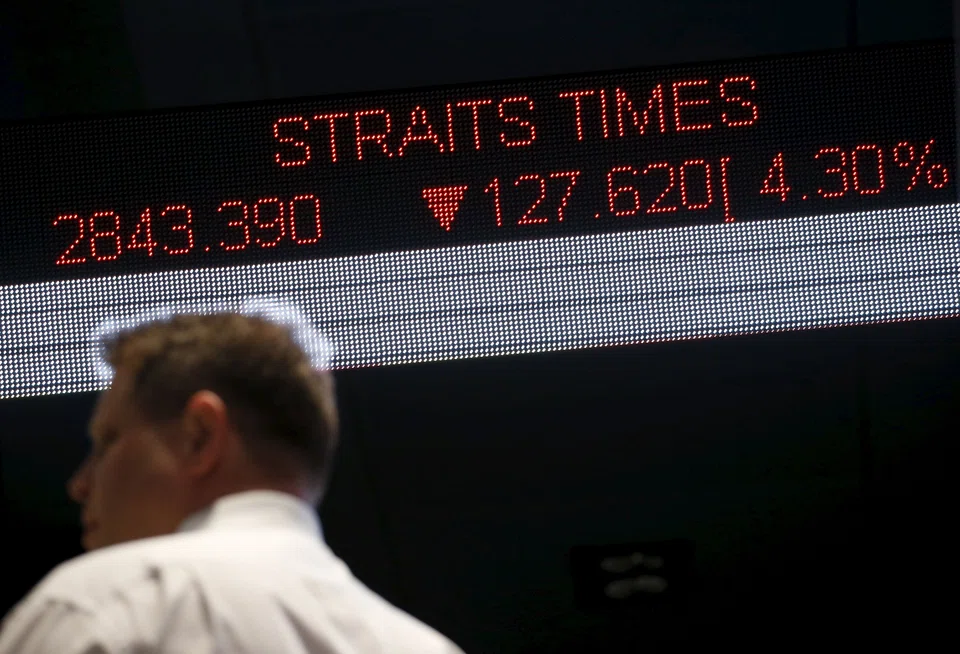
A 7.7 per cent jump in Japan's Nikkei Average after announcement of a cut in corporate tax, a 4 per cent jump in Hong Kong's Hang Seng Index and a 180-point rise in the Dow futures on Wednesday helped the Straits Times Index (STI) extend its rebound into a second consecutive day, this time adding 42.86 points or 1.5 per cent to finish at 2,928.18.
Volume was 1.3 billion units worth S$1.2 billion and excluding warrants, there were 308 rises versus 114 falls. The rise brings the STI's two-day recovery to a total of 76 points or 2.7 per cent.
Apart from Japanese stocks turning in their best one-day performance since 2008, two announcements added to either the urge to buy or to cover one's short positions.
The first was a Chinese Ministry of Finance statement noting that it will look to "strengthen fiscal policy, boost infrastructure spending and speed up reform of its tax system". The second was the World Bank's chief economist Kaushik Basu warning to the US Federal Reserve that it should refrain from raising rates in September given the increased uncertainty about Chinese growth going forward. This follows a similar warning from the International Monetary Fund recently.
Banks led the rise for a second day. Morgan Stanley (MS) in its Sept 9 Asean Financials report said Singapore banks remain the best positioned in Asean for MS's base-case rate environment. It said it prefers DBS and OCBC.
In the second line, shares of e-payments and social media firm Yuuzoo continued to rise following news recently of a S$30 million funding facility from a US alternative investment fund called GEM Global Yield Fund. The counter on Wednesday added S$0.003 at S$0.172 on volume of 69.2 million.
DBS's senior economist Irvin Seah in the latest Asian Insights issue said full- year GDP growth of 1.8 per cent for Singapore is below expectations.
"In the immediate term, the manufacturing sector is on thin ice with poor industrial production and non-oil domestic export (NODX) figures likely to persist given weak external demand. Plainly, the manufacturing sector is already in a cyclical recession," said Mr Seah. "While Singapore manufacturers are finding it difficult to take on new orders given supply side constraints, they are also losing their price competitiveness to regional players."
Beyond external headwinds, companies are also struggling with the domestic labour crunch and restructuring pains. These will exacerbate the drag on the economy and take the toll on growth performance. Downside risks on growth are piling up rapidly. Against the backdrop of the second-quarter GDP contraction, the probability of a technical recession in the third quarter has risen significantly.
Singapore Exchange's (SGX) education portal My Gateway reported that Singapore's 28 Reits and six stapled trusts have a combined market capitalisation of S$58.8 billion, an average price-to-book (P/B) ratio of 0.9, and maintain a dividend yield of 7.1 per cent.
"In comparison, the MSCI World Reits Index trades at a P/B ratio of 1.9 and generates a dividend yield of 4.1 per cent," said My Gateway. "Five of the trusts listed on SGX average a dividend yield that is more than double the yield of the MSCI World REITs Index." It added that on average, the 34 trusts on SGX are trading 7.3 per cent above 12-month lows and 18 per cent below 12-month highs.
Rabobank said of the World Bank warning that although it could be counterproductive in the sense that some Federal Open Market Committee members may feel an even stronger urge to establish their own independence by supporting a September hike, Rabobank thinks the Fed still has some room for manoeuvre on this front as a hike in December would signal that it remains sensitive to developments in global markets while still "preserving face".
For full listings of SGX prices, go to http://btd.sg/BTmkts
TRENDING NOW

Despite the de-dollarisation debate, demand for dollar liquidity in Asia is growing
URA to review guidelines on floor space to give developers more design flexibility: Chee Hong Tat

He built the Vingroup empire. Now South-east Asia’s richest man is handing some key roles to his sons
Can a first-time homebuyer couple earning S$18,000 a month afford a new EC unit?

