

Regional stock exchanges, market players go big on commodities as interest spikes
Market players expand offerings to make it easier to ride interest in commodity derivatives and futures options

MACROECONOMIC uncertainty is driving both institutional and retail investors in the region towards safe-haven assets and alternative investment options that could buffer portfolios from shocks.
Market players in South-east Asia polled by The Business Times said they have noticed a pick-up in interest in commodity derivatives and futures options, and are looking to further capitalise on the growing demand by introducing new options and making it easier for investors to dabble in the commodities sector.
Commodity derivatives are typically only available to institutional investors such as hedge funds, pension funds or commercial banks, who utilise this asset class as a hedge against risks typically associated with the commodities themselves.
On the other side of the coin, commodities futures contracts can be used by investors to make directional price bets on the underlying commodity’s price.
Shah Jahan, Bank of America’s head of global markets for South-east Asia, said the bank saw an uptick in institutional money into commodities in 2022; the trend then reversed in the later part of the year and in 2023.
“However, in the last few months, there has definitely been increased interest in commodities on the back of client concern that inflation is likely to be persistent,” he said.
He said more assets under management have been diverted to “broad-based” commodity complexes such as the Bloomberg Commodity Index. There is also increased interest and activity from the bank’s clients in commodities that fall in the energy-transition category, such as copper.
“While commodity beta markets have historically been a tough conversation, commodity alpha or quantitative investment strategies have far outperformed their peers in other asset classes,” said Jahan.
He added that the bank has seen “success” in speaking to clients in the region about investing into commodities-related quantitative investment strategies, even when these clients do not otherwise trade commodities.
With climate change issues rising to the forefront of investor decisions, Jahan believes commodities such as base metals, gas, agricultural products and carbon are likely to be “a top pick for institutional clients for some years to come”.
Wave of interest in commodities
Stock markets in the region, too, are not letting the commodities wave pass them by.
Gold appears a hot favourite among retail investors. On the Singapore Exchange (SGX), the SPDR Gold Shares exchange traded fund (ETF) hit a 26-month-high in turnover in April, with daily turnover amounting to S$6.4 million.
SGX market strategist Geoff Howie said net purchases from retail investors came in at S$2.9 million during the month – the highest since September 2022, when net purchases hit S$3.3 million.
Investors who have put their money into the Singapore-listed SPDR Gold Shares ETF have also been on the receiving end of sweeter returns, compared to other benchmark indices in the region, Howie said.
The total year-to-date returns from the SPDR Gold Shares ETF as at May 24 stood at 15.5 per cent in Singapore dollar terms, according to Bloomberg data. Total returns from the Straits Times Index came in at 5.1 per cent, while the FTSE APAC Index delivered returns of 9.5 per cent.
On the Bursa Malaysia, the TradePlus Shariah Gold Tracker has been one of the exchange’s top five actively-traded ETFs since January 2024.
The ETF’s assets under management grew to RM79 million (S$22.7 million) in April, from RM57 million in the prior year, on the back of the yellow metal’s safe-haven asset status during volatile market periods.
Outside of gold, SGX has derivative contracts for the likes of iron ore and steel, freight, rubber, coal, oil, petrochemicals and electricity – all of which are available to institutional investors.
SGX’s head of commodity derivatives Tan Tee Yong explained that the exchange’s commodity derivatives business has three pillars that allow investors to capitalise on opportunities in different sectors.
The pillars are iron ore – which he described as the exchange’s “flagship product” – freight and shipping, and electric vehicles.
Tan said that in terms of absolute volumes, there is higher participation in commodity derivatives from all segments of market participants. But the segment that is growing at a “slightly faster” pace is the financial participants segment, he said.
The exchange breaks down participation volumes and figures into two categories: The first includes financial participants such as proprietary traders, commodity trading advisors, hedge funds and asset managers; the other is physical community participants, comprising commodity producers, consumers and traders.
A pick-up in interest from the financial community has been noted across SGX’s entire suite of commodity-derivative offerings, but the growth is “more pronounced” and “much more obvious” in the exchange’s iron ore contracts, Tan noted.
In April, SGX’s market statistics showed that petrochemicals derivatives’ traded volume rose 78 per cent year on year to 7,918 swaps and futures contracts. The equivalent tonnage came in at a record high of just over 2 million tonnes.
Total traded volume on the exchange’s commodities offerings – including iron ore and freight derivatives as well as Sicom rubber futures – was up 68 per cent to 5.6 million contracts, on the back of more financial hedging by physical commodity participants.
On the commodity derivatives business as a whole, Tan said SGX’s key objective initially was to provide a risk-management platform for the commodities sector.
“But as time progressed and as our contracts evolved, you get eyeballs and active participation from other segments,” he said.
Capitalising on the rising interest in the commodities space, SGX has taken to beefing up its offerings in the sector, so investors can tap these opportunities.
One such area, Tan said, is the China waterfront. The exchange now offers the SGX FTSE China A50 Index Futures or a free-float, market cap-weighted index that tracks the 50 largest A-Share securities, the USD/CNH currency contract, as well as the iron ore commodities contract.
“This China waterfront makes a lot of sense for participants to assess opportunities in China and Asia,” he said.
Regional moves
Elsewhere in the region, other exchanges are making similar moves to meet the growing interest.
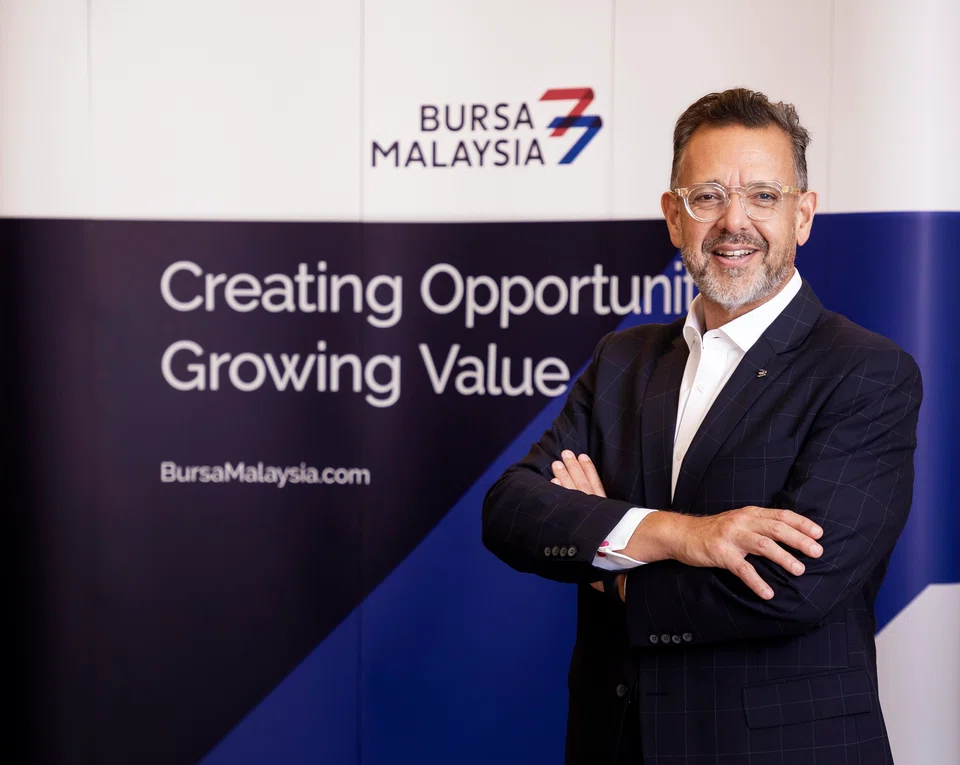
Muhamad Umar Swift, chief executive of Bursa Malaysia, said the exchange offers a spectrum of products such as derivatives, structured warrants and ETFs that are based on commodities such as crude palm oil and gold, among others.
In Q1, Bursa Malaysia Derivatives’ (BMD) average daily contracts rose 18 per cent year on year to 84,222 contracts, while derivatives trading revenue was up 18.2 per cent to RM25.4 million. The open interest for all products on BMD also hit a record high, with 366,962 contracts achieved.
Umar said the exchange is continuing to innovate. BMD in March introduced the Bursa Malaysia DCE Soybean Oil Futures, the first collaboration between a Chinese derivatives exchange and an Asian exchange based outside China.
He said BMD is also looking to introduce a renewable feedstock futures contract “in the near future”, in response to the “growing demand for sustainable investment options”.
Umar said Bursa Malaysia is also exploring alternative distribution channels – beyond the current brokers – to expand the distribution of securities, including commodity-backed ETFs and structured warrants.
“The emergence of new digital channels like e-wallets, robo-advisors and digital banking presents opportunities to enhance the accessibility of securities like ETFs and structured warrants investments to our investing public,” he added.
The Thailand Futures Exchange (TFEX), a subsidiary of the Stock Exchange of Thailand, told BT that local investors are increasingly being drawn to commodities, recognising their potential for portfolio diversification and inflation hedging.
On TFEX, precious metals, particularly gold, have “consistently been top performers”, the spokesperson said.
In March, average daily volumes were up 9.5 per cent to 45,530 contracts worth a collective US$1.6 billion, from an average daily volume of 41,593 contracts worth US$1.4 billion in January and February.
The spokesperson said TFEX has actively leveraged the growing interest in commodities by introducing a range of accessible products. These include the TFEX Gold Online Futures, which enable investors to negate foreign-exchange risks by allowing price-monitoring across global markets and use a fixed multiplier for settlements.
The spokesperson added that the exchange plans to expand the morning trading session for precious metal and agricultural futures in Q4. The exchange axed the midday break for all its precious metal products in January.
TRENDING NOW
From legacy to launch: Francis Yeoh and Yeoh Pei Xien on family unity and YTL’s next‑gen ventures

Could Japan trigger the next global financial crisis?

Wealthy Indonesians snap up government bonds as yields near 8%: OCBC
‘You buy more picks and shovels because you keep hitting gold’: Why AI spending needs to see results

