

Reit IPOs reign in Singapore, but more diversity welcome
98 per cent of the total S$3.06 billion across 11 deals raised this year came from four Reit and business trust listings
Claudia Tan HS
Singapore
SINGAPORE initial public offerings (IPOs) raised more money in 2019 than a year ago, but more diversity would be welcome, with Reits dominating new listings and set to continue doing so.
IPOs on the Singapore Exchange (SGX) raised a total of S$3.06 billion across 11 deals this year, a marked improvement from 2018 when S$730 million was raised across 15 listings.
However, 98 per cent of the total proceeds raised came from four Reit (real estate investment trust) and business trust listings. Overall, Reits and business trusts accounted for some S$3.0 billion in proceeds raised this year.
Market watchers The Business Times spoke to said that while this year's IPO performance can be considered a win, more can be done for the market to see greater diversity among listings and to attract larger deals.
"For the capital market scene to be more robust and dynamic, investors need to diversify their portfolio beyond traditional segments. This will set the scene for listings from companies in the technology or biotech and medtech space to enhance Singapore's competitiveness in these areas," said Gail Ong, head of equity capital markets practice at WongPartnership.
Furthermore, given the size of the Singapore economy, it is natural for the Republic to see fewer large domestic listings, making it crucial for the exchange to look overseas for bigger deals, according to Tham Tuck Seng, capital markets leader at PwC Singapore.
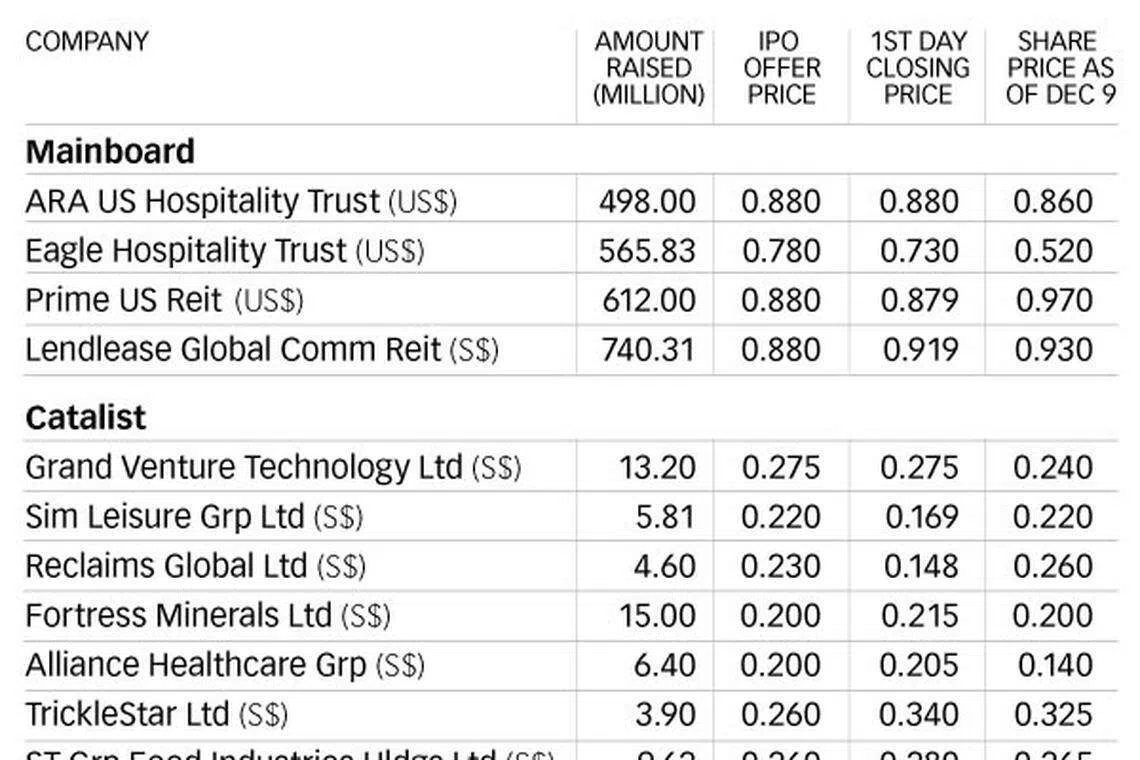
Still, 2019 has been an encouraging year for the Singapore IPO market. Four companies listed on the Mainboard compared to the three last year. Lendlease Global Commercial Reit was the latest addition to the board, raising S$740.3 million in October. The largest IPO was Prime US Reit, which raised US$612 million in July. Meanwhile, Eagle Hospitality Trust and ARA US Hospitality Trust raised US$565.8 million and US$498.0 million respectively.
The Catalist board, however, saw S$59 million raised across seven listings compared to the 12 that raised S$174 million in 2018. The smallest listings on the Catalist board this year were Reclaims Global and TrickleStar, which raised less than S$5 million each, and the largest was Fortress Minerals, which raised S$15 million.
First day trading produced mixed performance. Five companies ended their trading debuts with healthy first day premiums. TrickleStar had a 30 per cent gain on its initial IPO price while the other four companies gained between 2.5 per cent and 7.7 per cent.
On the other hand, Eagle Hospitality Trust, Reclaims Global and Sim Leisure Group ended down from the IPO price on the first day. Prime US Reit, ARA Hospitality Trust and Grand Venture Technology made tepid debuts, closing at their initial IPO price.
The Reit dominance of the IPO market reflects underlying trends, noted Ronald Tan, director of listings at SGX, pointing out that strong global themes are often at work.
"If we track the IPOs in the last couple of years, there are always certain thematics that influence listings each year and in different years, you will get a fairly good concentration in certain sectors," he said.
For instance, in 2015, BHG Retail Reit was the only Reit that made it to the exchange under volatile market conditions and looming interest rate hikes.
But as the search for yield continues amid low interest rates, and the persistence of economic uncertainty from trade tensions and geopolitical events, Reits and trusts are expected to continue to anchor Singapore's capital market, according to PwC's Mr Tham.
While Reits will still underpin IPOs, market watchers are looking forward to a flow of listings from other sectors. IPOs of various sizes are expected across a broader range of sectors including consumer, healthcare, financial and technology come 2020.
Mr Tham said: "We can expect more local companies seeking listings on the Catalist board and few larger size Mainboard listings in the healthcare and food and beverage sectors."
For one, Thai Beverage is considering an IPO of US$10 billion, possibly making it the biggest listing in Singapore since the 2011 listing of Hutchison Port Holdings Trust, which raised US$5.5 billion.
"Many of these Mainboard listing candidates have resources to hold their listing and wait for a favourable timing to enter the market," noted Tay Hwee Ling, disruptive events assurance leader of Deloitte South-east Asia and Singapore.
But market watchers are also quick to caution that 2020's IPO performance will still be largely dependent on how global economics pan out to impact the different sectors.
"We continue to focus on our core multi-sectors and the IPO performance will very much be shaped by global macroeconomic trends and markets that influence investor demand," said SGX's Ronald Tan.
Deloitte's Ms Tay suggested more targeted market engagement by identifying regions with companies that can meet their corporate objectives by listing in Singapore. "These investor educational sessions are key and SGX can definitely increase their efforts to have more of them," she said.
"IPO aspirants and professional advisers must also play their part by getting companies ready and ensuring that the listing project is well planned so that quality companies can have a shorter time to market," she added.
TRENDING NOW

He built the Vingroup empire. Now South-east Asia’s richest man is handing some key roles to his sons
Can CDL become a powerhouse in fund management?

Canada is upping oil flows to Asia, but South-east Asia’s refineries aren’t ready to handle them yet

Data centre energy demand from Asean telcos not a ‘big risk’, says industry group

