CapitaLand China Trust H1 DPU falls 19.5% to S$0.0301 on lower revenue

Its revenue shrank on the back of reduced contribution from its logistics parks portfolio and its divestment of CapitaMall Shuangjing


Samuel Oh
Megan Cheah
Published Tue, Jul 30, 2024 · 08:32 AM
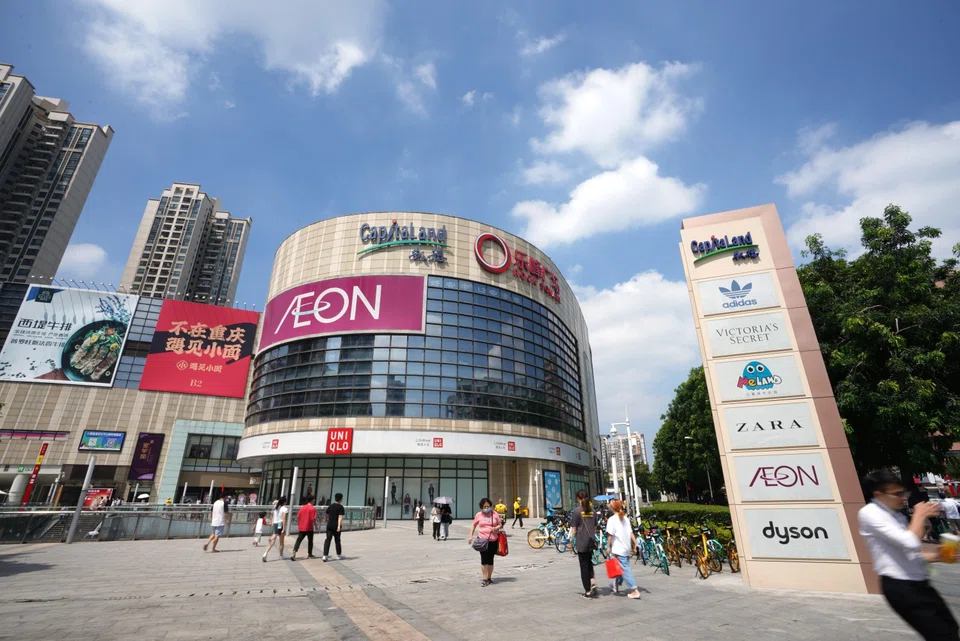
    • Rock Square, a shopping mall in Guangzhou owned by CapitaLand China Trust. CLCT's revenue fall was partially mitigated by higher revenue growth from the retail portfolio.
    • Rock Square, a shopping mall in Guangzhou owned by CapitaLand China Trust. CLCT's revenue fall was partially mitigated by higher revenue growth from the retail portfolio. PHOTO: BT FILE

    THE manager of real estate investment trust (Reit) CapitaLand China Trust (CLCT) on Tuesday (Jul 30) announced that the Reit’s distribution per unit (DPU) declined by 19.5 per cent to S$0.0301 for the first half ended Jun 30, from S$0.0374 in the corresponding year-ago period.

    This came from decreased revenue for the period, which came in at S$173 million in Singapore dollar terms, down 6.3 per cent from S$184.5 million year on year.

    In yuan terms, revenue slid 2.3 per cent to 925.9 million yuan, from 947.8 million yuan. The fall in Singapore dollars was higher because the yuan was weaker against the Singapore dollar.

    The Reit manager said the decrease was due to lower revenue from the logistics parks portfolio, given lower occupancy and rental rates. This portfolio pulled in S$4.4 million in revenue in H1 FY2024, declining 47.5 per cent from S$8.4 million in H1 FY2023.

    There was also a reduced contribution from CapitaMall Shuangjing, which was divested in January.

    CapitaMall Shuangjing in Guangqu Road in Beijing was divested in January, says the manager. PHOTO: BT FILE

    The drop was partially mitigated by higher revenue growth from the retail portfolio, primarily driven by the completion of asset enhancement initiatives (AEIs) in CapitaMall Grand Canyon in Beijing, Rock Square in Guangzhou and CapitaMall Yuhuating in Changsha, as well as proactive lease management in CapitaMall Xizhimen in Beijing and CapitaMall Xuefu in Harbin.

    Net property income fell 8.7 per cent to S$117.9 million, from S$129.2 million. This was due to higher property operating expenses in yuan terms, as there was a reduction in property tax incentives received by business parks in H1 2024.

    Distributable income available to unitholders likewise shrank, falling 18.7 per cent to S$51.3 million, from S$63.1 million the year before.

    The record date for the first half DPU of S$0.0301 is Aug 7, and the payment date, Sep 25, said the manager.

    On a half-on-half basis, the DPU for H1 FY2024 rose marginally by 0.3 per cent; the H2 FY2023 DPU was S$0.03. This was due to higher income contribution from the retail portfolio and lower net financing cost.

    Healthy retail occupancy

    CLCT’s retail portfolio occupancy grew to 97.8 per cent for the period, with the majority of its retail assets recording improved occupancy on year. Rental reversion for the first half was positive at 1.2 per cent, based on the average rent of new leases versus that for old leases.

    Footfall across the retail portfolio grew 14.1 per cent on year, and tenant sales rose by 6.6 per cent. “This increase was primarily driven by the strong performance of its dominant malls and malls that recently completed AEIs, including CapitaMall Yuhuating, Rock Square and CapitaMall Grand Canyon,” the manager said.

    CLCT’s manager updated that the bulk of the AEIs and active tenancy remixing works at its malls were completed at the end of June.

    The Reit manager disclosed that the malls under its portfolio are “normalising”, in that it has been successful in retaining tenants, with a retention rate of about 60 per cent. CLCT offered tenants who signed new leases discounts on the upfront rental to help them in their first year. This helped to boost traffic and sales in the malls, it said.

    CLCT noted that consumer habits in China are always evolving, with most Chinese consumers currently tightening their belts and being more cautious about spending. As the Chinese economy has slowed, the Reit manager said it hoped the government would implement more targeted measures, whether on the fiscal side or monetary side, to boost the economy.

    Occupancy at CLCT’s business parks rose from 90.2 per cent as at Mar 31 to 90.5 per cent as at Jun 30.

    The Reit has been prioritising domestic tenants, such as those from the electronics and engineering sectors, and has worked with the local community and government on the sectors that they want to attract into the business parks.

    By prioritising sectors high up on the authorities’ agenda, CLCT’s manager said it has succeeded in drawing tenants despite a growing supply pipeline.

    For the logistics portfolio, the occupancy rate of CLCT’s three logistics assets rose to an average 90.3 per cent as at Jun 30. Including Shanghai Fengxian Logistics Park, which is undergoing an evaluation for repositioning, the occupancy of the logistics park portfolio was 70.4 per cent.

    For H1, the logistics park portfolio recorded a negative rental reversion of 27.2 per cent for three out of its four logistics properties. Tan Tze Wooi, chief executive of CLCT’s manager, described the rental reversion as being “quite consistent with what we have guided you in the last three to six months”.

    “We are seeing these short-term supply-demand imbalances, so most landlords would adjust their rentals downwards to reflect what is in line with the market today,” he said.

    He expects the logistics segment to improve in H2, based on the current pipeline and ongoing negotiations, and added that the Reit would continue to look for new tenants and work more closely with the local governments.

    He said that local governments had preferences for certain types of tenants, so CLCT would work with the authorities to provide the space, or work with the tenants directly, and even offer some capital expenditure to tailor the space for them.

    On divestments, Tan said: “If there are opportunities for us to exit, use the money to improve our balance sheet strength, we stand ready to do that, because it would be an enhancement to our overall financial metrics and DPU profile. So I think that’s something we would do.”

    The manager also noted that the Reit has refinanced all loans due in FY2024, and secured refinancing for certain loans due in FY2025 and FY2026 at lower interest rates, ahead of their maturities. As at Jun 30, the average term to maturity of its borrowings was 3.4 years. 

    CLCT’s cost of debt stood at 3.49 per cent per annum, supported by a healthy interest coverage ratio at 3.2 times, said the manager. Its gearing remained stable from the previous quarter at 40.8 per cent, well below the regulatory limit of 50 per cent.

    Commenting on the results, Tan said that China’s government is likely to focus on stimulating domestic demand and promoting technological advancements among its series of reforms, and that the Reit was positioned to capitalise on the growth opportunities from these policy directions.

    Units of CLCT closed at S$0.69 on Tuesday, up 0.7 per cent or S$0.005.