

CICT posts 2.5% rise in H1 DPU to S$0.0543 despite higher finance costs
Net property income rises 5.4% to S$582.4 million
CAPITALAND Integrated Commercial Trust (CICT) recorded a distribution per unit (DPU) of S$0.0543 for the first half of the year, up 2.5 per cent from S$0.053 in the corresponding period the year before.
It also announced on Tuesday (Aug 13) distributable income of S$366.5 million, up 3.7 per cent from S$353.2 million in the first half of last year. The distribution will be paid out on Sep 26, after the record date on Aug 21.
However, the total return attributable to unitholders fell in H1 to S$364.9 million, compared with S$387.8 million in the year-ago period due to higher finance costs.
Revenue increased 2.2 per cent to about S$792 million, from S$774.8 million in H1 FY2023. This was due to higher gross rental income, the manager of the trust said.
Net property income (NPI) was up 5.4 per cent to S$582.4 million in H1 FY2024, from S$552.3 million in the year-ago period. This rise was attributed to lower utility expenses and savings from property management reimbursements under the new property management agreement.
The average cost of debt remained flat at 3.5 per cent quarter on quarter, with the bulk of refinancing due in 2024 already refinanced or in advanced stages of loan documentation. As at Jun 30, 76 per cent of borrowings are on fixed interest rates, with the rest on floating rates.
The floating rate could be a positive, should the Fed cut rates. Every 0.5 per cent movement would impact interest expenses by S$11.5 million per year for the floating-rate portion.
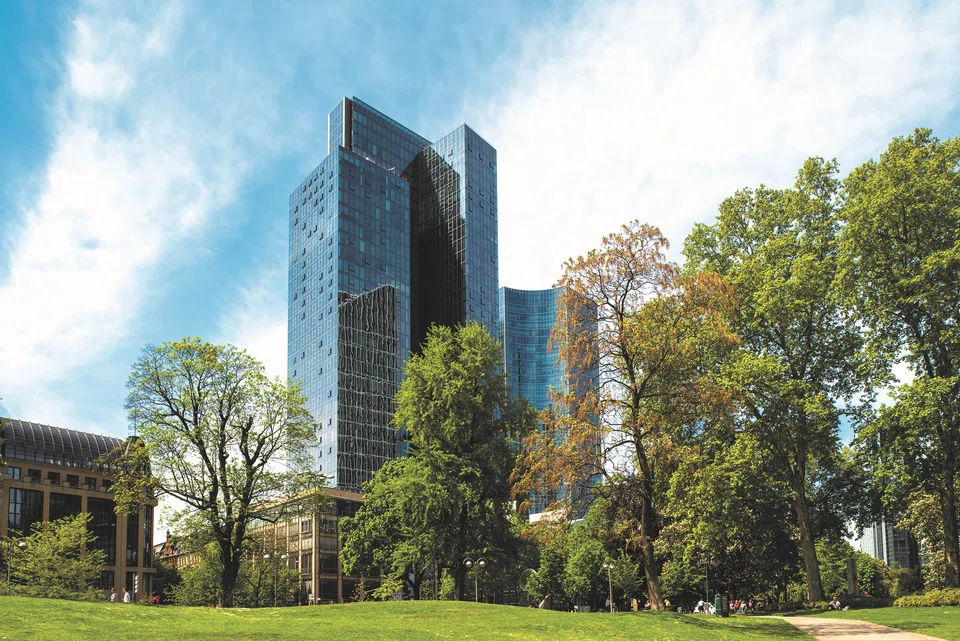
Income from Gallileo – a Grade A commercial building located in Frankfurt’s Central Business District – was temporarily absent due to an asset enhancement initiative (AEI).
Chief executive of the manager Tony Tan added: “Our AEIs at IMM Building in Singapore and Gallileo in Germany are progressing well and are expected to complete in H2 2025.
“Including leases under negotiation, phases one and two of IMM Building’s AEI have achieved a high committed occupancy of 98.7 per cent, while Gallileo’s committed occupancy stands at 96.7 per cent.”
CICT’s office and retail segments
While the Singapore office markets – along with Galileo – have healthy occupancy rates, CICT’s properties in the Frankfurt Airport district and North Sydney markets have elevated occupancy rates. The Reit’s German office occupancy rates trended down from 92.1 per cent as at Mar 31 to 89.4 per cent as at Jun 30. It experienced similar trends in its Australia office occupancy rates, down from 88.6 per cent as at Mar 31 to 88 per cent as at Jun 30.
CICT’s Singapore office occupancy rates also dipped slightly to 97.3 per cent as at Jun 30 from 97.5 per cent as at Mar 31. Overall, office portfolio occupancy rates decreased to 95.3 per cent as at Jun 30 from 95.8 per cent as at Mar 31.
Office demand led to smaller size requirements, and expansion needs from existing tenants helped fuel demand for CICT’s Singapore portfolio. An example cited was a tenant looking to scale up from about 20 desks to 5,000 square feet of space, of which are the kind of vacancies the Reit has in its portfolio.
“There’s that kind of demand that we do see a lot more in the market compared to really big deals, which I think works from a portfolio perspective,” said Lee Yi Zhuan, head of portfolio management, CICT’s manager.
Both retail and office segments had a more than 80 per cent retention rate for tenants, with retail at 85.7 per cent and office at 81.5 per cent.
On the retail front, CICT’s manager sees opportunities for its malls, even as the Rapid Transit System Link between Singapore and Johor opens up. While there might be some short-term sales leakage, and the impact is likely incremental over the longer term, the manager will be fine-tuning its mall positioning and trade mix.
“The increase in cross-border traffic could also present opportunities to showcase our malls to tourists coming from Malaysia, while also potentially alleviating some of the manpower issues faced by some of our retailers and suppliers,” said Lee.
The trust’s portfolio occupancy was 96.8 per cent, with a weighted average lease expiry of 3.6 years. Its interest coverage ratio was three times, with an aggregate leverage of 39.8 per cent.
Based on the average rent of signed leases in H1 FY2024, the trust’s Singapore retail and office portfolios recorded positive rent reversions of 9.3 per cent and 15 per cent, respectively. The manager is guiding for high single-digit rental reversions in the second half of FY2024.
While the rent expiring in January 2025 is slightly below the market rates of S$12 per square foot, the manager will be engaging with tenants and will be cognisant of market conditions.
“We want to ensure that we keep tenants within our ecosystem, depending on the overall budget of the tenant,” said Tan.
In H1, CICT secured about 1.1 million square feet of new leases and renewals, split evenly across its retail and office portfolios.
Units of CICT closed on Tuesday unchanged at S$2.10.
TRENDING NOW

LTA proposes combining car COE categories, adding rebate-surcharge system

StarHub to acquire MyRepublic’s mobile business amid ongoing telco consolidation
DBS, OCBC, UOB rout lops billions off STI as inflation, rate concerns spook investors

Grab CEO’s wife Chloe Tong on life with Anthony Tan and finding her purpose

