

ESR-Reit eyes S$8 billion AUM over five years, targets 8-10% unitholder returns
These goals will be achieved through selective redevelopments and acquisitions, while actively paring short land lease assets


[SINGAPORE] ESR-Reit aims to grow its assets under management (AUM) to S$8 billion over five years, targeting total unitholder returns of 8 to 10 per cent through selective redevelopments and acquisitions.
Achieving the AUM target could lift the real estate investment trust (Reit) from a mid-cap to a larger-cap stock and secure inclusion in key indices, said Adrian Chui, chief executive officer and executive director of its manager, at an earnings call on Wednesday (Feb 4). As at end-December 2025, ESR-Reit’s AUM stood at S$5.2 billion.
The Reit’s strategy will focus on both net asset value (NAV) and distribution per unit (DPU) growth, moving beyond short-term DPU targets to deliver sustainable total returns, he said.
Redevelopments in the pipeline
ESR-Reit plans to drive organic growth through redevelopments, starting with the 2 Fishery Port project, where construction is expected to start in the fourth quarter of 2026.
The redevelopment of the cold storage and food processing facility is expected to cost S$200 million to S$250 million, with an estimated stabilised yield of 7 per cent and an equity internal rate of return of 12 to 15 per cent.
Other assets earmarked for major asset enhancement initiatives (AEIs) include Tuas Biomedical Park, which could unlock an additional 320,000 sq ft of gross floor area (GFA), and a site in Ang Mo Kio with another 230,000 sq ft of potential GFA.
The third asset – a ramp-up distribution centre at Penjuru Road – has around 12 years of remaining land tenure. “We could potentially get land lease extension if we undertake major AEIs,” said Chui. “This will help to solve that land lease decay issue.”
The 2 Fishery Port redevelopment is more immediate, while the other projects are likely to start in late 2026 or 2027, with timings staggered to optimise resources and capital deployment.
ESR-Reit will also pursue selective acquisitions to drive growth. It will focus on high-quality, new-economy logistics assets in markets with strong growth tailwinds, DPU-accretive and return-accretive potential, and the ability to leverage ESR’s operational footprint and pipeline.
The Reit also aims to expand its freehold portfolio and improve income quality.
ESR-Reit will retain its core focus in Singapore, which is expected to remain over 50 per cent of portfolio value, while selectively pursuing international opportunities.
Japan and Australia remain the two key external markets. While rising interest costs in Japan are a consideration, Chui noted that the spread between potential yields and funding costs remains attractive.
Since its privatisation in July last year, ESR-Reit’s sponsor has said the trust will be its flagship regional listed vehicle, holding around a 21 per cent stake.
This gives the Reit continued access and visibility to the sponsor’s asset pipeline, allowing divestments and acquisitions to be timed carefully and avoiding “lumpy DPU and NAV growth”, Chui said.
He added that assets available for ESR-Reit to acquire from the sponsor over 2026 and 2027 are expected to total S$400 million to S$800 million. Still, acquisitions will only proceed if terms are right, with a focus on assets that help drive DPU and NAV growth.
Short land lease assets
As part of its active asset management strategy, ESR-Reit is divesting short land lease assets.
Short land lease assets – defined as those with less than 15 years of remaining tenure – account for 11.9 per cent of the Reit’s portfolio. Chui noted that this is down from around 20 per cent two to three years ago, following gradual divestments and redevelopments.
The figure is expected to fall to 10.8 per cent after the announcement of the sale of eight non-core assets to Brookfield for S$338.1 million and the sale of a hotel strata lot to Coliwoo for S$101 million.
ESR-Reit is also in discussions with end-users to divest about S$100 million of smaller short-lease assets, with divestments staggered through 2026-2027.
All in, short land lease assets are projected to make up 4 to 6 per cent of the Reit’s portfolio.
Chui noted potential challenges to reaching the S$8 billion AUM target. Redevelopment risks are primarily tied to construction costs, driven by rising labour costs amid tight supply and competing projects, including Marina Bay Sands, Terminal 5, and public housing.
Material costs, particularly steel, have remained relatively stable, providing some relief. For acquisitions, the main hurdles are competition for assets and financing costs.
Resilient performance
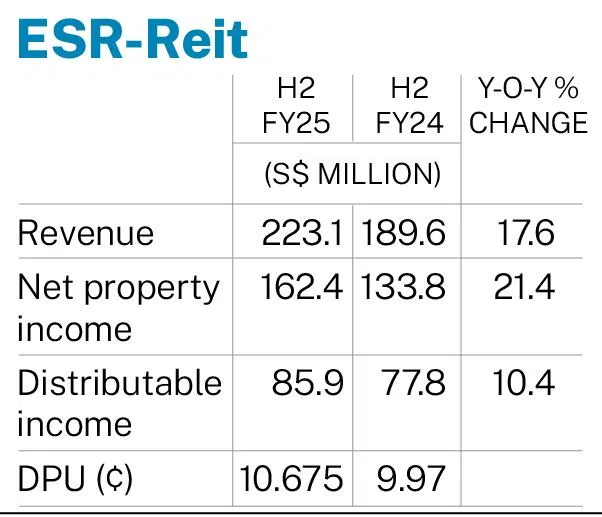
ESR-Reit’s growth targets come on the heels of its a strong showing for its second half ended Dec 31, 2025. DPU rose 7.1 per cent to S$0.10675 from S$0.0997 a year earlier, bringing FY2025 DPU to S$0.21914, up 3.4 per cent year on year.
The distribution for H2 FY2025 will be paid out on Mar 24, after the record date of Feb 12.
Revenue for H2 FY2025 was up 17.6 per cent year on year at S$223.1 million, while net property income (NPI) grew 21.4 per cent on year to S$162.4 million.
Distributable income grew 10.4 per cent to S$85.9 million for the six-month period, from S$77.8 million a year earlier.
For the full year, distributable income increased 7.3 per cent to S$176.1 million, with revenue up 20.4 per cent to S$446 million, driven by strategic acquisitions, positive rental reversions and completed enhancement initiatives. NPI grew 25.6 per cent to S$328.7 million.
Logistics and high-spec industrial assets drove positive rental reversions, with portfolio-wide growth of 11.7 per cent in FY2025, up from 10.3 per cent in FY2024.
Portfolio occupancy remained stable at 91.1 per cent, supported by resilient demand.
As at Dec 31, 2025, ESR-Reit’s cost of debt stood at 3.35 per cent, with gearing at 43.4 per cent. The manager expects lower debt costs through the refinancing of FY2026 Singdollar-term loans and revolving credit facilities at about 30 basis points lower margins.
“Logistics and (high-spec) industrial assets are expected to remain key drivers of portfolio performance amid resilient structural demand, even as rental growth may be moderated by increased supply,” said the Reit manager.
Units of ESR-Reit were trading 1.1 per cent or S$0.03 higher at S$2.74 as at 2.02 pm on Tuesday.
TRENDING NOW

Once staunchly pro-China, Malaysian Chinese businesses are now distancing themselves from Beijing

Looking beyond looming CEO succession, should UOB potentially pursue a transformative merger?

Could stablecoins be the future of money?

Grab CEO’s wife Chloe Tong on life with Anthony Tan and finding her purpose

