

Headwinds expected to persist for US office S-Reits despite sharp year-end rally

Raphael Lim
DESPITE expectations of a rebound from deeply discounted valuations, market watchers were surprised by the sharp rally in Singapore-listed US office real estate investment trusts (Reits) in the final quarter of 2023.
These analysts are warning, however, of continued volatility in the sector as investors’ expectations adjust.
The trio of US office Reits listed in Singapore – Manulife US Reit (MUST), Prime US Reit, and Keppel Pacific Oak US Reit (Kore) – suffered steep declines through most of the year, and were the worst performers in the benchmark iEdge S-Reit Index in 2023.
Up until end-October 2023, their unit prices tumbled between 60 and 83.3 per cent, as concerns over changing work patterns in the US and the impact of higher interest rates on distributions and portfolio valuations wreaked havoc on investor sentiment.
But the three Singapore-listed real estate investment trusts (S-Reits) have rallied sharply since then.
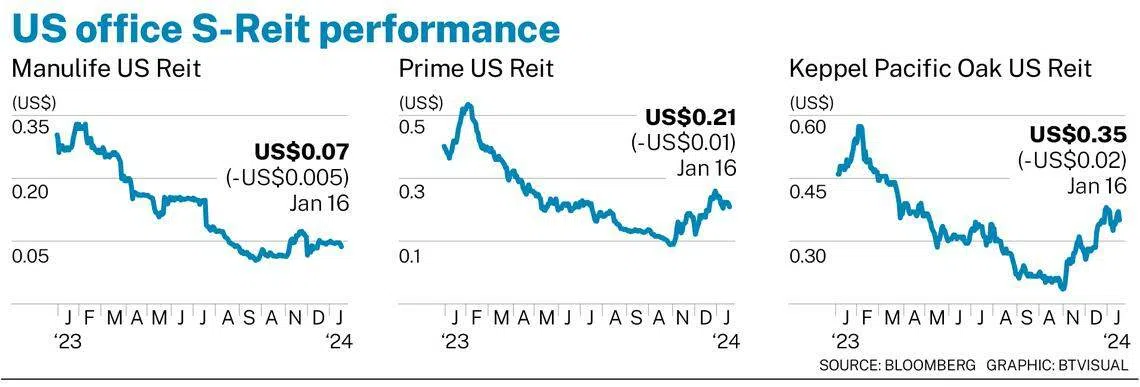
Over the past 2.5 months since November 2023, Prime US Reit has surged 125.8 per cent to US$0.21, while Kore has almost doubled to US$0.35 and MUST has risen 40 per cent to US$0.07.
In comparison, the iEdge S-Reit Index climbed 13.9 per cent over the same period as peaking interest rates lifted investor confidence, while the Straits Times Index gained 3.8 per cent.
However, analysts believe that the road ahead will remain rocky for US office Reits in 2024 amid tight lending conditions and lingering structural headwinds.
Notably, retail investors have been adding exposure to the sector, with positive net retail inflows for all three US office Reits in 2023. Institutional investors, meanwhile, have been net sellers during the year.
While RHB analyst Vijay Natarajan believes that the recovery in US office Reits is warranted, he said the pace has been slightly surprising.
“With the sharp recovery, we do expect some volatility in share price from profit-taking in the near term,” he said.
The way Natarajan sees it, structural headwinds for the sector are likely to persist over the next six to 12 months, as the sector finds an equilibrium between return-to-office policies and hybrid working.
But he also noted that “the worst is likely behind us” as the resilient economy and stricter hybrid working policies mean that the overall office sector is expected to “gradually improve”.
One key factor to monitor, he added, is the return of lenders’ appetite towards the commercial sector.
“This has been a key impediment for the transaction market and has broadly resulted in market freeze,” he said. “With rates peaking, we do expect a gradual return of lenders to the sector, which could result in an increase in transactions and a bridging of some of the huge valuation gap between buyers and sellers.”
Veteran Reit investor and chairman of GCP Global Gabriel Yap also sees the return of lenders as a necessary step for US office Reits to become attractive.
“Right now, you don’t even have any lenders for some syndicated loans to be financed,” he said.
He added that more clarity is needed on whether mortgage debt coming due in the next two years can be refinanced without much higher costs and owners reneging on their loan obligations.
Despite the strong year-end rally, Yap noted that the three US office Reits remained among the worst-performing S-Reits.
Kore, Prime US Reit and MUST ended 2023 down 18.5 per cent, 40.7 per cent and 73.3 per cent, respectively.
“A couple of cents in recovery would not even qualify as a ‘rebound’ in view of the huge capital destruction they have done,” he said, adding that he expects continued headwinds even if interest rates taper from their peak.
Darren Chan, senior research analyst at Phillip Securities Research, noted that Reits with foreign assets are trading at steeper discounts to net asset value than those with Singapore assets.
“We expect Reits with foreign assets to experience one last impact from year-end 2023 valuation declines before a more positive outlook emerges in 2024,” he said.
Chan added that the Singapore-listed US office Reits could continue to face challenges with lower occupancies, a more challenging leasing landscape and declining asset valuations in 2024.
However, most of the negatives have already been priced in, and any positive developments on the US commercial sector this year could have substantial share price impact on the upside.
Chan said: “The silver lining is that they are trading at steep discounts... and might present an attractive opportunity for higher-risk investors.”
TRENDING NOW

ComfortDelGro appoints two new independent directors

Once staunchly pro-China, Malaysian Chinese businesses are now distancing themselves from Beijing

NoonTalk needs continued financial support from CEO Dasmond Koh, auditors warn

DP Architects sets the benchmark for sustainability disclosure and design

