Kore’s focus on US suburbs could pay off amid Fortune 500 exodus from traditional gateway cities

FROM the window of a suite in Keppel Pacific Oak US Reit’s (Kore) One Twenty Five office asset in Dallas, a familiar brand name can be seen emblazoned on a building a block away: Caterpillar.
The construction equipment manufacturer in June last year announced the move of its global headquarters from Deerfield in Illinois, to Dallas-Fort Worth in Texas.
In a statement, Caterpillar chairman and chief executive Jim Umpleby described the move as being “in the best strategic interest” of the company as it seeks “profitable growth”.
Caterpillar is among many Fortune 500 companies shifting offices in search of lower costs.
The list is long: Boeing, pharmaceuticals distributor McKesson Corporation, Oracle, Tesla, Tyson Foods, United Airlines and drugstore operator Walgreens are among them. Once-popular gateway cities such as New York, San Francisco, Los Angeles and Chicago are losing their appeal.
“Gateway cities are the places where we used to have all the new ideas and new developments. They were the creative places, and you saw the new industries born there. It’s where people really wanted to be,” said David Snyder, CEO of Kore’s manager. “Starting 20 years ago, we began seeing all of that shift away.”
In their moves, companies are also seeking favourable business regulations, cheaper housing for their employees and lower tax rates – for both corporates and individuals.
Additionally, some of these traditional gateway cities have been rocked by rising crime rates.
In New York City, for example, more than 170,000 felony crimes were reported in 2022. This represented an increase of some 20 per cent year on year, and was the highest level since such statistics became publicly available in 2006.
Their quest for better office locations have brought many of these companies to Texas and Florida, where, happily, Kore has properties, Snyder noted. “The majority of the companies that have left California have moved into our markets… It’s definitely a trend that accelerated during the pandemic.”
Room for growth
Kore’s portfolio comprises 13 office properties across eight cities. It has three properties in Seattle, Washington; two in Denver, Colorado; five in the state of Texas, across the cities of Austin, Dallas and Houston; and one each in Nashville, Tennessee; Orlando, Florida; and Sacramento, California.
Following a site visit to five of these cities – Nashville, Dallas, Houston, Denver and Seattle – UOB Kay Hian (UOBKH) analyst Jonathan Koh observed “vibrancy in the local economies and growth from domestic tourism”.
Koh added: “In-migration and population expansion at these growth cities should cushion the negative impact from hybrid arrangements and remote work.”
Kore’s properties tend to be in the more vibrant suburban submarkets, instead of downtown areas.
“Downtown locations in most of the markets that we’ve visited appear to be very quiet, especially post-Covid,” said DBS analyst Rachel Tan. “(Whereas) selected submarkets in the respective growing cities are still active”.
Thanks in part to its locations, Kore’s tenants tend not to be the professional firms or financial services companies – among which there has been a greater structural shift towards hybrid work.
“The big advantage with suburban submarkets is you don’t usually have big accounting firms, big law firms, and big consulting firms in your buildings. The trend (for these big firms) started a long time ago – not just post-Covid – where they give up space at every lease renewal,” Kore’s Snyder said. “We don’t want the types of tenants that constantly shrink; we want tenants that generally, on average, grow.”
The strategy appears to be paying off. As at Mar 31, Kore’s portfolio committed occupancy stood at 91.9 per cent – the highest among Singapore-listed real estate investment trusts (S-Reits) with a focus on US office assets.
Recent filings for Prime US Reit and Manulife US Reit show occupancies at 88.6 per cent and 86.1 per cent, respectively.
“We’ve got higher overall occupancy in large part because we have better tenancy,” Snyder explained. “We’ve got a lot more technology and a lot more healthcare tenants; both of those are generally recession-proof.”
No to ‘elephant hunting’
Snyder is not a fan of “elephant hunting” – going after tenants that take up larger chunks of space. “When you have really concentrated tenants, any one of them having a problem is a big issue for you,” he said.
Kore’s top tenants account for only 24 per cent of total income, whereas its US office S-Reit peers have concentration ratios of 33 per cent to 40 per cent. Also, no single tenant accounts for more than 3.5 per cent of income.
In the current environment, one analyst said, this is a good thing.
“The lack of anchor tenants and concentration risk has greatly aided in a post-pandemic leasing environment in which most anchor tenants are seen to be downsizing and typically moving to newer buildings in the market to suit their revamped office space needs,” said RHB analyst Vijay Natarajan.
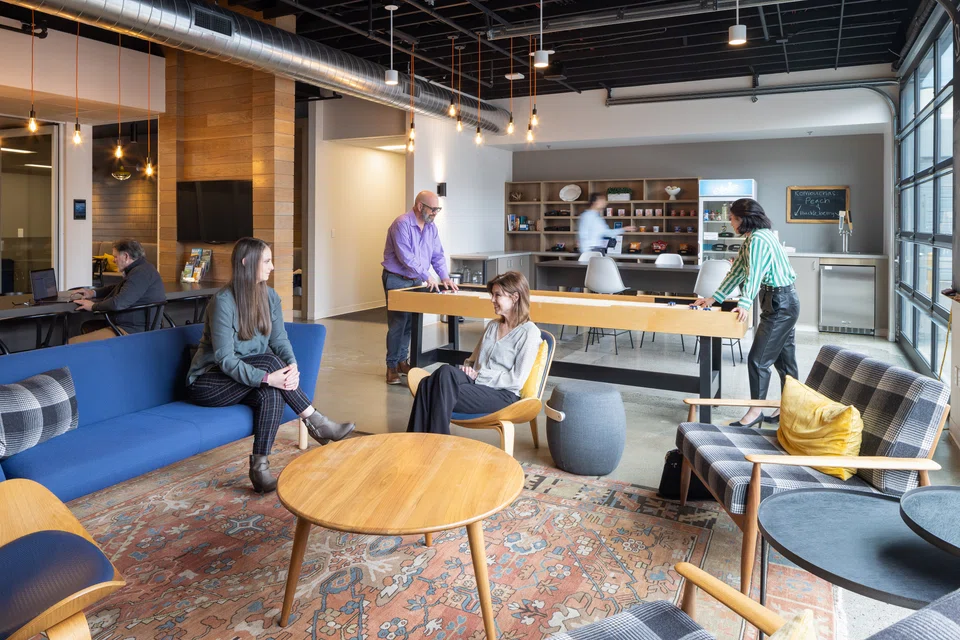
This focus on smaller tenants has also allowed Kore to build “speculative suites”, or spec suites. These are move-in-ready spaces designed to attract tenants.
“We build spec suites as a matter of course. At any given moment, we usually have multiple spec suites that are available or that we’re about to start building,” said Snyder.
Such spec suits, alongside landlord-managed amenities such as in-house cafes, gyms and conference facilities, have helped Kore outperform its peers, RHB’s Natarajan added.
“These efforts have paid dividends in Kore’s operational data,” Natarajan noted. “Since listing or acquisition, its portfolio value – on a like-to-like basis – has increased 20 per cent, despite Covid-19 and rising work-from-home trends, with all but two of its 13 assets seeing valuations increase.”
Snyder thinks work-from-home policies are “a short-term phenomenon”.
“Most major companies in the United States have brought everybody back three days a week. Most of them will get to four days a week, I believe, within 12 to 18 months. That’s considered full occupancy,” he said.
The bigger threat is artificial intelligence (AI), which is “empowering people to be more efficient”.
“That means you may need fewer employees,” Snyder said. “If you’re a smart office landlord, you should be looking at AI, like we are, and asking: ‘What does that mean for office demand in the future?’”
“We’ve got a lot of tech companies that still need creative people, which is difficult for AI to replace… And medical, you can’t do without people,” he added. “I think we’re better prepared for AI because of our tenant base.”
As at Mar 31, close to half of Kore’s portfolio by net lettable area comprises tenants from the technology, advertising, media and information; as well as medical and healthcare industries. The manager deems to be “growing and defensive sectors”.
Snyder has convinced several analysts that he is on the right track. “We believe the strategies employed by the asset managers of Kore, coupled with supportive market fundamentals, could drive more resilience than what the market is pricing in,” said DBS’ Tan.
“The office market outlook is challenging but with a highly uneven impact: dependent on city, location, amenities, and building use. This is where we see Kore’s differentiation, as its US assets are mainly in better submarkets and used primarily for research and development (R&D) with limited tenant concentration risks,” added RHB’s Natarajan.
UOBKH, DBS and RHB all have “buy” recommendations on Kore, with target prices of between US$0.64 to US$0.68. Units of Kore closed at US$0.30 on Wednesday (Jun 28).