Manulife US Reit’s new CEO keen to tap co-working, tailwind sectors for growth
Tripp Gantt wants to build a higher proportion of growth tenants, and this will be done through capital recycling, not acquisitions, for now

Wong Pei Ting
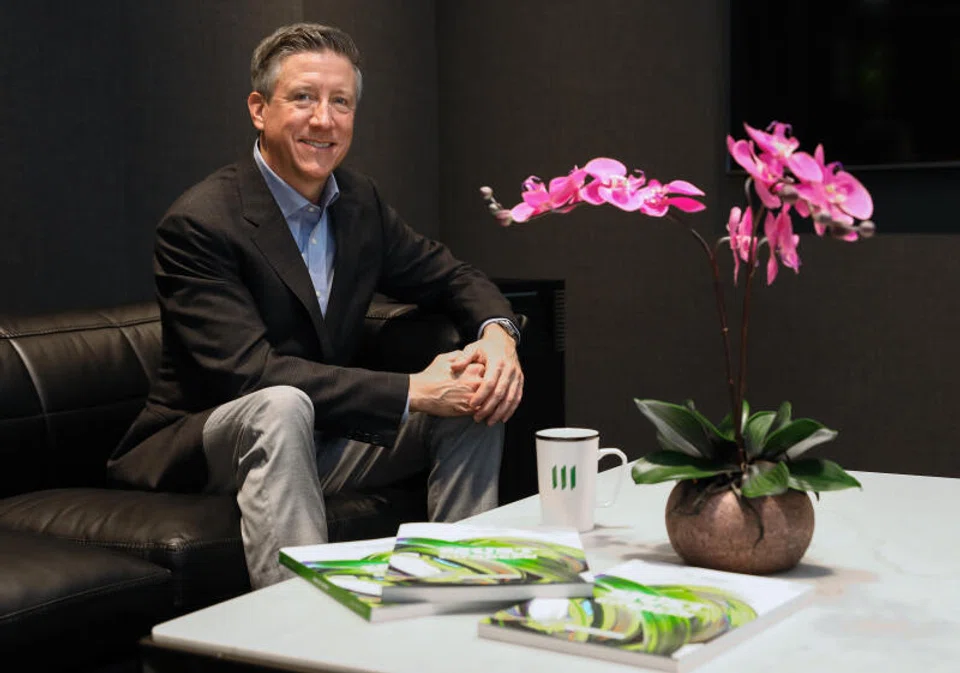
THE US office sector is facing its greatest identity crisis yet, as Covid-19 ushered in an era of hybrid work, and Tripp Gantt has just taken over the reins at pure-play US office real estate investment trust (Reit) Manulife US Reit (MUST).
Gantt, who was most recently the second-in-command of the real estate division of Washington State Investment Board (WSIB), a US pension fund with a US$29.6 billion in real estate assets under management (AUM), believes he is the right man for the job.
“My job has always been to look at both macroeconomic trends, sociological trends, and see opportunities that other people don’t see, and capitalise on them, and be decisive, take action, and actually make them happen,” Gantt told The Business Times.
The 52-year-old newly installed chief executive officer (CEO) of MUST’s manager was giving his first media interview since succeeding the Reit’s founding CEO Jill Smith, 68, on May 6.
His appointment comes as the Reit clocked a 52-week low of US$0.58 on May 26 – down 13.4 per cent year to date – following the release of its quarterly report, which saw a dip in portfolio occupancy: from 92.3 per cent as at end-2021 to 91.7 per cent as at Mar 31.
Having barely recovered from the Covid-induced plunge in March 2020, when prices fell to a low of US$0.555, the counter has returned -20 per cent since going public in 2016. The poor performance is stark when compared with the FTSE ST Real Estate Investment Trusts Index, which brought 15.5 per cent in total returns over the same period.
For those who reinvested their dividends into the security, the total return was 17.4 per cent, which translates to an annual equivalent of 2.7 per cent, compared with 59.7 per cent in the Index’s case, or an annual equivalent of 8.1 per cent.
The return on equity for MUST has been relatively low over the past few years, prompting questions as to what the new CEO can do to turn around the counter’s underperformance.
Focus on income
Gantt said he brings with him expertise in formulating and seeing through creative real estate strategies, as he cited his track record with growing WSIB’s real estate AUM from US$5 billion when he joined the pension fund in 2005 to US$27 billion by the time he left. MUST, in comparison, is a Reit with US$2.2 billion in AUM.
“WSIB’s mandate is to provide a long-term, high-quality income stream for its pensioners and, really, my job was devising strategies and implementing strategies to achieve that objective. That lines up really well with what a Reit does,” said Gantt, who joined the Reit as deputy CEO in January. “A Reit’s primary objective is to provide stable income and sustainable growth to its unitholders.”
It helped that WSIB did not invest like a lot of pension funds that limit their influence to capital allocation, he noted. His former job scope had him creating operating companies and investment management organisations that work only for WSIB outside the US, he said.
As an investment officer, he spent a substantial amount of time pounding the ground in Asia’s growth markets.
In fact, across the street from his current office on Cross Street sits a row of shophouses he had a hand in injecting life into — by helping to establish 8M Real Estate, a property investment company now with more than S$800 million AUM.
When he got involved back in 2012, historical shophouses weren’t seen as an institutional asset class yet. But Gantt said he saw potential for both strong income growth and capital appreciation.
“It’s supply and demand dynamics,” he said. “We saw that they’re not making any more of them, so there’s limited supply. We also saw that Singaporeans love to eat out, and we always try to focus on necessity – necessity real estate is what provides the most stable income stream, because it’s something that people have to use every day.”
Creative strategy, creative revenue
Gantt sees his first priority as putting MUST a step ahead of US employees’ slow return to the office.
Physical occupancy at MUST’s 12 properties had been a frustrating indicator to watch, rising from 11.1 per cent in the first quarter of 2021 to 29 per cent in the fourth quarter before yo-yoing between 25.3 per cent and 34 per cent this year.
Gantt himself noted that there are “a lot of conflicting signs” of what space needs are going to be and what office demand is going to be, so he has made it his first order of business to walk the ground and hear from tenants directly.
“Tenants have a lot of power right now in how much space they need, how much rent they pay… That’s largely a result of employees having a lot of power. Employers are having to look very carefully at what their employees want, and then that translates into their business needs,” he said.
Gantt said it is there important to identify the steadiest and broadest sources of demand.
He is entertaining several ideas, such as partnering with co-working operators to give tenants the flexibility they are looking for, and introducing dark kitchens to emptier carparks to tap the rise of food delivery.
He sees a spectrum of opportunities in the co-working space, and is assessing which would be the best fit for the Reit based on its assets and unitholders’ interests.
The car park idea could suit Figueroa, its 35-storey Class A office building located in the South Park district of Downtown Los Angeles, given its competitive advantage of being in the middle of the city, Gantt said. The property comes with an adjacent car park with 841 lots.
Focus on capital recycling, not accretive acquisitions
As of Mar 31, MUST’s top 5 trade sectors by gross rental income are finance and insurance (21.1 per cent), legal (19.1 per cent), retail trade (12.5 per cent), information (7.9 per cent), and real estate (7.2 per cent).
Gantt hopes to bump up the proportion of tenants that are in high-growth markets or come from sectors with secular tailwinds, such as technology and information services. Such tenants are “probably going to be the ones that have the healthiest opportunities for growth” over time, he added.
He expects to sell certain assets and recycle the capital to achieve this mix, rather than add on new properties.
This is also his answer to MUST’s relatively high indicative gross yield of 8.4 per cent. The higher this figure, the harder it is for the Reit secure yield-accretive acquisitions in the near future.
While MUST could dilute its yield by issuing more units, doing so could also alienate retail investors who might not want to cough up more cash.
MUST had raised some US$100 million through a private placement for institutional and accredited investors last November, to partially fund the acquisitions of 3 properties.
The placement was priced at US$0.649, an 8.9 per cent discount to the counter’s volume-weighted average price, and units of the Reit fell from a price of US$0.71 before the Nov 30 announcement to US$0.68 thereafter.
MUST’s chief investor relations and capital markets officer Caroline Fong said MUST decided on a private placement as it needed to seal the deal expeditiously.
A rights issue would have taken 6 to 8 weeks, she said, during which the sellers could have walked away upon receiving a more compelling offer from other buyers.
It would also have been a hard sell for banks to underwrite a 6- to 8-week fundraising exercise in the current volatile market environment, she added.
Said Gantt: “(The yield) is largely a result of our share price, which is going to be driven largely by our performance, so... there is a feedback loop.
“As long as we are at this kind of yield, we’re going to continue to focus on recycling opportunities, rather than trying to focus on finding new accretive acquisitions in the short term.”
In any case, Gantt said he doesn’t know of any companies that have had a successful equity offering this year: “I think the challenges that are out there in terms of that yield and that cost of capital are real.”