

S-Reits in good position to stave off challenges from competing Asian Reit markets

SINGAPORE’S real estate investment trust (Reit) market is facing increasing competition from up-and-coming counterparts across Asia, where the asset class is gaining popularity among investors.
But market watchers say Singapore-listed Reits (S-Reits) – currently the second largest Reit market in the Asia-Pacific outside Japan – are likely to stave off challenges from the likes of Hong Kong, India, Australia, the Philippines and Thailand.
There are some 43 S-Reits listed on the Singapore Exchange (SGX), with a total market value of more than S$111 billion – representing about 12 per cent of Singapore’s overall listed stocks.
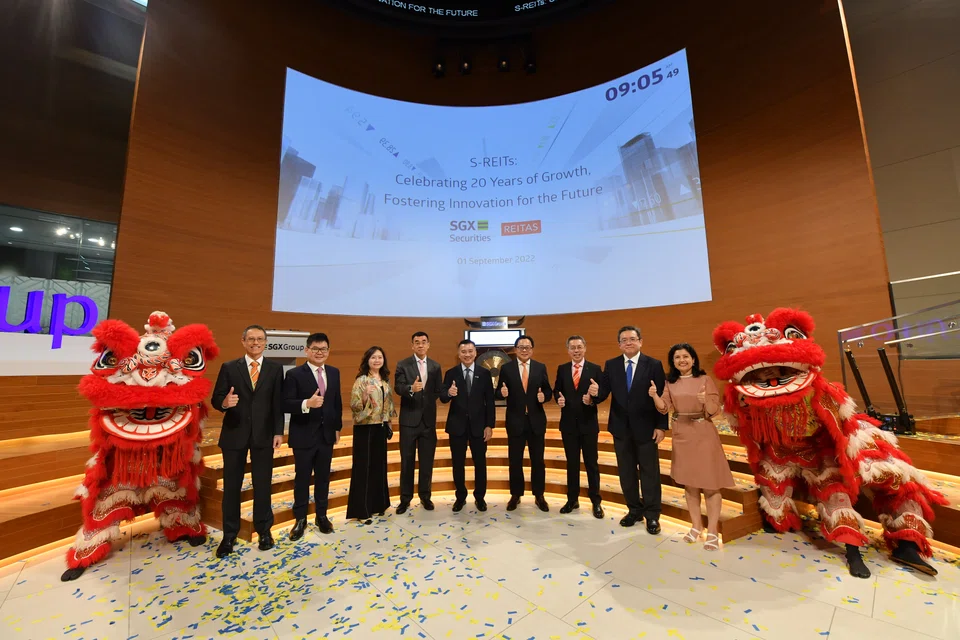
Speaking at an event organised by the Reit Association of Singapore (Reitas) on Sep 1 (Thursday) to celebrate the 20th anniversary of S-Reits, SGX Group chief executive officer Loh Boon Chye noted that Singapore’s Reits industry continues to be one of the fastest-growing in Asia.
“The standing of Singapore as a global Reit hub is well-established and is in a strong position to further innovate and capitalise on trends such as sustainability,” he said.
“As the ecosystem continues to deepen, we are focused on staying relevant for investors, to meet their demands for diversification and investment returns,” he added.
Ronald Tan, honorary ex-co member of Reitas and senior vice-president of the equity global market, global sales and origination at SGX, believes it would not be an easy task for other Asian Reit markets to dislodge Singapore from its position as a global Reits hub.
“People take it for granted, now that we have a lot of overseas assets. But when we first tried to introduce this to the market, it took a lot of effort, a lot of learning, a lot of reach-out and education,” Tan said.
Currently, some 80 per cent of S-Reits and property trusts hold offshore assets across the Asia-Pacific, North America and Europe. “People think that any platform will be able to do that, but that’s not necessarily true,” he added.
Gail Ong, head of equity capital markets at WongPartnership, said: “I expect Singapore to remain a popular venue for Reit listings due to the established regulatory framework for Reits, its favourable tax regime, successes experienced by many Reits and investor familiarity with the Singapore Reit market.” The law firm has a strong Reits practice that has handled a number of primary listings and secondary fund-raisings of Reits in Singapore.
At a press conference held in conjunction with the 20th anniversary celebration, Reitas vice-president Jonathan Quek recounted the various phases of growth for S-Reits over the years.
In the beginning were initial public offerings (IPOs) that comprised mainly domestic Singaporean assets. These were followed by predominantly Singapore based S-Reits going overseas and acquiring foreign assets.
More recently, the S-Reit market started seeing the listing of portfolios comprising purely foreign assets. Some of the largest global sponsors also started to list some of their assets here.
In addition, there has been a broadening in terms of sector exposure, with new asset classes such as data centres and student housing coming to the market.
“We do have quite large Reits now in Singapore, when you look at all these combined vehicles. To me, the next phase of growth is whether these Singaporean large Reits will go out into other markets and acquire Reits from other markets,” said Quek, who is also managing director and co-head of Asean banking, capital markets and advisory at Citigroup Global Markets Singapore.
“The future outlook is bright,” he added. “There’s been a tremendous amount of resilience that’s been built into this market. When you look at performance year to date in these very trying times, across Asia, the Singapore Reit market is probably the second best performing Reit market.”
He ascribed this strength to a diverse investor base for S-Reits.
“You have institutional investors, you have high-net-worth (individuals), you have retail (investors), you have a lot of foreign regional funds that invest in the S-Reit market that typically don’t invest in other Reit markets in Asia. So there’s a tremendous amount of resilience and diversity, which I think will put the S-Reit market in good stead,” he said.
TRENDING NOW

OCBC mobile, online banking services restored after Friday afternoon disruption

SGX CEO Loh Boon Chye to step down; succession planning under way

Waymo founder predicts ‘landslide’ robotaxi adoption in Singapore, driven by high car costs

Vietnam’s northern provinces, not Hanoi or Ho Chi Minh City, are powering near 10% GDP growth

