Renault expects to dodge slowing economies with revamped models
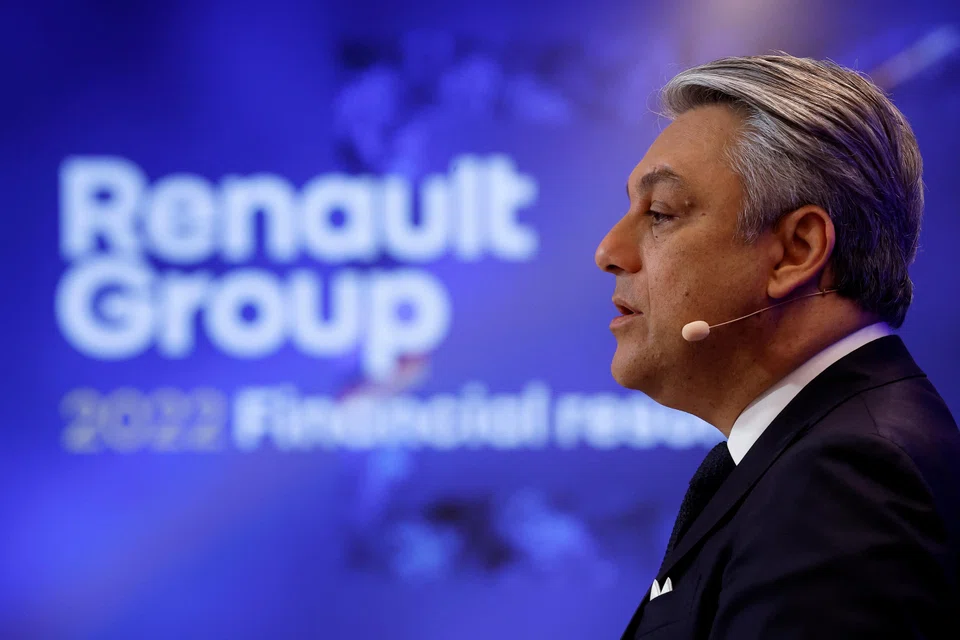
RENAULT offered an upbeat view of its mainstay market in Europe on Thursday (Feb 16), with an overhauled line-up to insulate the carmaker from an economic downturn.
The group said it expected margins to rise further this year, with a group operating margin at or about 6 per cent, up from 5.6 per cent last year. This came after it accelerated a turnaround plan. It explained that new models such as the Arkana and Megane e-Tech would keep prices firm, even as consumers fight a cost-of-living crisis.
Chief executive Luca de Meo said: “We are back in the game, and now we are ready to fly and to race. Free cash flow generation is at a historical level, and we are finally cash rich.” Renault forecast free cash flow to be at or above 2 billion euros (S$2.9 billion), around the record level hit last year.
The group also said it would resume dividend payments for the first time in four years.
Renault is pushing ahead on a deep revamp of its business, following this month’s landmark deal to reshape its troubled alliance with Nissan. The hard-won agreement caps a tough 12 months for the group, dominated by a costly withdrawal from Russia while navigating crippling chip shortages. While some of that pressure is easing, Renault still faces logistics troubles, with a lack of parts preventing vehicles from being delivered.
Chief financial officer Thierry Pieton said that record orders in Europe at the end of last year, equivalent to 3.5 months of sales, could stretch even longer due to logistics issues.
Rising earnings and the prospect of an alliance reboot have boosted Renault’s shares, making the stock the top performer on the Stoxx 600 Automobiles & Parts Index this year, with a market value of 13 billion euros.
Renault said that in 2022, semiconductor shortages shaved production by about 300,000. Carmakers, such as Volkswagen, are still struggling to source enough of the components. Many have prioritised the production of their higher-priced vehicles, and questions on when consumers might start to cancel longstanding deals have grown.
Goldman Sachs analyst George Galliers said that Renault’s “strong outlook goes against much of the autos narrative”.


Renault is moving ahead with a split of the businesses in five units, and will proceed with plans to work with new partners, including China’s Zhejiang Geely Holding Group and Qualcomm.
De Meo said that that Renault was also in talks with US car dealer AutoNation, to start selling Alpine sports cars in the US. But he added that the group was “not stopping here” on partnerships.
As part of the separation, Renault is planning an initial public offering of its carved-out electric-vehicle business, Ampere, in Paris “ideally toward the end of the year,” de Meo said. A lead for the new company is set to be named next month. It could seek a valuation of 10 billion euros, with Nissan pledging to invest in the venture.
Renault said it was also expecting to move forward with a joint combustion-engine business with Geely towards the middle of the year.
In November 2022, Renault outlined new medium-term targets for an operating margin of more than 8 per cent in 2025 and above 10 per cent by 2030. The group’s revenue in 2022 rose 11 per cent to 41.7 billion euros, with operating income more than doubling to 2.2 billion euros. BLOOMBERG
Decoding Asia newsletter: your guide to navigating Asia in a new global order. Sign up here to get Decoding Asia newsletter. Delivered to your inbox. Free.
Share with us your feedback on BT's products and services