

Resilient Europe turns into a winning bet for money managers
The Stoxx Europe 600 Index has rallied about 12 per cent in 2026
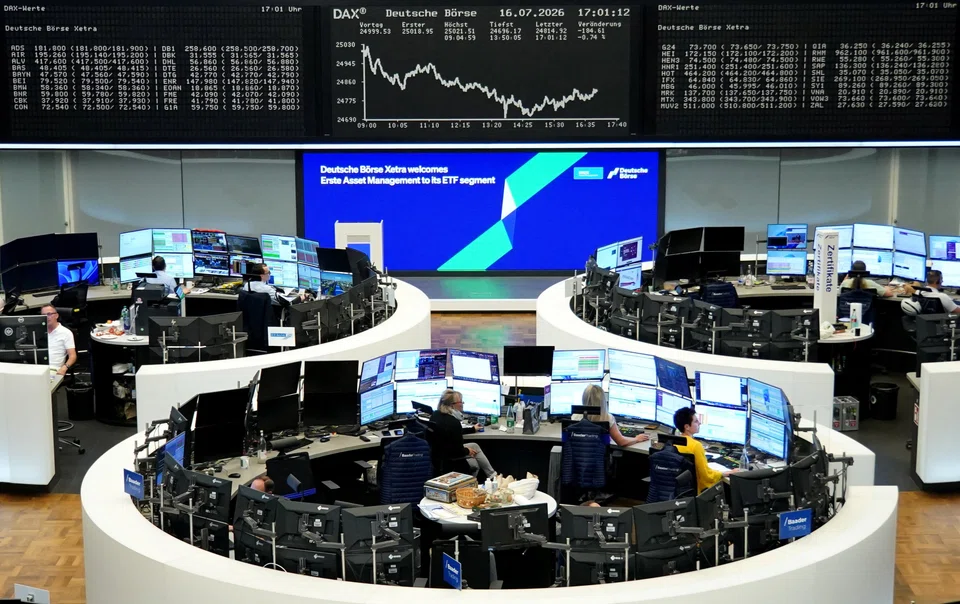
[BRUSSELS] European markets are charging ahead this year, defying doom-laden forecasts that the Iran war would tip the region into stagflation.
The Stoxx Europe 600 Index has rallied about 12 per cent in 2026, with benchmarks in Germany, Italy and France scaling record highs. German government bonds are outperforming US Treasuries, while the euro stands near a two-month high.
Investors are flocking to Europe’s stocks and bonds, drawn by the best earnings season in nearly four years and economic momentum that is picking up but remains cool enough not to trouble rate-setters at the European Central Bank. In particular, some bond funds say Europe looks appealing against the US given a lack of clarity around Federal Reserve policy.
“The economy is in a sweet spot that doesn’t require the ECB to hike rates as inflation isn’t out of control, and at the same time growth is strong enough to boost stocks,” said Sophie Huynh, portfolio manager at BNP Paribas Asset Management. “We’ve added some calls on European equities because there’s potential room for further upside.”
MSCI Europe constituents have reported a 17 per cent surge in second-quarter profits, the biggest jump since late 2022, according to data compiled by Bloomberg Intelligence. Sectors that are more sensitive to economic growth, such as miners and industrial goods, are among the biggest contributors.
“People are really attracted to the earnings resilience,” said Helen Jewell, international chief investment officer for fundamental equities at BlackRock Inc. Europe’s broader exposure to artificial intelligence is also helping, allowing investors “to play the AI theme in a less risky way than the more concentrated nature that you might see in pockets of Asia and the US.”
After initially rewarding mainly US stocks that are spending hundreds of billions of dollars to enable AI, market participants are turning to companies that will benefit from adopting the technology. A Bank of America Corp basket of European AI adopters has rallied 14 per cent so far this year, compared with a 4 per cent advance in the US hyperscalers.
So far this year, European equities have attracted the strongest inflows in a decade, excluding 2021, driven almost entirely by foreign investors, according to a note from Goldman Sachs Group.
Bond investors are also turning to Europe as the region’s improving growth outlook still lags other major economies. The euro area’s real gross domestic product is projected to rise by 0.8 per cent and 1.2 per cent in 2026 and 2027, respectively, trailing increases of 2.2 per cent and 2.1 per cent forecast for the US, according to data compiled by Bloomberg.

The ECB has raised rates by a quarter-point once this year, and is expected to hike twice more by the middle of next year, to contain the inflationary shock sparked by the war. But the lukewarm outlook for growth is helping to sustain demand for euro-area debt, particularly as fiscal and policy risks become harder to price in markets such as the US and Japan.
“European government bonds remain attractive for international investors,” said Erik Liem, a rates strategist at Commerzbank. “The ECB has already reacted to the Iran shock and its policy path is easier for markets to predict, compared with the Fed where communication is shifting in a new direction.”
The gap between 30-year Treasury and German yields hit its widest in a year last week as investors question the Fed’s credibility and the longer-term fiscal trajectory. Europe is not immune to fiscal pressures, with elections in France and Italy next year a potential risk, but for now they are viewed as less acute.
The shift in sentiment is showing up in cross-border flows. Japanese investors bought French sovereign debt last month, while selling US Treasuries and Australian bonds, according to Japan’s latest balance-of-payments data.
Euro government bond ETFs saw net inflows of over 1.45 billion euros (US$1.7 billion) in July, more than double the 655 million euros that flowed into dollar government bond ETFs, according to Morningstar.
Improving demand for European assets can also be seen in the euro, which touched a seven-week high on Friday and currently trades above US$1.15. While that partly reflects broad dollar weakness, MUFG forecasts the common currency will rise to US$1.20 by the middle of next year as reserve managers diversify their currency holdings.
“The euro is the number one currency in terms of increasing exposure to over the next 12 to 24 months,” said Derek Halpenny, head of research at MUFG Bank Ltd.
Still, some market participants remain skeptical about how long the renewed optimism toward Europe will last.
Oil prices are nearly 26% above a July low, and a deal to fully reopen the Strait of Hormuz remains elusive. Low European reserves of liquefied natural gas and rising global food prices could add to inflationary pressures later this year.
While the bond market is likely fully pricing ECB rate hikes, fiscal deterioration and political uncertainty will dent sentiment, according to James Athey, a money manager at Marlborough Investment Management. He also prefers Japanese stocks to European equities for exposure to the economic cycle.
For Duncan Toms, a multi-asset strategist at HSBC Holdings, Europe’s attraction hinges on how quickly investors rotate back into stocks that have led the AI trade, including semiconductors.
“As we think the momentum unwind is largely done, from a relative perspective a renewed pick-up in semis makes it hard to see European outperformance as sustainable,” Toms said. BLOOMBERG
Decoding Asia newsletter: your guide to navigating Asia in a new global order. Sign up here to get Decoding Asia newsletter. Delivered to your inbox. Free.
Share with us your feedback on BT's products and services
TRENDING NOW

MSCI proposes standalone status for Indonesia; Jakarta stocks plunge 8%

Palm oil stocks slide after Singapore begins looking into which firms responsible for haze

High Court rules against Julius Baer’s Singapore trust arm in US$50 million family trust dispute

Why is the haze so bad in South-east Asia this year?

