Restoring trust in financial services
Financial institutions need to work a lot harder to earn longstanding customer trust
Singapore
THERE is no "future-proofing" the financial sector from fallouts such as the recent Archegos Capital collapse, but financial institutions can learn by re-examining the processes to identify and understand the flaws and risks that led to the saga, said a top executive from UBS.
"Be risk aware, but in my business you can't be risk averse. Occasionally, you get that (Archegos episode) in the financial sector because it is very competitive . . . there is over exuberance. But there is no future proofing of such issues," said Edmund Koh, president of UBS Asia-Pacific.
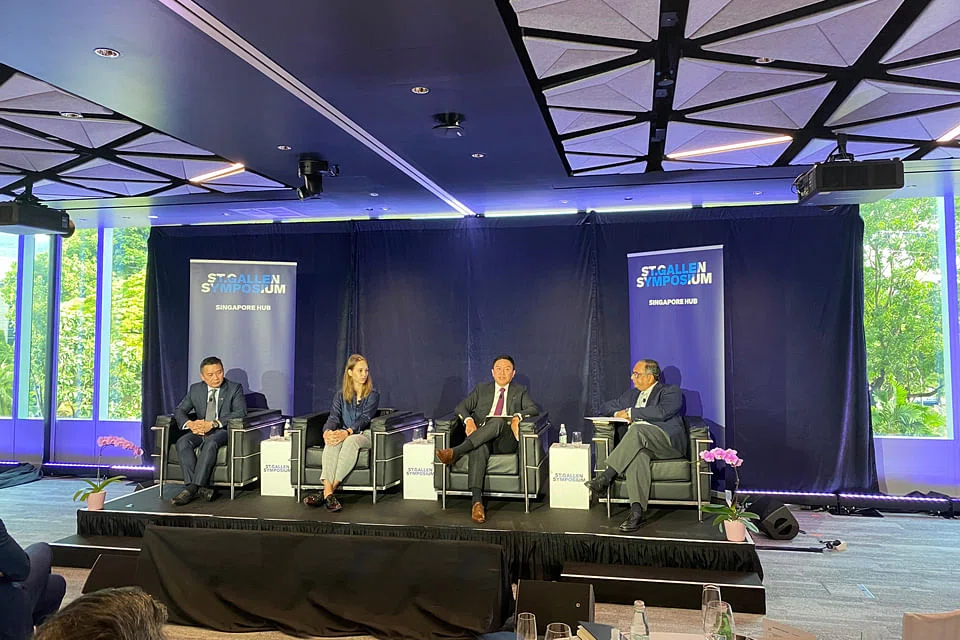
Mr Koh was responding to a question posed by The Straits Times associate editor Ravi Velloor during a panel discussion entitled "Trust in financial services" on the second day of the St Gallen Symposium hosted by UBS at its brand-new UBS University in Singapore.
"Can we be trusted? Well, if you look at the capital provided and the honest truth of coming out to admit to it and the process in which you deal with it - it is what it is. You have to deal with it," he added.
Banks are facing billions of dollars in losses after US-based Archegos, set up as a so-called family office, failed to meet margin calls.
It had used financial derivatives to take huge bets without disclosing them to banks and regulators. The episode sent shock waves across financial markets, and Archegos is reportedly preparing for insolvency.
Mr Koh also spoke about the shift from brick to click, and how the aggregation of technology in banking could increase the trust factor.
"(That's) because we (banks) will then be able to take central data and hopefully in future, prevent much of the positions like Archegos and the rest. I firmly believe that data science, algorithms and the extraction of a central data pool will have to happen in the course of the next three to five years . . . sooner rather than later," he added.
To a question by Mr Velloor on how banks could get people to trust them the way they trust their doctors, the Singapore Exchange's chief executive officer Loh Boon Chye replied that similar factors from capabilities and expertise to credentials and reliability would apply.
"If you trust your doctor, you would probably find these characteristics. For the financial system, if it exhibits reliability, consistency, transparency . . . and builds them over time, then it will earn the trust," said Mr Loh.
Swiss fintech vestr's head of Apac operations Lisa Schroder said startups have to work especially hard as they lack the trust as newcomers, and need to approach and actively engage clients to understand their needs.
"This is also very much needed with traditional financial institutions - a better understanding of what they mean with their statements and engaging . . ." she added.
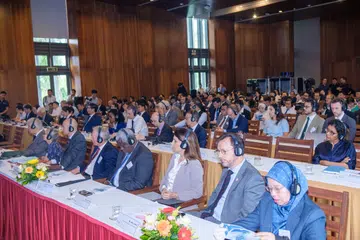
The 50th edition of this year's St Gallen Symposium is being conducted in a hybrid format, with live panels and discussions streamed from four global hubs - St Gallen in Switzerland, Singapore, New York and London.
This is also the first time Singapore is holding an event concurrently with the actual symposium in Switzerland.