Rex seeks oil in Oman to steady topline growth
Oil E&P player is armed with proceeds from divestment in Norway and a surging share price.

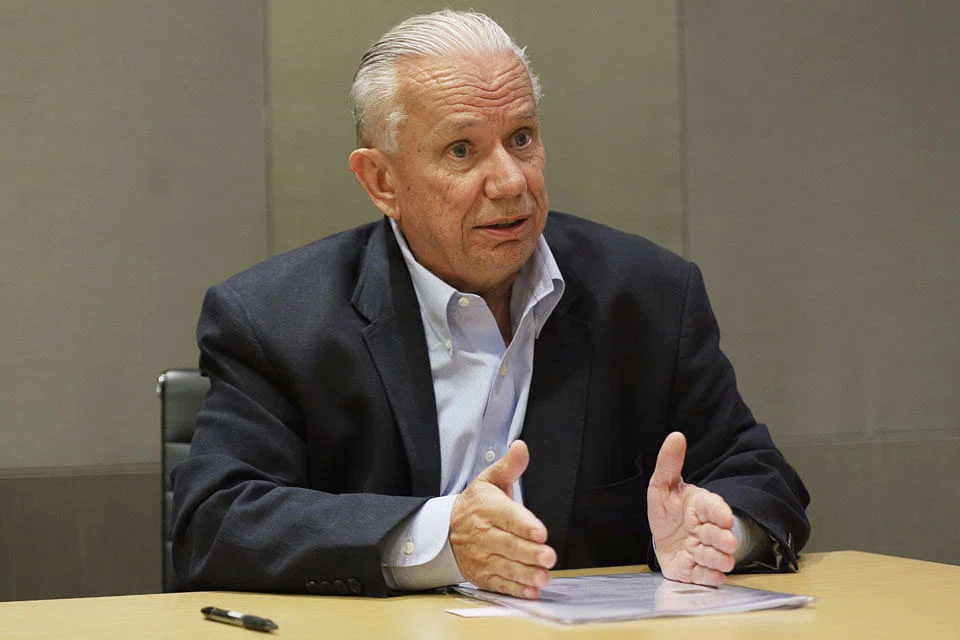
REX International Holding is in the thick of assessing the production capacity of its oilfield asset in Oman. The Catalist-listed firm sees itself progressing towards a robust revenue stream with this move, on the back of stabilised oil prices, executive chairman Dan Broström told The Business Times.
In late December, Rex, an oil exploration and production (E&P) firm, announced that its 92.65 per cent-owned unit, Masirah Oil, is drilling an appraisal well in the Yumna oilfield within its Block 50 concession in Oman. Masirah fully owns the offshore concession.
"Oman is important for us to succeed in because that gives us ... recurrent cash every month; producing and selling (oil). When you have that, you feel much more certain that you can start doing dividends and things like that, because then you have money coming in all the time," Mr Broström said, noting that this will be the first time Rex heads into oil production.
Rex has not paid out dividends since its listing in 2013, but it is "on the wishlist" and could be realised if the Omani venture takes off, he added. While Rex has largely stayed net cash positive since going public, it had been in the red until FY2018. Its shares had meanwhile fallen each year, save for a recent rally on the back of profitability (see chart).
Rex aims to kick off oil production from the Yumna oilfield this month. The drilling of the appraisal well will help it find out the approximate volume of oil that can be produced and decide the production period. Rex has set its minimum production target at 5,000 barrels of oil per day.
After the results of drilling the appraisal well are ready and analysed, Rex may consider issuing an independent qualified person's report on Yumna, subject to regulatory requirements.
Masirah had in fact discovered oil in Oman way back in 2014. Mr Broström dubs the discovery a "feather in the hat" for the company's Rex Virtual Drilling technology, which uses seismic data analysis to detect liquid hydrocarbons.
But after oil prices crashed from over US$100 per barrel to about US$40 that year, and later sank below the US$30 mark, Rex held off drilling an appraisal well.
"We had to wait because of the oil prices; we couldn't tell our shareholders that we are going to spend millions of your money, but there is no way that we can make money from the well. That wouldn't have been right," Mr Broström said.
"So, we just had the well plugged for a while. In the end, when we could make a calculation that made sense for the company and shareholders, then we said okay, now we'll drill an appraisal well," he added.
In 2019, oil prices stabilised largely within the range of US$55 to US$70 per barrel. Mr Broström reckons that a price of at least US$60 per barrel can produce comfortable margins.
Analysts have echoed this optimism on oil prices, albeit cautioning volatility. Howie Lee, an economist at OCBC Bank, forecasts Brent crude at US$68 per barrel in 2020, on the base case that the Organization of the Petroleum Exporting Countries (Opec) retains existing supply quotas through 2020, he said in a Dec 11 report.
Mr Broström acknowledges that he can't be absolutely certain which way oil prices will flow, but he believes that Rex can adapt to any shifts with its clean balance sheet. The company had US$41.4 million in cash and no non-current borrowings on its books as at end-September 2019.
Rex is now pumping some of that cash into Masirah. In late December, Masirah entered into agreements to issue US$21.5 million in preference shares to Rex Oman and other parties including Trace Atlantic Oil - an entity linked to Rex's controlling shareholders Karl Lidgren and Hans Lidgren - and Masirah's management member John Pringle. Upon completion, these transactions will lower Rex's stake in Masirah to 86.37 per cent.
Noting that Block 50 is about 17,000 sq km, or roughly 23 times the size of Singapore, Mr Broström said: "It's a very big block and that means that if we successfully commence production from Yumna, then we can copy-paste what we are doing there into a number of other places we have already identified nearby, in Block 50," he said.
While Rex is just picking up the pace in Oman, the company's stock has already soared far ahead. Its share price more than tripled in 2019, outperforming 27 other oil and gas counters on the Singapore Exchange. The rally appears to be driven by positive news flow from Rex's other core market, Norway.
In mid-October, the company announced that an oil discovery had been made in the Shrek prospect in the Norwegian Sea, under the PL838 licence. Rex's 90 per cent-owned unit, Lime Petroleum, holds 30 per cent of the licence. After the announcement, Rex's share price rose over 130 per cent through to the end of 2019.
The company has also been in the black in recent quarters, spurring hope that FY2019 could mark a second profitable full year. For the nine months of FY2019 ended September, Rex recorded a US$23.2 million net profit, reversing the US$6.4 million year-ago loss.
Rex's income was mostly buoyed by the divestment of its 30 per cent stake in the Rolvsnes discovery and 20 per cent stake in the Goddo prospect in Norway for US$45 million, contributing to the US$32.7 million in other income it recorded for 9MFY2019. The buyer was Lundin Norway, the operator of both prospects.
The sale is in line with the original business model that Rex touted in its IPO prospectus - to spin off mature assets to recycle capital, Mr Broström noted. Rex still has three other assets in Norway, worth an estimated US$20.7 million, according to a Dec 12 report by UOB Kay Hian.
Divesting the Shrek prospect in a similar fashion to Rolvsnes could be an option. "We know that there is already interest in the market to buy our shares ... The model in Norway does not exclude going all the way to production. But if we get people that knock on our door again and say, we like your participation in this one, we would like to buy your percentage, and they offer us a good price, we'll entertain that," Mr Broström said.
Divestment gains can be an unstable source of income, but that model makes more sense in Norway because of the long turnaround time to head into production. Oil production in Oman, which has a quicker turnaround, will make up for this shortfall, Mr Broström said.
"You have one area, where you get cash coming in all the time, then you have another area where you can go in and out, and suddenly do a smashing deal. That's quite an interesting business model for a company, where you can have two areas that complement each other," he said.
While it remains to be seen how Rex's bid for oil in Oman plays out, early optimism is brewing. UOB Kay Hian initiated coverage of Rex with a "buy" rating and S$0.218 target price, about 1.1 times its forward book value for FY2020, below the 1.3 average of seven E&P peers.
Analyst Llelleythan Tan believes that Rex, which trades at 0.8 times forward FY2020 book value, is "deeply undervalued". In particular, he sees value in the 78 per cent tax refund Rex enjoys in Norway for exploration costs. The company has been using the extra cash to pay off debt, keeping its balance sheet clean, Mr Tan told BT.
Masirah's move to raise US$21.5 million in equity, rather than debt, is similarly wise, he added.
"Many of the oil companies, before the 2014 oil crash, had (a lot of) debt on their balance sheets. Rex was one of the few that did not, and they managed to survive ... By doing this again, I think it's very prudent ," he said.