S-Reits' acquisition blitz set to hit S$10b in 2020 despite Covid-19
But not all buys boosting DPU, as some managers trade DPU accretion for diversification and income stability
Singapore
SINGAPORE real estate investment trusts (S-Reits) are back in the buying game, spurred on by low interest rates, higher debt capacity under an enhanced gearing limit allowed by the central bank, and pent-up from the transaction slowdown in the first two quarters of this year.
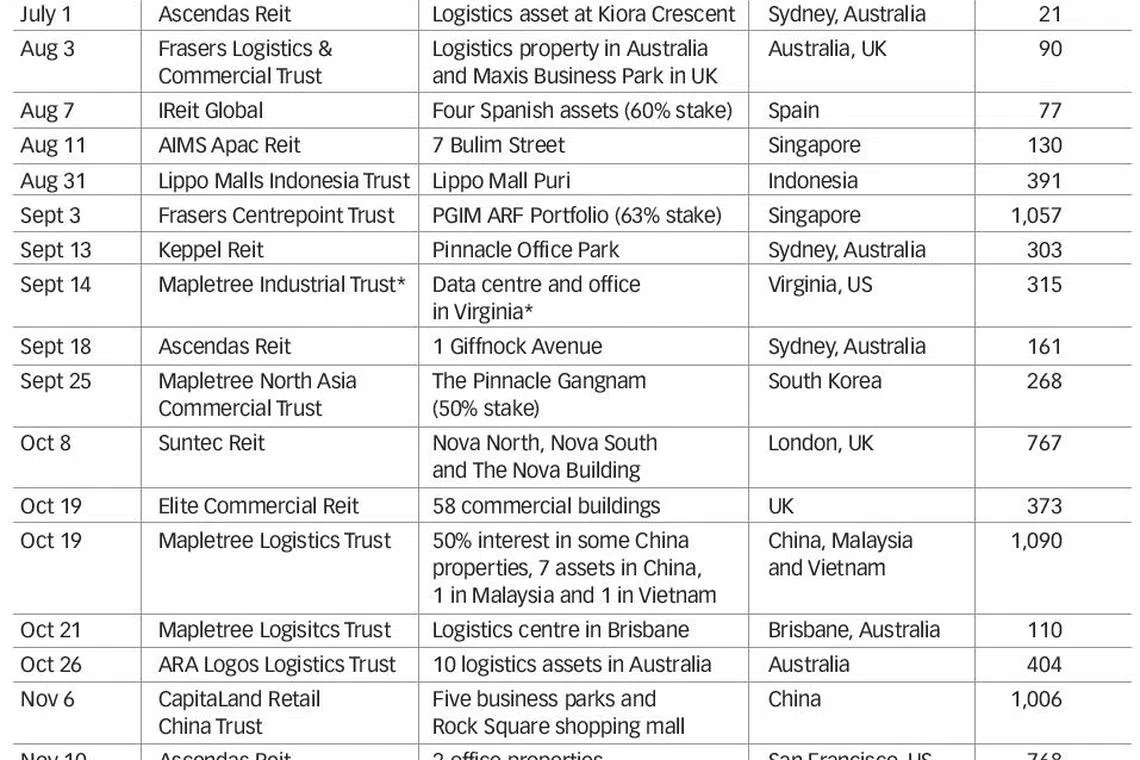
Since July, S-Reits have announced S$7.3 billion in acquisitions, compared to about S$1.4 billion in the first half of the year.
The management of Ascendas Reit on Tuesday told analysts that on top of its proposed acquisition of two San Francisco office properties, it is also planning to buy a portfolio of data centres in Europe and a suburban office property in Australia, subject to negotiations and due diligence. Including the US office assets, the total purchase price would add up to about US$2 billion.
That, analysts say, could easily bring S-Reit's total acquisition quantum in 2020 to S$10 billion, on par with the S$10.5 billion and S$10.2 billion in acquisitions in 2018 and 2019, respectively. It would appear that Covid-19 did not create any dent in their acquisitive appetite at all.
In a September report, DBS analysts had noted: "S-Reits are now ready to acquire and grow, taking advantage of any potential pricing dislocations in the geographical markets that they operate in. We believe that opportunities are likely to stem from their respective sponsors who may also look to recycle capital to boost their respective return on equity."
Going forward and continuing into 2021, most of these acquisitions are likely to be overseas, as S-Reits look to diversify their geographical and earnings exposure, they added.
The industrial subsector is expected to generate more deals, especially in the "future-proof" data centre, logistics and business park space, given that they currently enjoy the "cheapest cost of capital in decades" at about 3.7 per cent, assuming a funding model of 60 per cent equity and 40 per cent debt funding, DBS said.
Meanwhile, industrial assets in S-Reits' favourite locations such as Asean, Japan, Australia and China have asset yields of 5 to 7 per cent, versus the sector's FY21 dividend yield forecast of 4.86 per cent, which make finding acquisitions accretive to their distribution per unit (DPU) a lot easier.
DBS expects accretive acquisition growth to propel S-Reits' earnings and complement their DPU recovery forecast of about 13 per cent in FY21.
Maybank Kim Eng analyst Chua Su Tye added that the Monetary Authority of Singapore's raising of the leverage limit for S-Reits from 45 per cent to 50 per cent to help them manage their capital structure amid Covid-19 also helped to support Reits in their acquisition growth. Most S-Reits, even after their transactions, still maintain a leverage limit well within the initial 45 per cent limit, he added.
But there are some S-Reits that are fast approaching 45 per cent as at end-September, such as ARA US Hospitality Trust (43 per cent), Suntec Reit (41.5 per cent), and ARA Logos Logistics Trust (40.5 per cent).
Not all acquisitions are equal, too. Some have purchased assets for more sustainable income growth, but at the expense of accretion to DPU.
For instance, two weeks ago, ARA Logos Logistics Trust said it would buy five properties in Australia from its sponsor, Logos Property Group, as well as invest in two of the sponsor's funds at a blended 5 per cent net property income yield, all for S$404 million.
Mr Chua said: "It will gain immediate scale in its core market, as the assets will boost its assets under management by 28.2 per cent, and deepen its Australian contribution from 32.5 per cent to 47.6 per cent. Importantly, the assets are backed by a long 11-year weighted average lease expiry, which will improve its DPU visibility."
He acknowledged that the deal is dilutive to both DPU and net asset value per unit, partly because of the Reit's own high yield at about 8 per cent.
"The Reit likely was not ready to miss this opportunity from its sponsor's pipeline. The market for well-sited modern logistics in Australia is tight, and so the same portfolio is likely to be priced at a 4.5 per cent cap rate from third parties," he pointed out.
RHB analyst Vijay Natarajan also noted that IReit Global's proposed acquisition of a 60 per cent stake in a Spanish portfolio of offices would similarly lower the Reit's DPU by more than 8 per cent post-purchase, mostly because of its equity financing through a rights issue, but this was because the Reit also had to exercise a call option within a certain time frame following its acquisition of the earlier 40 per cent stake in December 2019.
Mr Natarajan said that IReit's management had indicated that it wanted to shore up capital for growing and diversifying their portfolio, which explained the resulting funding structure.
"They want to grow more, and don't want to have to keep tapping on markets, so they decided to take advantage of the opportunity since the price has risen (in August), plus they want to maintain that debt headroom."
Its unit price has fallen about 18 per cent since it announced its purchase in early August.
Mr Natarajan said that with capitalisation rates not too compressed yet across asset classes, and S-Reits' continued ambition of diversifying their portfolios in geography and asset size, managers are willing to give and take.
"Some of them are willing to trade DPU accretion for more diversification and income stability," he said.
READ MORE: Ascendas Reit to raise S$1.2b for US, Europe, Australia acquisitions