Sabana's activist investors to fast-track plan to internalise management after merger with ESR scuppered
Sabana Reit's manager says its priority is to enhance the Reit's portfolio returns and complete an asset-enhancement project
Singapore
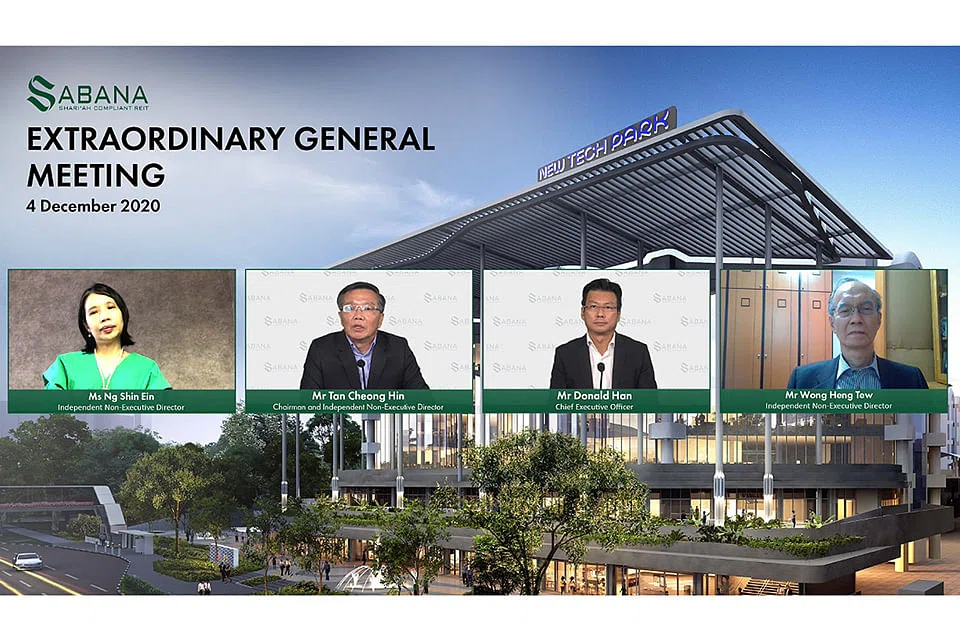
ACTIVIST unitholders got to work fast after the proposed merger between ESR-Reit and Sabana Reit fell through on Friday.
The question "What next?" was top on their minds to ensure a clear path to recovery for Sabana Reit, and one answer was to pursue an internalised Reit management model - an unprecedented move for a Singapore Reit.
In an e-mail to unitholders, Quarz Capital and Black Crane Capital said: "Given the substantial independent unitholders' support, we are fast-tracking the internalisation proposal for Sabana Reit to further expedite on improving the value for all unitholders... The work starts now!"
At Friday's extraordinary general meeting (EGM), exactly a third of the votes were cast by Sabana Reit unitholders opposing the amendments to be made to the Sabana trust deed to allow for the scheme to take place. This was a prelude to the execution of the scheme. Votes representing 192.04 million units or a 33.33 per cent stake were against the resolution. Votes representing 384.16 million units, representing a 66.67 per cent stake, voted in favour.
An extraordinary resolution has to be carried by a majority of at least 75 per cent of the total votes cast. As a result, the scheme meeting to vote on the merger was not convened. As the merger was conditional on unitholders' approval for the amendments of Sabana Reit's trust deed, the implementation deal the manager earlier inked terminated, and the merger lapsed.
The EGM lasted no more than 10 minutes. Following the no-deal outcome, Donald Han, chief executive of Sabana Reit's manager, said in a statement that the manager respected the unitholders' decision: "While we believe the merger has a compelling strategic rationale, unitholders have expressed that they prefer Sabana Reit to remain as a standalone Reit. We are heartened by their confidence in Sabana Reit's prospects and remain committed to continue creating value for all unitholders." He added that the manager had been "working hard" to increase the portfolio's occupancy rate and that this remained a priority. Discussions with existing and prospective tenants to renew leases and secure new ones are also ongoing.
"We are also exploring other potential portfolio rejuvenation opportunities in a prudent manner, balancing the need to be cautious amid ongoing macroeconomic uncertainties, and the need to grow," he said.
Asked if it would be open to an internalised manager model, Sabana Reit's manager said its immediate priority is to enhance the Reit's portfolio returns through leasing activities, and completing the asset enhancement initiative at New Tech Park in Lorong Chuan. This is the first time a Reit merger has been voted down by unitholders. The consolidation trend in the sector began just two years ago with the marriage of ESR-Reit and Viva Industrial Trust, which was completed in October 2018. Quarz and Black Crane noted that independent unitholders' turnout was also among the highest at Friday's EGM.
Unitholders holding a combined stake of close to 55 per cent of the Reit voted. About 36 per cent in unitholding (of the entire Reit) voted for the merger, and about 18 per cent voted against, including the 11 per cent owned by Quarz and Black Crane. According to the scheme document, ESR Cayman and its entities and substantial investor Tong Jinquan owned about 24 per cent in the Reit.
Jan Mörmann, chief investment officer of Quarz, said the outcome underscores the lack of confidence that independent unitholders have in the current board and manager of Sabana Reit, and sends a strong signal that boards and managers should not ignore minorities who can band together to safeguard their rights to ensure their investments are managed well.
The fund managers also said they have laid a clear path for the Reit manager to immediately execute in order to increase distribution per unit and unit price for all unitholders. These include plans to rent out the retail component at the Lorong Chuan asset, and removing Shariah compliance to lower finance costs.
To be sure, Croesus Retail Trust, a business trust, had in August 2016 successfully internalised its trustee-manager; a year later, however, the trust was privatised and delisted by Blackstone.
"If the existing manager is unable to execute, they should resign and allow professionals with the right expertise and skill set to contribute to the Reit," the fund managers said.
CGS-CIMB analyst Eing Kar Mei said the no-deal will not have any fundamental impact on ESR-Reit. "It will be business-as-usual for ESR-Reit, although it would take longer for it to be included into the index."
Not everyone was happy with the outcome, however. Chew Yi Hong, an observer of the corporate governance scene, called the outcome a "lose-lose" for the Reit and its unitholders.
"Firstly, the board pushed ahead with the scheme, knowing that they did not have the support of big minority unitholders ... (Secondly), how much professional fees did the board and the manager chalk up for unitholders? Are they footing the bill? No!"
He said the Reit manager should have focused more on managing its portfolio instead of rebutting activists and other market commentators to defend its actions.
Meanwhile, on Friday morning, unitholders of ESR-Reit voted overwhelmingly in favour of a merger with Sabana Reit, with 98.91 per cent supporting the merger.
Both Reits have requested to lift their trading halts and will resume trading on Monday.