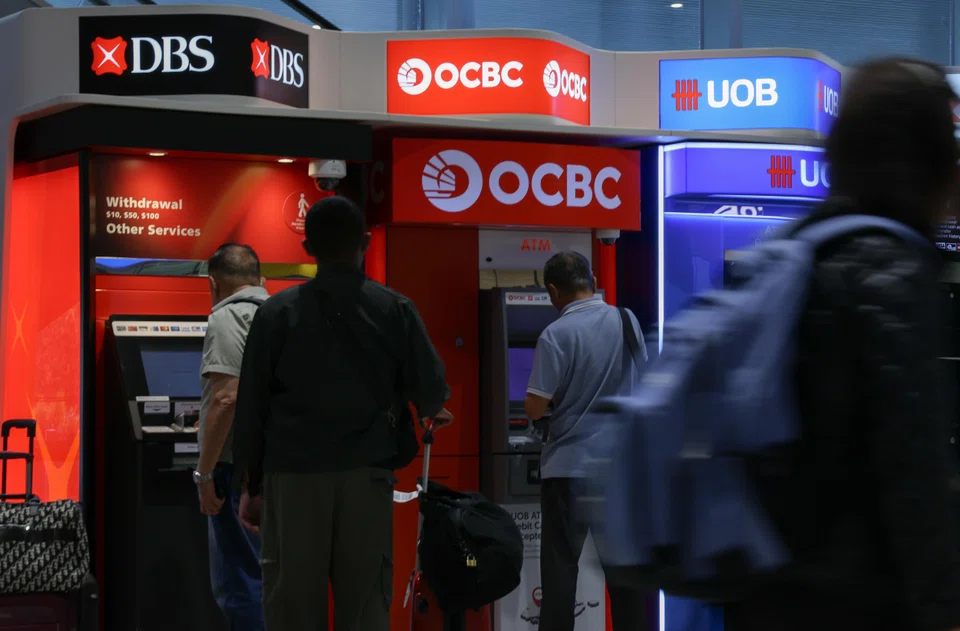
Safe-haven flows, no Q1 Fed cut support positive earnings outlook for DBS, OCBC, UOB: analysts
All 3 lenders have little to no exposure to private credit risks, management teams say

[SINGAPORE] Singapore’s three local lenders – DBS, OCBC and UOB – could see first-quarter net interest income supported by safe-haven deposit inflows linked to the ongoing Middle East war, analysts said.
The boost also comes as the US Federal Reserve backed away from previously expected rate cuts in the first quarter after fuel prices surged, though this may be partly offset by lower benchmark rates in Singapore and Hong Kong during the period.
The next Fed meeting is later this week, with analysts expecting the central bank to keep rates unchanged.
Last Wednesday, (Apr 22), a Reuters poll of more than 100 economists showed expectations that the Fed would wait at least six months before cutting interest rates this year.
“We expect robust deposit growth across the sector – partly from safe-haven flows,” said Maybank analyst Thilan Wickramasinghe in an Apr 23 report. He was referring to inflows linked to the US-Israel-Iran war, which began on Feb 28.
DBS is expected to kick off the first-quarter earnings season on Apr 30, with UOB due to report on May 7 and OCBC on May 8.
As at last Friday, analysts polled by Bloomberg forecast on a median basis that DBS would post a net profit of S$2.88 billion in Q1, from S$2.9 billion a year earlier.
For OCBC, consensus stood at S$1.88 billion, unchanged from the previous year, while UOB was expected to report S$1.41 billion, from S$1.49 billion.
While the full benefit of safe-haven inflows is likely to be felt in the coming quarters – given there was only a little over one month between the conflict’s start and the end of the Q1 reporting period – DBS, the largest of the three banks, had already pointed to deposit growth from such flows on Mar 26.
“If the current elevated oil price situation remains for a prolonged period due to the Middle East conflict, inflows could pick up pace in Q2 and Q3,” Carmen Lee, head of equity research at OCBC, told The Business Times.
Analysts expect the banks to deploy part of these deposits into high-quality liquid assets such as government bonds, which should provide an earnings lift.
However, this would dilute net interest margins, said Rena Kwok, senior credit analyst at Bloomberg Intelligence, as yields earned on high-quality liquid assets are typically lower than those generated from customer lending, dragging down overall margins.
That said, lenders are likely to prioritise “fortress balance sheets” – referring to a financial strategy centred on strong capital levels and ample liquidity – as well as absolute net interest income growth over aggressive margin expansion, Kwok said.
Apart from this dilution effect, interest margins could also come under pressure from lower benchmark rates in Singapore and Hong Kong. In Q1, the three-month compounded Singapore Overnight Rate Average fell 12 basis points, while the three-month Hong Kong Interbank Offered Rate declined 58 basis points.
Wealth and trading seen supporting fees
Lim Rui Wen, analyst at DBS Group Research, also pointed to wealth management, and trading and markets as likely growth drivers.
“Wealth management remains the key FY2026 driver, with inflows emerging as a new catalyst,” Lim said in an Apr 20 report. “Based on our channel checks, early-2026 momentum remained largely intact despite volatility, despite some pullback on risk appetite during March.”
Still, weaker sentiment may have weighed on wealth fees as investors turned more cautious, Lee warned.
“Fee and wealth income should be good for two out of three months – January and February – before the Middle East conflict in late February, which would have reined in fees in March,” she said.
For the trading and markets segment, stronger capital markets activity could support investment banking, advisory and brokerage fees, Wickramasinghe said. “With one month of the US-Iran war in the quarter, there is potential for higher customer-led trading income as clients hedged volatility.”
There could also be “upside surprises” in trading income, similar to trends seen in recently concluded first-quarter results from major Wall Street banks, he added.
On asset quality, analysts broadly expect the three banks to remain largely unscathed by the conflict because of their “immaterial” exposure to the region – a point also made by management teams at their respective annual general meetings in recent weeks.
However, the lenders “may take the opportunity” to book general provisions due to changes in macroeconomic assumptions, Lim wrote.
“Singapore banks remain in a strong position to deal with headwinds, with non-performing asset coverage ratios of (between) 97 per cent and 151 per cent across the banks,” she added.
All three lenders also have little to no exposure to private credit risks, management teams said previously at their annual meetings, amid concerns over the US private credit market.
Said Lee: “For now, we are not expecting higher provisions, as we do not expect any major exposure to the Middle East or any major deterioration of asset quality.
“While most investors are familiar with the first order impact from the current crisis, it is good to watch for second order impact on the region’s outlook for the coming quarters.”
In the year to date, shares of DBS, OCBC and UOB were up 0.9 per cent, 9.4 per cent and 2.1 per cent, respectively, as at last Friday’s close.