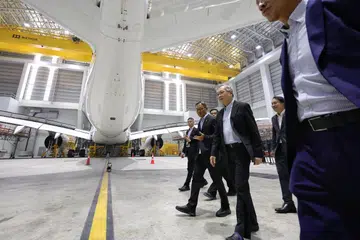
Safe as houses, from Singapore to Qatar
Founding CEO of Certis Cisco talks about the Temasek-owned security firm's global expansion

Annabeth Leow
Singapore
REAL-LIFE emergencies are rare in Singapore, but that is no barrier to business for a billion-dollar security firm here, says its boss.
State-owned Certis Cisco is instead tapping 60 years of experience, backed up by new technology, to offer a bespoke suite of security services - more than just warm bodies in blue - both in the Republic and abroad.
First a police unit, then a Home Affairs statutory board, Certis Cisco became a wholly-owned subsidiary of national investment firm Temasek Holdings in 2005. Beyond its base here, Australia and Hong Kong are core markets, alongside countries such as Qatar and the United Arab Emirates.
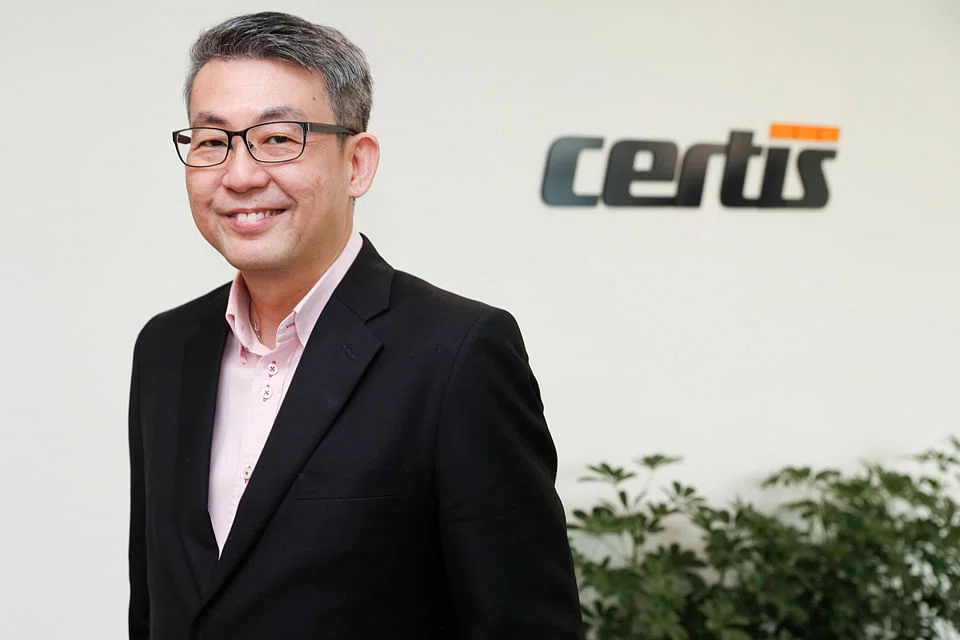
Founding group chief executive Paul Chong said: "Today, Certis is more than just a security company. In fact, we've coined a new phrase. We call it 'security-plus', to represent what we really do."
As red alerts are few, "what we do in the ordinary course of the day is more important to our clients".
"So we have moved up one notch from being just a security provider to providing customer service... We have evolved over the years."
Part of that evolution is taking place far beyond Singapore's shores. Group revenue grew from S$323 million in FY2008 to S$1.2 billion in the year to March 31, 2018. Contributions from overseas operations rose from 2 per cent of turnover to 22 per cent over the same period.
The firm's pride and joy is its proprietary Business Process Re-engineering and Operations (BPRO) framework, patented in 2015, which applies design thinking to tailor security solutions to clients' demands - a method that enables technology to be deployed more efficiently.
Other technology investments have included a blockchain-based digital record-keeping service, launched last month.
Asked whether there is any pushback against having a Singaporean company guard the national installations of its foreign clients, Mr Chong said Temasek ownership "hasn't posed any problems for us" in international markets.
"In Australia, our Australian subsidiary is run by Australians. It's largely a very local team. I don't foresee any problem and in fact... we have engaged some other critical infrastructure service providers. They are quite keen to have us there because, I think, they like the way we address the problem. And I think that will get us some traction."
He added that the jury is still out on whether Certis would take up prison-related outsourcing contracts. "We're still thinking very hard in Australia, because we know of a service provider that tried and had very bad press from it. So, we're not quite sure. I think the answer now is: I don't know. Because everything has risk. Maybe if it's a good price, worth the risk, then we'll do."
But it is a different question altogether when it comes to airports. Certis has officers - more than 3,000, armed and unarmed - at Changi Airport.
"We are still trying to finalise our plans. We clearly will grow into other markets... Major airports are one key area we will be going into," said Mr Chong. "We haven't quite finalised our plans exactly - which continent, where it will be - but clearly, that's a space where we have found a good niche for ourselves and we clearly will also go into markets where our brand of 'security-plus' is going to give us an edge. We don't want to just go there and supply warm bodies."
Certis already provides aviation services in Australia, where it bought Business Risks International (BRI) Security in 2016 and SNP Security in February - at the Sydney and Canberra airports.
And a franchise arrangement with Qatar's Group Security System landed the firm a five-year contract for Hamad International Airport in 2013, which has been extended until end-2019; Certis said it is in talks to renew the deal for another five years.
"We are always looking for what I would call market-segment diversification," said Mr Chong. "When we were a stat board 14, 15 years back, we didn't do aviation security. But with our entry into Changi, we started to develop... We will evolve according to what the market needs are."
Another market that he thinks has grown is the domestic retail scene: "We didn't use to do a lot of security for shopping malls, for example, because at that time, they were only interested in having security guards."
But, with a higher threat level and the rising cost of engaging security guards, "that's where we become really very relevant for their current needs".
"As a result, I think we have, I would say, more than 60 per cent, if not 70 per cent, of the shopping mall market share at the moment," he said.
Customers in this sphere include Temasek-linked CapitaLand, as well AsiaMalls and Far East Organization.
Asked by The Business Times about the potential for a public listing, he would say only: "That depends on the shareholder, on what Temasek thinks."
But the auxiliary police force (APF), which is provided for by law, has been in the hands of government entitities since its inception. "Whether it will be the case going forward is something that we've got to find out from the authorities, but right now, yeah, I think that seems to be the case," he said. It might be tricky to ring-fence APF operations, which contributed to a quarter of group revenue last year. Clients "don't buy auxiliary police on its own - they buy a security outcome", said Mr Chong. "It has now become an integral part of what we do, and I cannot imagine it being separated. It would be very difficult to operate."
He added: "This is our key thrust today. We talk about one Certis. We are forging this - our tech business, our APF, our unarmed business, our non-security business - to work very, very closely together in the market.
"And the key thing is that we don't look at four different (sets of) profit and loss (P&L). We look at one P&L, and when we make a commitment, we deliver it on time, so you get your savings - this is one price."
TRENDING NOW
Fed hike throws Singapore banks a margin lifeline; UOB most likely to feel impact
He built the Vingroup empire. Now South-east Asia’s richest man is handing some key roles to his sons
Real-estate veteran Desmond Sim quits from CEO roles at Realion, ETC
Chagee, Mixue and Luckin won the market. Sustaining their edge is the harder part