

Sasseur Reit focuses on operational resilience, financial prudence to ride out sector headwinds
It aims to build a robust internal corporate culture that prepares the group and employees for the intense competition in the future


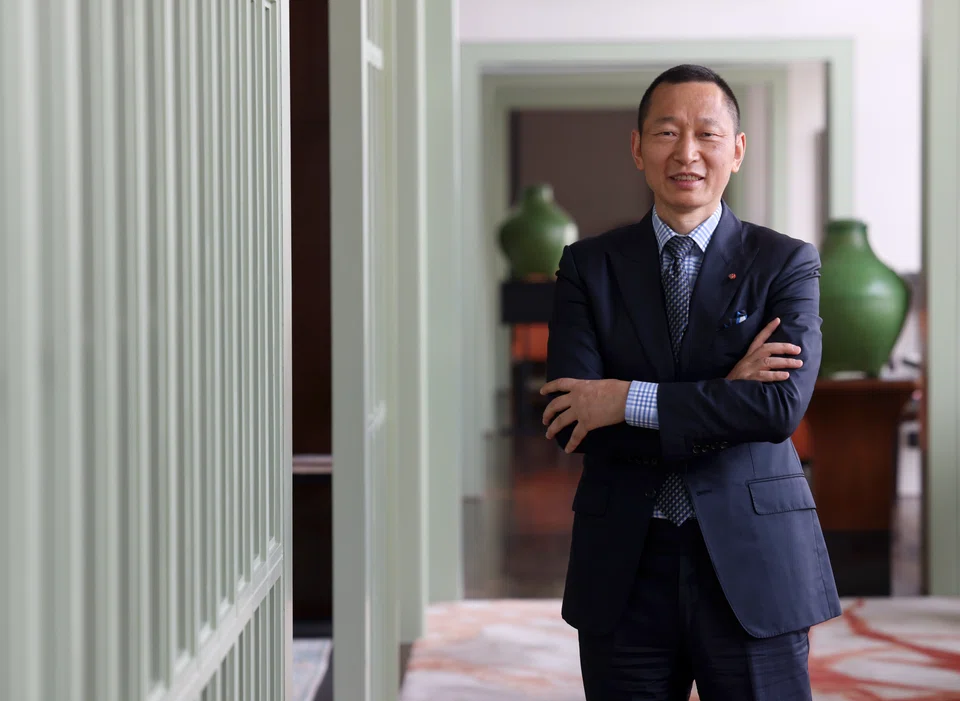
THE Chinese economy has faced headwinds amid a property crisis and prudent consumer behaviour, which has weighed heavily across property groups as well as some real estate investment trusts (Reits).
But outlet-mall player Sasseur Reit is confident that its focus on operational performance, coupled with financial prudence, will allow it to ride out the headwinds in the sector as it eyes long-term growth.
Vito Xu, chairman of Sasseur Reit’s sponsor, Sasseur Group, told The Business Times in an interview that an increasingly saturated outlet market in China coupled with economic downturn poses both challenges and opportunities for Sasseur Group.
While China’s economy is going through challenges, with the property crisis weighing on sentiment, Chinese consumers are favouring cheaper goods. This, in Xu’s opinion, is playing in outlets’ favour.
“Economic downturn requires people to be more prudent when it comes to spending ... which actually drives traffic in outlets,” he said in Chinese.
“There are also more end-of-line goods from high-end brands, allowing us to push for greater discounts,” added Xu, noting that the group is implementing an even more strict pricing system to get better deals.
Xu established his first outlet in Chongqing in 2008. The group has since expanded to some 17 managed outlets across China, of which four are owned by Sasseur Reit.
But the outlet segment has also been experiencing rising competition with certain cities already saturated with outlets, Xu noted. The Reit is thus focused on building a robust internal corporate culture that prepares the group and employees for the intense competition in the future.
Operation is key
Enforcing high standards over tenants’ sales performances is among the strategies for the group to ensure strong operational performance despite the economic headwinds in China.
Sasseur Reit’s revenue is directly linked to sales performance of the tenants, and the sponsor is focused on managing outlets’ operation to drive higher sales. Instead of charging tenants a fixed rent, it takes a cut of tenant sales at its outlets.
“We have ... formed a joint venture or association with the tenants – a very different model from traditional Reits,” said Xu.
He noted that the group’s malls are located outside city limits, but its model has meant that the effective rent received is higher than city properties, which would not be possible on a fixed rental basis.
“That’s why we need strong operational management to drive higher sales for the tenants, which translates into greater revenue growth for the Reit,” he added.
The group conducts company-wide reviews every year, and the bottom-performing tenants in terms of sales will be replaced with others, said Xu. The Reit sponsor is also highly involved in setting up the pricing terms for the tenants.
Xu noted that outlet customers are not shopping for cheap items, but are looking for value and the feeling of getting a good discount. He said: “We need to provide a wide range of selections at the most cost-effective prices, focusing on meeting customers’ needs.”
Sassuer Reit has operated on an entrusted management agreement (EMA) model since it listed on the Singapore Exchange in 2018 in view of its unique rental model. The EMA structure provides greater stability for Reit investors, instead of more volatile cash flows from variable sales.
Unlike the typical rental model, the EMA model comprises a fixed component, with a built-in 3 per cent annual step-up, and a variable component that captures sales growth of the outlets.
The model also provided downside support to the Reit’s young projects in two second-tier cities Hefei and Kunming, said the chief executive officer of Sasseur Reit’s manager Cecilia Tan.
In the first quarter of 2024, the Reit’s EMA rental income grew 1.2 per cent on year in renminbi terms. This was despite outlet sales falling 2.6 per cent over the same period due to a higher sales base in the year-ago period.
For the full year ended December 2023, Sasseur Reit’s EMA rental income in renminbi terms was up 10.7 per cent, led by strength in the variable component. Meanwhile, distribution per unit (DPU) was down 4.6 per cent on year to S$0.06249, partly due to the impact of the stronger Singapore dollar. Excluding the impact of foreign currency translation, DPU would have been 4.1 per cent higher year-on-year.
The EMA model was designed to last for 10 years when it was set up in 2018. It expires in 2028, but the Reit has an option to extend for another 10 years.
Tan noted that a thorough analysis will be done on whether the EMA model should still be extended beyond 2028, with a possible solution to increase the variable component.
Partial acquisitions at right time
For longer-term growth, the Reit manager is also considering potential acquisitions.
“I will say acquisition is always on the table but we need to see how we can club the capital together,” Tan said, adding that an option would also be equity fund raising, but the market environment would need to improve.
The manager is prioritising prudent asset and capital management, given the turbulent macro environment.
As at Mar 31, 2024, Sasseur Reit’s aggregate leverage ratio of 25.2 per cent was the lowest gearing among all S-Reits.
Tan noted that the Reit would likely use a combination of equity and debt for any acquisition, and more debt may be an option, given the Reit’s debt headroom.
She observed that the Reit has the right of first refusal for two assets held by its sponsor. These are fairly large assets, but she said the Reit may also consider partial acquisitions at the right timing.
“It seems the market is becoming more receptive to partial acquisition,” she said. “That also requires Reit managers to be more vigilant with risk management and not over gearing because otherwise, you’re going to have another problem down the road where everyone is just liberally using their gearing.”






