SATS a good long-term bet but sit tight for now

Nisha Ramchandani
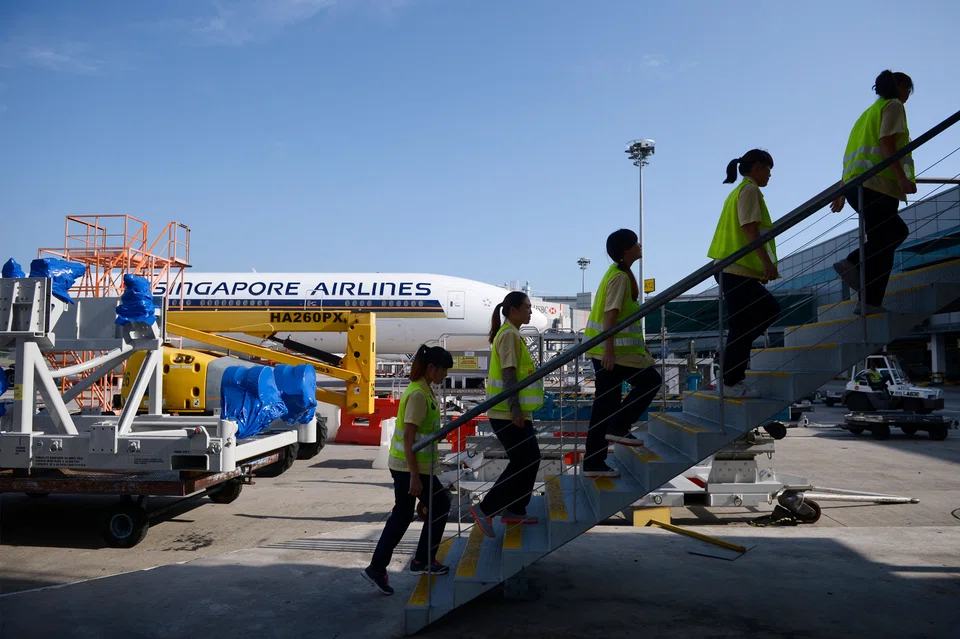
GROUND-HANDLER SATS is continuing to build its footprint overseas, which places it in good stead for long-term growth, but investors might want to sit tight for now.
The stock of SATS has climbed from S$4.22 on July 1 to a peak of S$5.11 on Sept 21. On Sept 20, the day when the counter gained 14 Singapore cents, the Singapore Exchange (SGX) queried the unusual price movement. In response, the ground-handler said that it was not aware of any reasons for the spike in trading activity.
Even with Thursday's fall of seven cents to S$4.98, the stock price is still above analysts' 12-month consensus target of S$4.69, based on Bloomberg data.
Noting that the stock is trading at rich valuations, OCBC Investment Research analyst Eugene Chua, who has a fair value share price of S$4.70, recommends buying at under S$4.40 as near-term positives have already been priced in.
Similarly, Daiwa Capital Markets' analyst Royston Tan deems the stock an attractive one as a long-term holding but notes that the shares are fairly valued on a 12-month view following the run-up in its share price over the past three months. Mr Tan has a "hold" rating with a target price of S$5.22.
Nonetheless, it's worth noting that analysts seem to be positive on SATS' prospects for long-term growth.
Recently, the ground-handler announced that it has secured a tender to run a cargo terminal in Dammam, making it the first foreign cargo handler to be awarded a cargo handling licence in Saudi Arabia. The terminal is slated for completion in the first quarter of 2019.
Other diversification efforts include building up businesses in the non-aviation or adjacent spaces such as a joint venture with DFASS Singapore to enter into the fast-growing travel retail market and a food-catering business in China together with a subsidiary of Wilmar International.
SATS' management has indicated that it will continue to expand in Asia and the Middle East, where it sees growth fuelled by an emerging middle class.
Meanwhile, Singapore currently accounts for roughly 80 per cent of SATS' revenue, which suggests there is plenty more room for the ground-handler to grow its share of revenue from overseas.
However, it may take time for some of these new ventures to bed down, which means that there is unlikely to be a major impact from its overseas ventures in the near-term, some analysts say.
At home, it is working to improve productivity, such as with an S$18 million investment in an automated production line which is expected to boost capacity at its inflight catering centres at Changi by 15 per cent. This takes place ahead of the launch of Changi's new Terminal 4, which opens its doors next year and will lift Changi's annual handling capacity to 82 million.
Changi's current handling capacity is 66 million.
Other efforts to enhance SATS' productivity and control costs are also starting to pay off. For the fiscal first quarter ended June 30, 2016, SATS' operating profit rose to S$54.5 million from S$44 million a year earlier on the back of higher revenue and lower expenditure.
But with some 80 per cent market share at Changi Airport, the gateway services and food solutions provider's revenue is also tied to traffic patterns at Changi; and in the near term, there are signs that traffic growth could be slowing down.
The latest figures from airport operator Changi Airport Group showed that passenger traffic at the airport dipped marginally in August, down 0.6 per cent, declining for the first time since January last year.
Daiwa's Mr Tan wrote in a report: "We believe that passenger throughput for 2H16 will grow at a more benign pace of 2-3 per cent year on year versus the eight per cent growth for 1H16."
Judging by preliminary data from the Singapore Tourism Board, the growth in arrivals from China - Singapore's biggest source market this year - has also been easing since April. The number of visitors from China expanded only 26 per cent year on year in July, versus 75 per cent in April, 65 per cent in May and 53 per cent in June.
It also remains to be seen what kind of impact the Zika outbreak will have on visitor arrivals since the outbreak was first reported in late August.
So while SATS is making a prudent move in building up its operations overseas and diversifying outside Singapore, it could take a while for that to reflect in its share price. And that's something investors might want to remember before scooping up the counter - at least for now anyway.