

Seatrium’s H2 loss widens to S$1.7 billion, proposes 20-to-1 share consolidation to axe ‘penny stock’ status


Michelle Zhu &
Uma Devi
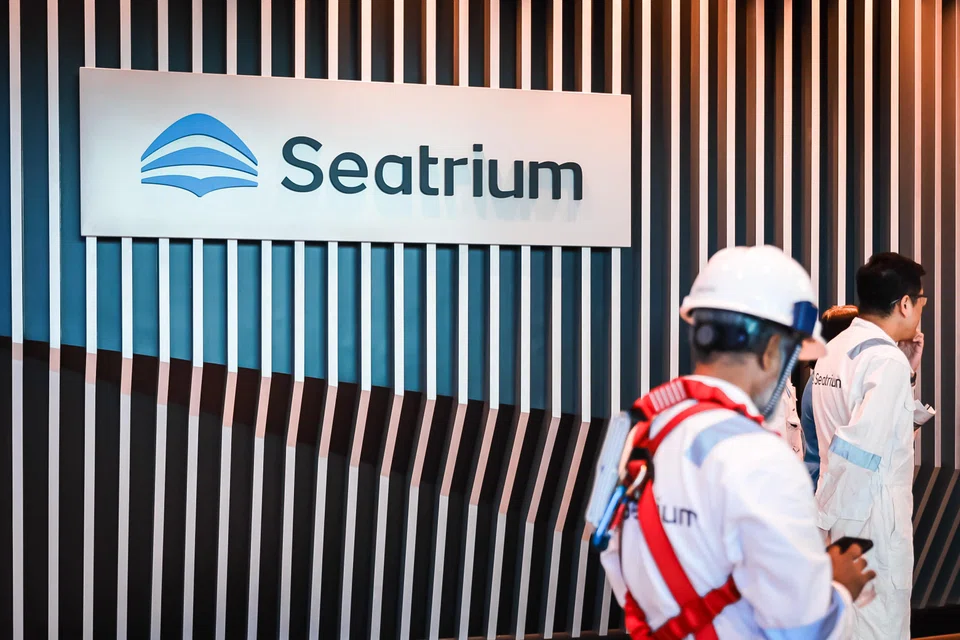
SEATRIUM reported a net loss of S$1.7 billion for the second half ended Dec 31, 2023, widening from a net loss of S$118.3 million in the same period a year earlier.
Loss per share (LPS) for the period stood at S$0.0246 as opposed to LPS of S$0.0038 in H2 FY2022.
For FY2023, the group’s net loss stood at S$1.9 billion as opposed to a loss of S$261.1 million the prior year, with LPS at S$0.0312 compared with S$0.0083. Its revenue for the year was S$7.3 billion compared with S$1.9 billion in FY2022.
As a result of the group’s strategic review, it registered a S$866.6 million write-down of property, plant and equipment, in addition to a S$277.7 million writedown of right-of-use assets in H2.
Speaking to reporters and analysts at a briefing on Monday (Feb 26) to discuss the company’s latest financial results, Seatrium’s chief executive Chris Ong said the group’s full-year financial performance was impacted by “exceptional items”.
These items included writedowns that are non-cash in nature, provisions for onerous contracts, legal and corporate claims, as well as merger expenses that were a result of the combination of Keppel’s offshore and marine arm – Keppel O&M – and Sembcorp Marine.
When asked what proportion of the writedowns and operating losses were attributable to Keppel O&M and Sembcorp Marine, Ong said the company does not split between the two accounts and it is “not relevant (to do so) anymore”.
He said the company has identified “surplus and non-core assets” and wrote down these assets. This, he explained, will also allow the company to strategically invest in its core assets.
“While (the writedowns have) widened our reported losses, it is value accretive in improving Seatrium’s productivity, optimising the company’s operational structure and reducing cash operating expenses over time,” he said.
In response to a query on whether Seatrium is expected to book more writedowns or impairments in FY2024, Ong said the company has undertaken a “very thorough strategic review” and he does not foresee more impairments at this point in time. However, he did warn that such impairments are also dependent on changes that may take place in industry conditions and other factors that will affect asset valuations.
Ong also declined to comment on whether the company is likely to turn profitable in FY2024, but said its business continues to be well-supported by industry tailwinds arising from the ongoing global energy transition and energy security.
He added that the company is focused on delivering an “improved financial performance” in the current fiscal year.
Ong said that post-merger, Seatrium has organised itself differently from its old “yard-centric way of doing things”.
“Today, Seatrium is organised around...a global delivery model where projects are worked on in different yards globally,” he said. This way, the company will not be limited to a specific yard capacity or resource limitation.
Revenue for the half-year rose to S$4.4 billion from S$852.2 million, driven by a surge in sales to external parties for rigs and floaters, repairs and upgrades, offshore platforms, and specialised shipbuilding.
Increase market interest
For projects that were granted revenue recognition in H2, Seatrium’s chief financial officer Adrian Teng said the group’s P Series Floating Production Storage and Offloading (FPSO) projects will contribute a majority of the figure. The repairs and upgrades segment also performed well, and the remaining revenue consists of the company’s green and wind projects.
On the back of its capital structure review, Seatrium is also proposing to undertake a 20-for-1 share consolidation exercise to “increase market interest and attractiveness in its listed shares”.
Ong said the company believes the share consolidation will be beneficial to the company and its shareholders by reducing market volatility of the stock’s share price. It will also help to boost the market interest in stock, and the counter’s appeal to shareholders.
“In our engagement with many of the potential shareholders that are looking at this counter, some of them are unable to participate in our shares because of the penny-stock status,” he said.
When asked how the ratio of 20-to-1 was decided upon, Ong said the company looked at a number of factors – including other constituent stocks on the Straits Times Index. The ratio will allow Seatrium to “achieve the true goals” that the company wants
The move is subject to shareholders’ approval at its upcoming annual general meeting in April.
Seatrium has about S$2.3 billion in cash and cash equivalents as at end-December last year. Teng said the company is taking a proactive approach to capital and liquidity management. The group is also looking at maximising interest income on this figure
Separately on the same day, Seatrium said it reached in-principle settlement agreements with Brazilian authorities to pay 670.7 million reais (S$182.4 million), with a further provision of S$82.4 million for indemnity to Keppel, in relation to Operation Car Wash.
Such provisions made for what the group calls a “one-off historical event” translate to 12 per cent of the group’s earnings per share, and 10 per cent of net tangible assets per share as at Dec 31, 2023.
These will have no impact on the group’s financial metrics for FY2024.
Ong said the settlement agreements gives the company “finality” on the matter that has been ongoing for quite some time. It will also ensure that Seatrium will be able to participate in tenders or other bidding projects in Brazil.
Explaining the dynamics of the “leniency agreement”, Ong said it is a settlement between Seatrium and the Brazilian authorities where the company will pay a fine to resolve “allegations of corruption-related offences”.
The agreement agrees to certain compliance-related requirements going forward, but there is no criminal liability for Seatrium. The agreement also “guarantees” that Seatrium will be able to continue to participate in Petrobras tenders or other bidding projects in Brazil.
The current agreement helps Seatrium avoid uncertainties and is the “least disruptive path forward” for the company’s business in Brazil, said Ong. He added that the country is “a very critical market” for which Seatrium has big ambitions.
Shares of Seatrium closed on Monday at S$0.091, down 2.2 per cent or S$0.002.
TRENDING NOW

Once staunchly pro-China, Malaysian Chinese businesses are now distancing themselves from Beijing
Cliff Tan has 7 million followers and a 4-month waitlist. Why won’t he expand his business?

Could stablecoins be the future of money?

Grab CEO’s wife Chloe Tong on life with Anthony Tan and finding her purpose

