

Seatrium stays bullish on green bets despite axing of US$475 million wind project
The offshore and marine player is also exploring ‘moonshot’ projects such as a floating nuclear platform

[SINGAPORE] Even in the face of a US$475 million contract termination for a wind vessel, Seatrium is staying the course on green opportunities.
The offshore and marine company is actively looking at developing infrastructure for floating offshore wind farms – a nascent segment that could revolutionise wind energy globally.
Seatrium, which specialises in building offshore oil and gas assets, is also looking into ammonia production platforms and carbon capture retrofits for vessels.
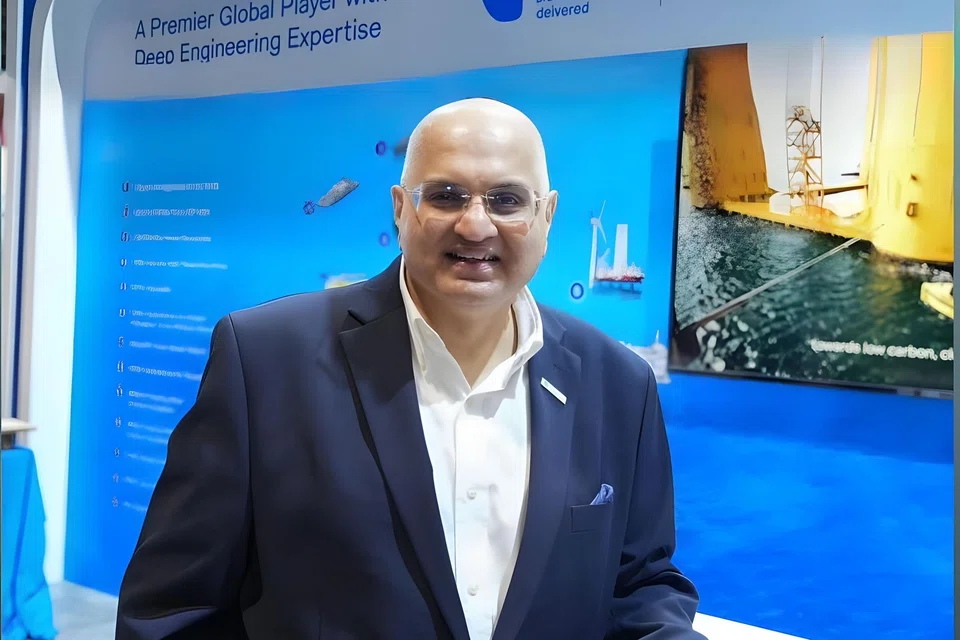
“We are actively pursuing new opportunities in key markets such as Europe and the Asia-Pacific,” said Aziz Merchant, the company’s executive vice-president for engineering, technology and new product development.
Seatrium on Friday (Oct 10) disclosed that it had received a termination notice for its US$475 million contract with Maersk Offshore Wind, for the construction of a wind turbine installation vessel.
The project, meant for deployment at the US offshore wind farm Empire Wind 1, was about 98.9 per cent completed.
Last year, Seatrium also faced the cancellation of a S$250 million contract for an offshore substation in the Empire Wind 2 project, located off the coast of New York.
While these cancellations have cast a pall on Seatrium’s wind ambitions, the company is still “progressing with longstanding partners on offshore wind platforms and carbon capture initiatives”, Merchant told The Business Times on Oct 10.
Green pivot
In a separate interview before the contract termination, Merchant emphasised the need for Seatrium to diversify away from its core oil and gas portfolio, into green growth areas.
“This is where we see that the market is moving to. Oil and gas is there for today; we definitely have to serve our current customers, but we also see our current customers pivoting… So we need to stay ahead of the market,” he told The Business Times.
Seatrium’s net order book stood at S$18.6 billion as at end-June. Of this, S$6.3 billion or 34 per cent is from renewables and “cleaner or green” solutions. The company aims to derive at least 40 per cent of its annual net order book from this segment by 2030.
Part of this involves growing Seatrium’s footprint in offshore wind solutions, even amid the tough outlook.
Merchant acknowledged that the US market has slowed down due to “political reasons”. US President Donald Trump has targeted offshore wind projects, as part of a broader crackdown on clean energy.
But Seatrium still sees demand outside of the US. “If you look at Europe, and if you look at the Asia-Pacific, our customers are still coming, they’re still talking to us... There are still projects out there,” Merchant said.
Floating wind farms and ammonia
Floating wind farms, which are still in the early days towards commercialisation, represent a big opportunity for Seatrium.
Unlike traditional “bottom-fixed” offshore wind farms, the turbines in floating wind farms are not grounded into the seabed. Instead, they sit on floating platforms that are anchored to the seabed with mooring lines.
This means that floating wind farms can be located in much deeper waters, where the winds are stronger, increasing the energy yield.
The total capacity of floating wind farms globally stood at just 278 megawatts (MW) as at end-2024, noted Merchant. But he believes that they could take off commercially between 2030 and 2035.
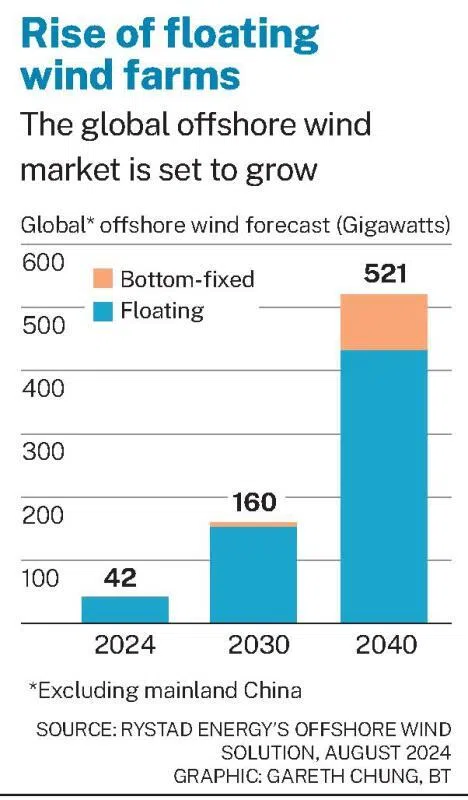
Industry forecasts are similarly bullish. Research outfit Rystad Energy expects global floating wind capacity to approach 90 gigawatts by 2040, led by the UK, France and Portugal.
Asia is also set to account for a significant portion of the market. Rystad expects the region, excluding mainland China, to capture a 20 per cent share of global installations by 2040.
“The good news is that consolidation in floating wind technology is already taking shape, and a clear trend is emerging from our discussions with future clients for the first wave of commercial projects,” said Merchant.
On the back of this trend, Seatrium is developing a floating wind semi-submersible (FWSS). Comprising three pontoons around a central column, the FWSS is designed to support wind turbines with a capacity of 15 to 22 MW.
Many competitors’ pilot projects are for turbines of up to 10 MW. Seatrium is instead “targeting the next generation of large-scale turbines”, which could lower the levelised cost of energy and make wind power more competitive.
Merchant noted that countries are not keen to give subsidies for the offshore wind sector and want it to be “self-sufficient”. This makes cost efficiency an important consideration.
The FWSS has undergone four rounds of testing, and Seatrium is now focused on further development to hit a higher level of technology readiness. The offshore and energy company is also building up the supply chain to produce the FWSS.
Seatrium is also working on a floating offshore substation, a semi-submersible platform that integrates power from multiple floating turbines.
Separately, Seatrium’s technology unit, Aragon, has designed floating production storage and offloading (FPSO) vessels capable of producing two variants of ammonia offshore: “green” and “blue”.
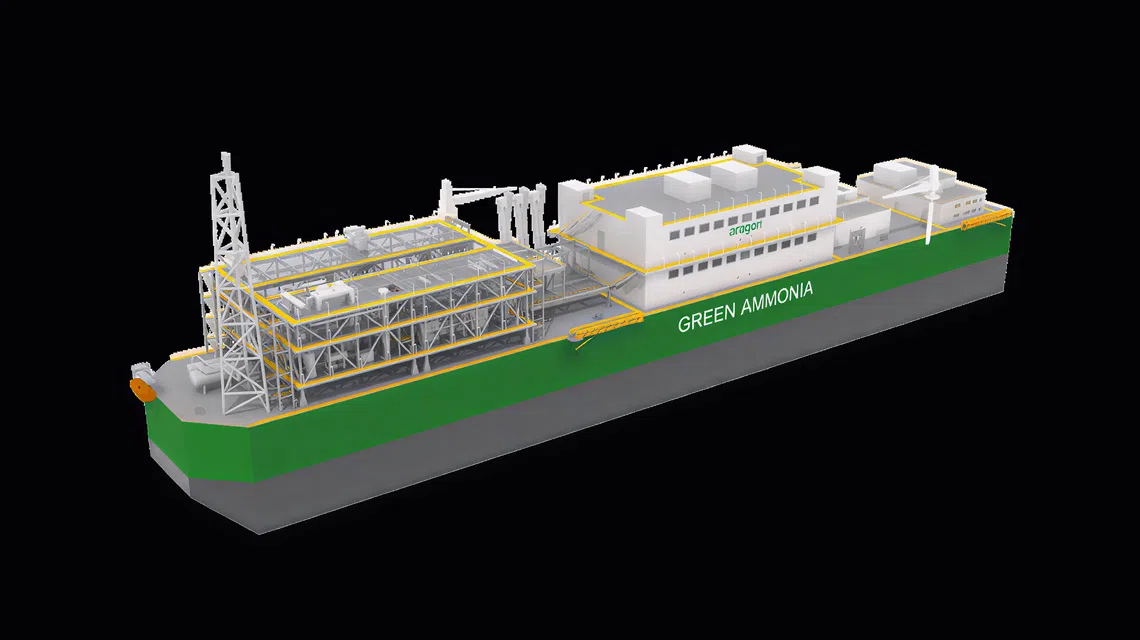
The green ammonia FPSO vessel will produce ammonia using hydrogen generated from renewable energy sources, such as wind power.
The blue one will produce ammonia from natural gas, with a carbon capture system in place to reduce emissions. This FPSO vessel has received an in-principle approval from the American Bureau of Shipping, a classification society, that validates its technical feasibility and safety standards.
Seatrium is in talks with some customers on these concepts, said Merchant.
Carbon capture
Another segment that the offshore and energy company plans to grow is green retrofits for vessels, such as carbon capture and storage solutions, and rotor sails that improve efficiency.
Merchant believes that the market for such retrofits could expand, given the growing pressure from the International Maritime Organization (IMO) for the sector to decarbonise. International shipping contributes to about 3 per cent of global emissions, and IMO has set a target for the sector to hit net-zero emissions by or around 2050.
“To meet the 2050 requirement of (net-zero) emissions, you cannot renew the entire fleet. Our belief is that about 57,000 to 60,000 vessels will be retrofitted… (with) carbon capture or wind-assisted propulsion,” he said.
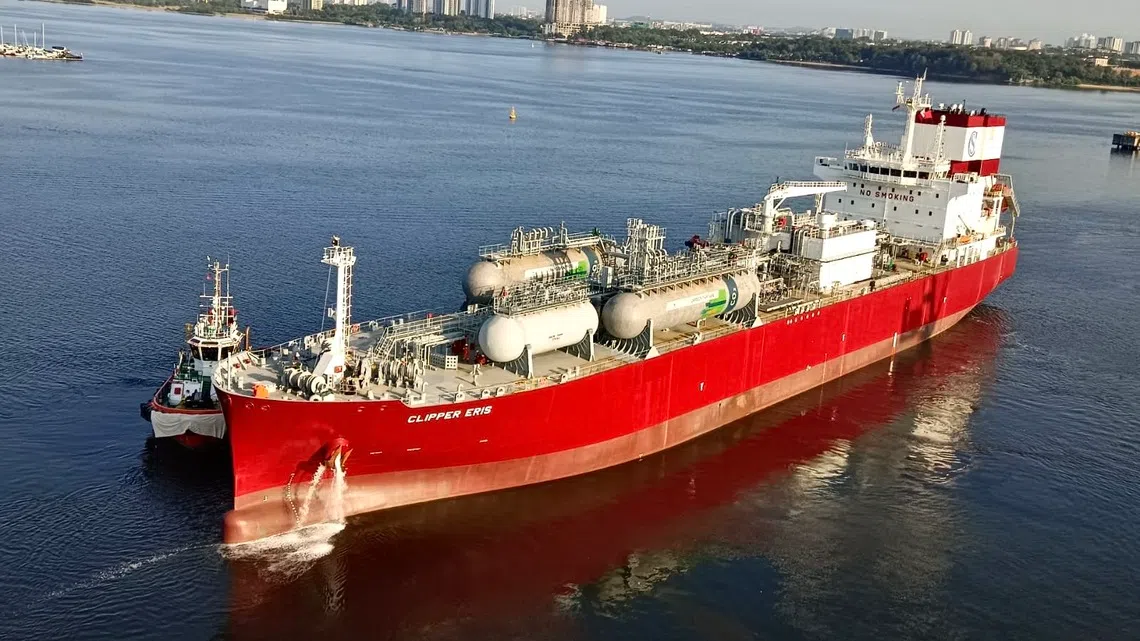
In February, Seatrium completed the world’s first full-scale turnkey retrofit of a 7 MW carbon capture system on a vessel, the Clipper Eris, for Norwegian shipping giant Solvang.
Seatrium has signed a letter of intent with Solvang to retrofit the shipping company’s very large gas carriers with carbon capture systems, with the work expected to start in late 2026.
Asked if customers are willing to spend on carbon capture systems in these challenging times, Merchant noted that these types of projects can often tap government funding, and that companies themselves are also embracing these new technologies.
Seatrium is also looking into “moonshot” projects – such as applying its hull technology to a floating nuclear platform – even though this is unlikely to materialise within the next decade.
“We are not spending a lot of time today on it, but we are keeping abreast of what is happening on that kind of technology,” he noted.
As he put it: “While we are busy today with oil and gas projects, we shouldn’t just be comfortable with what we are today; we should be looking five years, 10 years down the road.”






