Sembcorp posts 5% dip in H2 profit; eyes growth with data centres’ energy appetite
The company hopes to capture demand from Singapore’s latest call for applications for data centres
 Add BT as a preferred source

[SINGAPORE] Sembcorp Industries is eyeing fresh growth from powering data centres, amid headwinds in the gas business that dampened its latest earnings.
The company on Wednesday (Feb 25) reported a 5 per cent decrease in net profit to S$448 million for the half-year ended Dec 31, 2025 (H2).
Turnover for the period fell 11 per cent to S$2.9 billion. Turnover in the gas and related services segment, in particular, fell 14.2 per cent to S$2 billion.
For the full year, Sembcorp’s net profit shrank by 4 per cent to S$984 million. Revenue was down 10 per cent to S$5.8 billion.
The gas business was hit by lower spark spreads – the difference between electricity prices and the cost of production with natural gas. It also faced higher blended costs in Singapore and weaker customer demand in the UK.
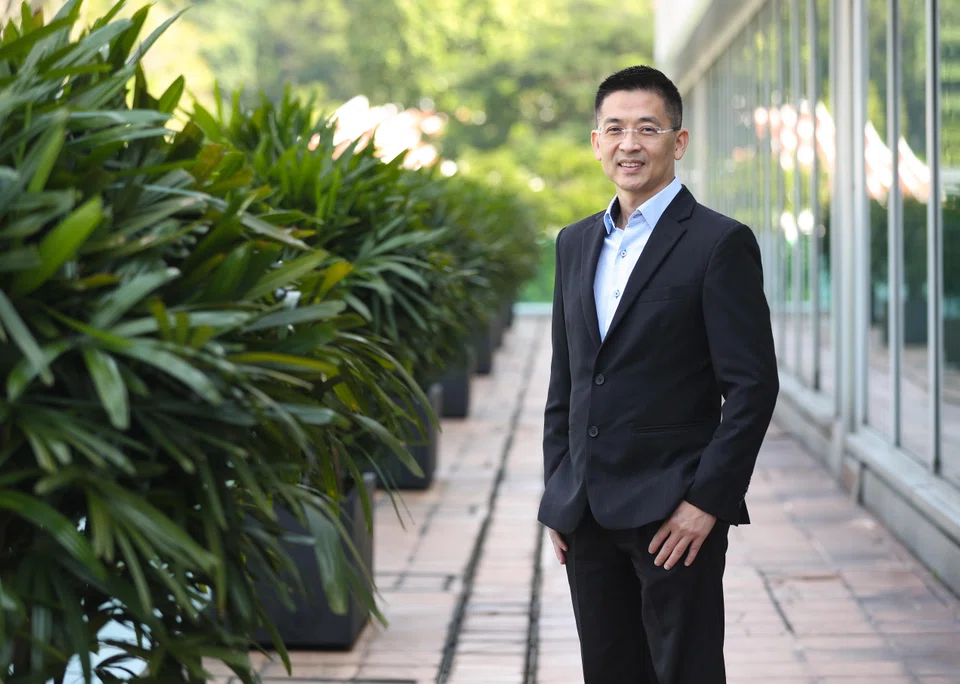
Acknowledging the headwinds, Sembcorp chief executive Wong Kim Yin pointed out a growth opportunity: supplying power to companies riding the AI boom.
“We think that we are highly competitive, and (our) diversified portfolio will position us to capture growing AI demand in Singapore, particularly from data centres and high-tech manufacturing,” he said at the company’s earnings briefing at its Hill Street office.
Sembcorp supplies about a third of the demand for data-centre energy in Singapore. It also supplies over 690 megawatts of power to the high-tech manufacturing sector – including a new 150MW contract with memory chip giant Micron announced in January.
Singapore’s latest call for applications for data centres is a key tailwind. Sembcorp is working with customers that are keen to secure capacity, providing them with clean power solutions such as biofuel and fuel cells, Wong said.

Wong further noted that Sembcorp is able to develop sustainable data centre infrastructure with its partners.
The company has land available in its Tembisi Innovation District project in Batam to host up to 100 MW of data-centre capacity. It also has a 138-hectare site in the UK with immediate grid connection and infrastructure for potential data-centre customers.
With the hype over AI, some may worry if Sembcorp would “catch the froth”, Wong acknowledged. He emphasised that what the company is focused on is securing “solid” power contracts with reliable customers.
“I’m not saying that we are an AI company now; by the time we receive the demand translated from all the noise in the market, it’s actually very solid,” he said.
Renewables growth offset by China curtailment
Sembcorp also sees growth opportunities for its renewables unit, although it is facing continued challenges in China.
For H2, the renewables segment posted S$471 million in turnover, up 21.1 per cent from the year-ago period. Adjusted earnings before interest, taxes, depreciation and amortisation (Ebitda) was up 10 per cent to S$327 million.
The rise was driven by better wind resources in India, as well as newly-commissioned solar capacity in Singapore, the Middle East and India. It also takes into account full-year earnings from the Vietnam subsidiaries acquired in 2024.
This was, however, offset by higher curtailment for the renewable energy business in several Chinese provinces – Guangxi, Xinjiang and Gansu – as well as lower tariffs in Ningxia.
China’s decision to cancel value-added tax refunds for onshore wind projects is another headwind in the market, noted Wong.
“We will remain very disciplined in managing our portfolio exposure in China,” he said.
Separately, Sembcorp is also focused on building up its portfolio of low-carbon industrial parks and ready-built industrial space under its integrated urban solutions unit.
The segment posted an 11 per cent fall in adjusted Ebitda to S$140 million in H2, following the absence of contributions from Sembcorp Environment, which was divested last year.
Closing the gap in dividends
Even with the earnings drop in FY2025, Sembcorp proposed a final dividend of S$0.16 a share, bringing the total annual dividend to S$0.25 a share – up from S$0.23 in FY2024.
Despite the headwinds, the company posted a “resilient” performance and has strong underlying cash flow, said Wong.
Highlighting that Sembcorp lags its peers in dividend payout, he added that the company expects to improve its dividend payout ratio over the coming years.
Sembcorp’s shares ended Wednesday at S$6.20, down by S$0.10 or 1.6 per cent.
Decoding Asia newsletter: your guide to navigating Asia in a new global order. Sign up here to get Decoding Asia newsletter. Delivered to your inbox. Free.
Copyright SPH Media. All rights reserved.