Serial System rides global chip shortage by diversifying
Its product portfolio has expanded to include printer accessories, household appliances and lifestyle goods.

Singapore
COMPARED to the bigger tech-related players listed in Singapore, electronic components distributor Serial System is a minnow. Still, investors have been showing more interest in the stock after the company delivered a solid set of financials for the first half of 2021 on the back of a global chip shortage and attempts to diversify its portfolio and customer base.
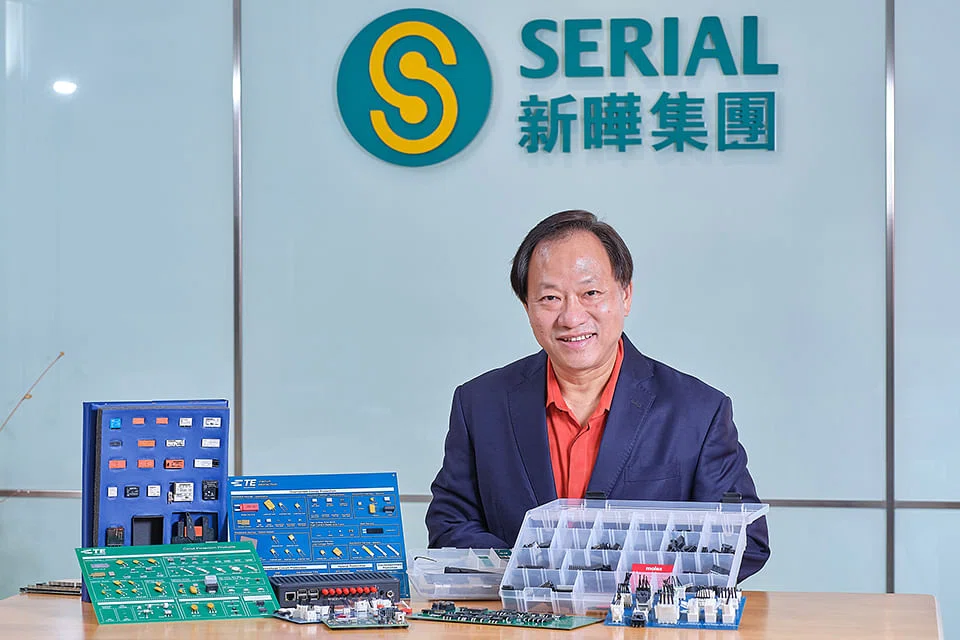
In an interview with The Business Times, chief executive Derek Goh said the global shortage of chips and higher demand for electronic products during the pandemic have been positive for Serial System. The company has diversified its product portfolio beyond semiconductors to include printer accessories, household appliances and lifestyle goods.
For the first half of 2021, Serial System swung back to the black with a net profit of US$5.8 million from a net loss of US$4.5 million in the previous year. Revenue increased 39 per cent to US$438.3 million from US$314.3 million. The company declared an interim dividend of 0.22 Singapore cent per share, versus no dividend for the corresponding period in the year before.
Electronics distribution is the group's biggest business segment, accounting for about 80 per cent of its revenue. During the half-year, sales from this segment increased 38.3 per cent to US$396.5 million. The consumer products segment's sales grew 58 per cent to US$36.1 million. Turnover from the group's other businesses rose 21.6 per cent to US$5.4 million.
Mr Goh said losses incurred in H1 2020 taught the company some valuable lessons, such as the need to widen its base of suppliers and customers as well as to streamline internal efficiency. It now has more than 5,000 customers, spanning a range of industries from security and surveillance to telecommunications, automotives and healthcare.
Serial System has also broadened its base of suppliers. It now has more than 90 franchised product lines for its electronics segment across countries such as South Korea, Hong Kong, Thailand and the United States. This diversified base has become more important amid US-China trade tensions.
"For us, during this pandemic, we have been sourcing for more China suppliers so when the Chinese suppliers pick up, business will come," said Mr Goh. "At the same time, we are also looking for more Japanese and Korean supplies just in case the US and China really go head-on with each other."
Serial System also offers managed print services business to customers looking to outsource their printing, scanning and copying functions. These services are offered through Print-IQ Singapore and PT Sentral Mitra Informatika. Serial System owns a 91.43 per cent stake in the former, and a 20 per cent stake in the latter.
Finally, the company has two businesses serving the medical sector. The first is Serial MultiVision, which provides many of Singapore's hospitals with services such as electronic meal ordering systems and an incident tracking and reporting system.
The second is Contract Sterilization Services, which is involved in the assembly and distribution of standard and customised perfusion tubing packs. These are used with heart and lung machines.
Since its formation in 1988, Mr Goh said Serial System has been through multiple crises. The company has tried to learn from each crisis to boost growth.
During this current pandemic the company tried to keep as many of its employees as possible. Mr Goh said staff size was trimmed by less than 5 per cent. It currently has just shy of 1,000 employees globally across 23 sales offices and 13 warehouses.
The company also took the opportunity to hire talent that had been let go by other companies, taking on those who would strengthen Serial System's sales, training and marketing capabilities. This, he said, would place the company at the front of the industry when business conditions return to normal.
"During this time we will train all of them so that when the market starts to pick up, the people are ready to go and grab all the business and the opportunities," he said.
Challenges presented by the pandemic remain. For instance, shipping costs are higher. And there are various supply chain disruptions. The electronics supply chain, in particular, is lengthy and spread across many countries.
Serial System's freight costs have spiked, although Mr Goh said customers have been willing to pay premiums on certain electronic components due to a global shortage. The company had to absorb some costs, but was also able to pass on some to customers.
Nevertheless, Mr Goh is optimistic about Serial System's prospects. He has tried to signal his optimism by picking up shares in the open market. The disparity between the company's market value and its book value is "too huge", he said. Over four transactions on June 11, June 15 and June 16, Mr Goh paid some S$144,700 to take his stake in the company to 40.6 per cent from 40.5 per cent previously.
Shares of Serial System are up 59 per cent this year, but closed 0.8 per cent or 0.1 Singapore cent lower at 13.2 cents on Friday. This gives the counter a historical price-to-earnings ratio of 15.3 times, and a market capitalisation of S$119.4 million.
The continued adoption of 5G and the Internet of things is expected to raise demand for chips with greater processing power and memory storage. With its extensive product line, Mr Goh said, Serial System is in a good place to capitalise on these emerging trends.