

SGX exits on the rise as pandemic weighs on market prices
New initiatives critical as IPOs play catch-up with number of delistings

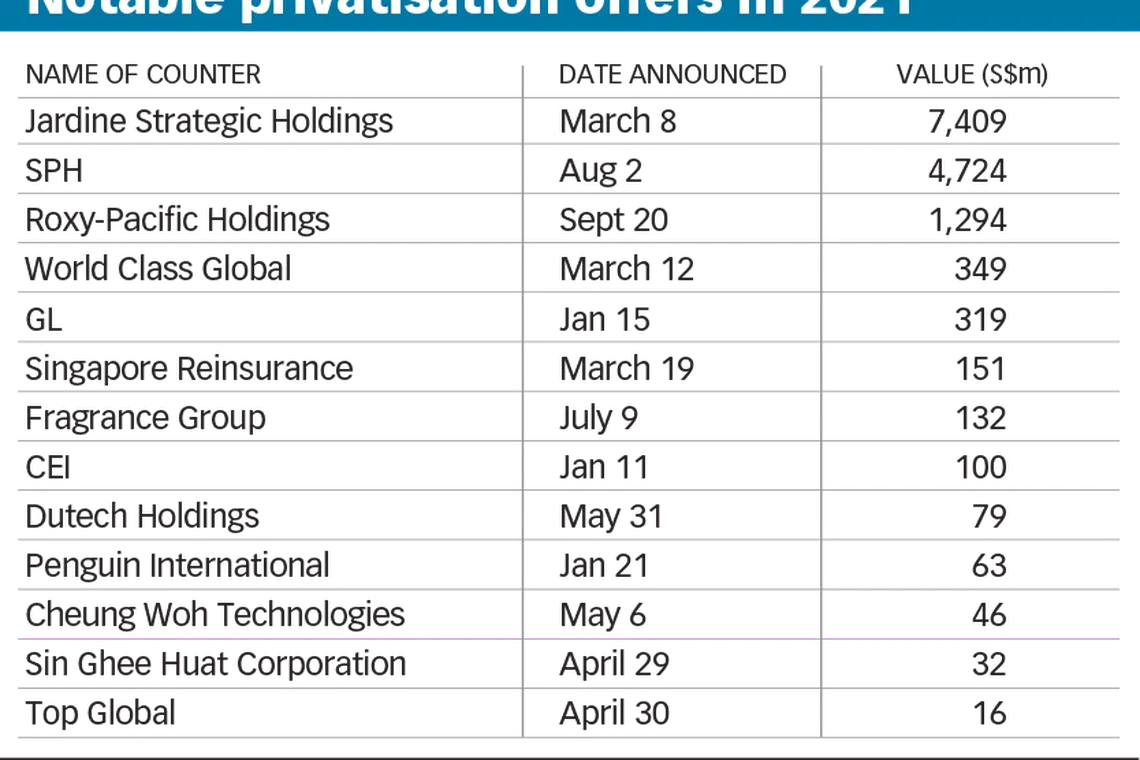
THE Singapore Exchange (SGX) has seen a flurry of privatisation offers this year - at a rate of more than one a month - in what market watchers say is part of a global trend amid the Covid-19 pandemic.
"Clearly, the owners (of the listed companies) see a disparity between its value and market price, and are taking advantage of this," said Justin Tang, head of Asian research at United First Partners.
The latest in the rash of delisting talks was for property and hospitality group Roxy-Pacific Holdings, which on Monday received a preconditional voluntary general offer from a consortium including chairman and chief executive Teo Hong Lim for all the issued ordinary shares in the company.
In a bourse filing, Roxy-Pacific said construction of its development projects continued to face prolonged challenges, led by a pandemic-related global supply chain disruption and labour crunch.
Meanwhile, global lockdowns and tightened border control measures have also hindered its hotel operations.
To be sure, the privatisation offers are not limited to Singapore-listed companies.
Australian energy company AusNet Services on Monday also received an indicative, non-binding proposal for the acquisition of all its shares via a scheme of arrangement. The ASX-listed company, which is 32.3 per cent owned by the government-owned Singapore Power, had a secondary listing on the SGX mainboard up until 2018.
"This is a global trend," said Mr Tang. "Mergers and acquisitions have been rising for a spectrum of reasons since Covid hit. This ranges from buying inorganic growth to privatising on the cheap."
Global M&A activity hit an all-time high in the first six months of 2021, with deals worth more than US$2.6 trillion, professional services firm EY noted in a recent news analysis.
This was up from US$926 billion in the year-ago period, and surpassed the pre-pandemic five-year average of US$1.6 trillion for H1 2015 to 2019, it added.
More than half of the activity was recorded in North America, which saw deals worth US$1.4 trillion, followed by the Asia-Pacific region, where M&A values doubled to US$446 billion.
"Dealmakers are operating in a once-in-a-lifetime market," said Andrea Guerzoni, EY's global vice chair of strategy and transactions. "Having successfully navigated the challenge of transacting virtually, they find themselves in the sweet spot between optimism about economic prospects, progress in the vaccine roll-out in key economies, low cost financing and record amounts of private capital dry powder."
READ MORE:
- Delisting and relisting can be rewarding exercise for some founders
- Roxy-Pacific CEO intends to privatise company at S$0.485 per share
- Offer to privatise SPH's non-media assets reasonable, say analysts
- Fragrance joins SGX delistings
SGX market strategist Geoff Howie said Singapore's economy has "long ranked highly in surveys of places to do business and business efficiency". As such, he points out, corporate reviews and proposals - including privatisation efforts - should not be seen as uncommon.
Among the Singapore listcos embroiled in privatisation talks this year are contract manufacturer CEI and high-precision engineering product manufacturer Cheung Woh Technologies.
Mainboard-listed electronics services provider AEM Holdings in January launched a buy-out bid for CEI, citing "synergistic benefits to the business and operations". CEI was delisted in July.
Cheung Woh was delisted a month later in August, after it was bought out by Woh Seng Holdings, a company owned by Cheung Woh's finance and administrative director Law Yu Chui and her family members.
Dual-listed bulk shipping company Pan Ocean in June also proposed to seek a voluntary delisting from the SGX. However, the company said it was not a privatisation exercise as it intends to maintain its primary listing on the Korea Exchange.
About half of the companies receiving privatisation offers this year are in property-related sectors. This includes the Guoco Group's hotel operator GL Limited, as well as property developers World Class Global and Fragrance Group.
GL in January received a voluntary conditional cash offer by Hong Kong-listed Guoco Group to privatise and delist from the SGX, after the hotel operator sank into a net loss of US$19.8 million for the six months to Dec 31, 2020.
GL had said at the time that its core business of owning and operating hotels in the UK has been severely impacted by pandemic-driven restrictions, resulting in most of the company's hotels being closed during the period.
World Class Global, which was spun off from Aspial Corp and listed on the Singapore Exchange's Catalist board in 2017, was another property player that sought to privatise due to a "challenging global and domestic economic outlook brought about by the Covid-19 pandemic".
In March, jewellery group Aspial announced plans to privatise its subsidiary through a scheme of arrangement, whose main businesses include property development and property investment in major cities in Australia and Malaysia, as well as the operation of hotels in Malaysia.
More recently, Fragrance Group on Sept 8 said it had applied to the exchange for a delisting following a privatisation offer. The group's founder and chief executive Koh Wee Meng, through offeror JK Global Treasures, had made a voluntary conditional cash offer in July to take the company private.
The property developer had reversed out of the red with a net profit of S$14.4 million for the six-month period ended June 30, 2021, compared with a net loss of S$12.7 million a year ago. Revenue jumped almost five times to S$286.8 million, from S$60.6 million in the year-ago period, driven by its ongoing property development projects in Australia.
Another property-related counter, Singapore Press Holdings (SPH), which publishes The Business Times, in August also received a privatisation offer for its non-media business through a scheme of arrangement. SPH shareholders earlier this month voted overwhelmingly in favour of the proposed restructuring of the media business, which paved the way for the proposed privatisation of SPH by Keppel Corporation.
Mr Tang explains that as a general rule, property companies trade at a discount to valuation. And this is even more pronounced in this period, with prices depressed amid the pandemic. Hence, he said, offerors get more bang for the buck through acquiring the company, instead of buying its assets.
The trend, though, does not bode well for the local bourse.
The total number of listed securities on the SGX has fallen nearly 5 per cent to 676 as at end-August, compared with 710 listcos in August last year. Back in August 2019, there were 736 companies listed on the local bourse.
However, market watchers note that the numbers of privatisations this year are not the highest in recent memory. "I think it still has not eclipsed the high we saw in 2016," Mr Tang said.
Some 30 companies had exited from the SGX in 2016, including prominent names such as shipping firm Neptune Orient Lines (NOL) and public transport operator SMRT Corporation.
"Basically, the situation in Singapore has been going on for a number of years, where out of the 700 stocks listed, 400 are trading below book value," said Nirgunan Tiruchelvam, head of consumer equity research at Tellimer.
"The privatisations will continue as long as the cost of capital is going to be low... until such time that significantly fewer counters are trading below net cash," he added.
To stem the tide of delistings, which have outpaced the number of initial public offerings (IPOs), Singapore Exchange Regulation (SGX RegCo) in 2019 tightened voluntary delisting rules to make it more difficult for dominant shareholders to take their companies private.
One change required offerors, and parties acting in concert with them, to abstain from voting on the voluntary delisting resolution - ultimately giving minority investors more say in determining the voting outcome.
Another change mandated that voluntary delisting offers to be both "reasonable" and "fair", in the opinion of the appointed independent financial adviser.
At the same time, Singapore is also attempting to attract more IPOs to its shores.
The Republic last week dangled multi-billion dollar funding initiatives to boost listings of high-growth technology startups on the SGX.
These included a co-investment fund established by the government and Temasek, with a first tranche of S$1.5 billion to lure "promising high-growth enterprises and market leaders" to list in Singapore, including secondary and dual listings on the SGX.
Mr Tiruchelvam is of the opinion that while the trend of the number of delistings outnumbering IPOs has been going on for a number of years, the decline in the total number of listcos could be arrested by government backing.
"The new initiatives announced last week will help," he said.
The package of initiatives come hot on the heels of new guidelines that make it easier for special purpose acquisition companies (SPACs) to list in the city-state. Singapore started allowing blank-cheque companies to list on Sept 3, becoming the first Asian financial hub to host the structures.
Already, several high profile investment companies have been said to be eyeing a SPAC listing in the Republic. These include Tikehau Capital, Turmeric Capital, Novo Tellus Capital Partners and Temasek's Vertex Holdings. Patrick Grove, chairman of Catcha Group, an Internet-focused investment company in South-east Asia, is also reported to have had discussions with SGX about a potential listing.
TRENDING NOW

If Europe goes to war, the fallout will be felt in East Asia
Firms linked to haze pledge cooperation in meeting with Shanmugam; government to table changes to haze law

Indonesia stocks suffer worst plunge in nearly 30 years as MSCI proposes standalone status
Keppel seeks US$1 billion for Vietnam investments as it joins country’s international financial centre

