

SGX firms' Q1 profits skid almost 40%; Q2 expected to worsen
Almost all sectors saw significant profit drop, especially industrials, healthcare, property

Singapore
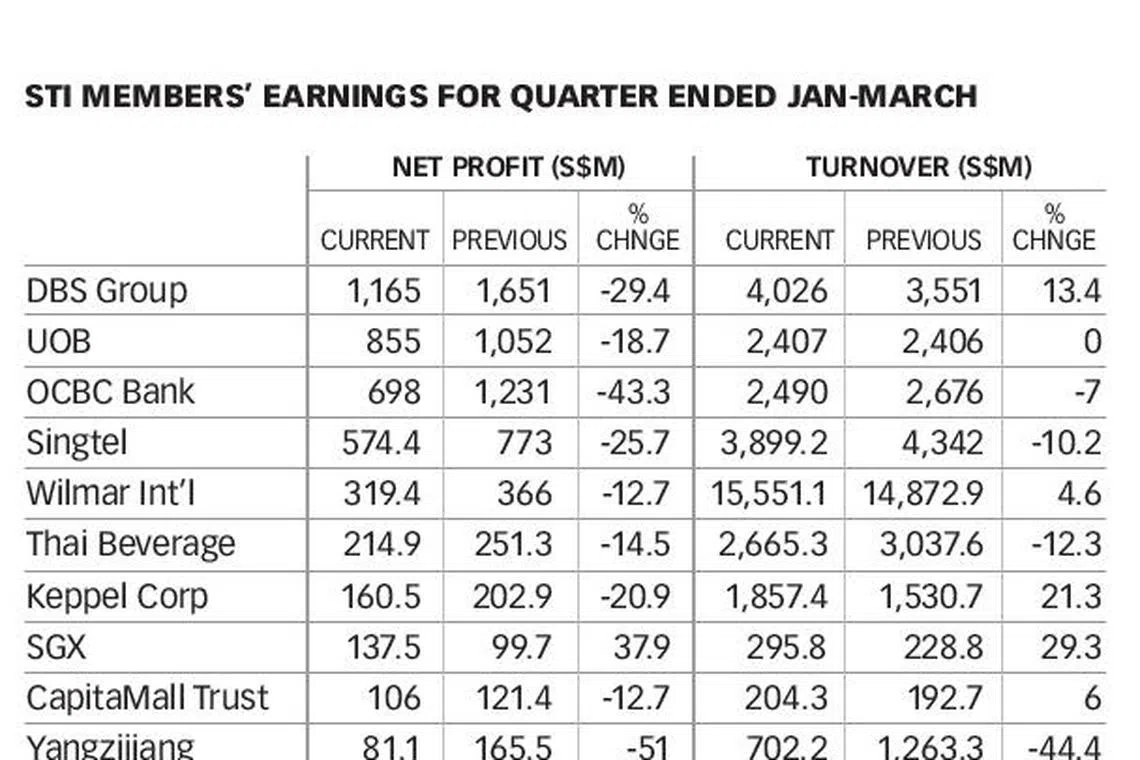
ABOUT one in three locally listed firms chalked up losses for the quarter ended in January to March, with total profits down almost 40 per cent. This was a much poorer showing than last year, when a trade war took its toll on companies. But pundits said the April-to-June quarter corporate results could be uglier.
Of the 155 companies listed on the Singapore Exchange that had issued their quarterly scorecards as at May 29, 53 were in the red and 102 were profitable. Their total earnings were down 38.5 per cent to S$4,896.2 million from a year earlier, according to data compiled by The Business Times.
This was the first set of earnings delivered by listed companies after the novel coronavirus hit Singapore shores in late January. In the corresponding period last year, the total net profit of listed companies increased 4 per cent. The proportion of loss-making companies was roughly the same though, at one in three.
Among those that slipped into losses in the most recent quarter was Singapore Airlines (SIA), which racked up its largest-ever quarterly loss of S$732.4 million. SIA had reported a net profit of S$202.6 million in the same period a year earlier.
The airline was blindsided by fuel hedging losses as fuel prices plunged towards the end of the quarter as airlines globally grounded their fleets.
CGS-CIMB research head Lim Siew Khee said the level of detail of business updates provided by the companies has affected the current earnings read-through, after mandatory quarterly reporting was scrapped for most companies.
Nonetheless, based on the data available, her team noted that there were more disappointments in the companies under coverage, with 23 having missed the research house's expectations and 12 having beat forecasts. Another 23 were in line with expectations.
Companies in the retail and hospitality sectors, as well as capital goods were those that had disappointed in particular. The capital goods companies faced a double whammy of lower oil prices and the pandemic. Conversely, consumer staples, gloves and small-cap tech had thrived, Ms Lim said.
Credit Suisse's private banking research head for South-east Asia, Kum Soek Ching, also said the earnings reported by Singapore companies for the quarter ended March had generally come in below expectations, with the exception of the financial and real estate sectors. "For the banks, loans growth had held up better than expected due to corporate demand and draw-downs on credit lines," she said. "The sharp decline in SOR (swap offer rate) and Sibor (Singapore interbank offered rate) only began in March, so the full impact on (bank) margins will only be seen in the April-June quarter and beyond."
The Q1 operating performance of the real estate investment trusts (Reits) had also not fully reflected the impact of Covid-19 and the circuit breaker, although distribution payouts have already been cut, especially among retail Reits, Ms Kum said.
Meanwhile, Maybank Kim Eng analysts Thilan Wickramasinghe and Lai Gene Lih pointed out that almost all sectors saw significant declines in after-tax profits, especially industrials, healthcare and property.
Financials recorded the smallest after-tax profits contribution since the offshore and marine crisis in 2017, they said, while losses posted by industrials and transportation were largely driven by Singapore Airlines. This was despite the limited extent of lockdowns in January and early February.
Said the Maybank KE analysts in a report: "Widely varying levels of trading update disclosures seen following the shift to half-yearly reporting on SGX (Singapore Exchange) may further cloud clarity on operating conditions, especially in an environment where circumstances change almost weekly."
Analysts expect firms to post lower earnings in the April-June quarter, as Singapore's "circuit breaker" was in place for most of this period.
Said Credit Suisse's Ms Kum: "Q1 earnings performance is hardly representative of 2020's performance, as Q2 is expected to be worse due to the circuit breaker, and the cautious and phased reopening of the Singapore economy suggests a slow recovery ahead."
She also said management guidance in general has indicated much uncertainty about the outlook. Hence, earnings downgrades have continued even for companies that have met or exceeded market expectations in the January-March quarter.
The consensus points to an 18 per cent decline in market earnings in 2020. Ms Kum expects downside risk to the earnings estimates, given what is shaping up to be an unprecedented economic recession in Singapore.
Nevertheless, CGS-CIMB's Ms Lim said corporate earnings in April-June should be somewhat supported by the 75 per cent wage payouts from the government as well as some belt tightening on the part of corporates.
CGS-CIMB sees the earnings of the Straits Times Index component companies declining 22 per cent in FY2020, but increasing 10 per cent in FY2021. The research house sees banks leading the recovery in FY2021, while rental and occupancy pick-ups for landlords and the hospitality sectors could drive a 9 per cent earnings rebound for Reits and developers - provided there's no new wave of Covid-19 cases.
Maybank KE said there are likely to be significant downgrades in earnings forecasts in subsequent quarters, as the economy heads towards quarters that are bearing the brunt of lockdowns.
Despite that, Singapore's stock market has rallied with those in the region. Maybank KE's Mr Wickramasinghe explained: "We have had significant amounts of liquidity injected into the system through stimulus measures regionally and there is optimism as economies open up from lockdowns. "
TRENDING NOW

Singapore identifies 7 firms responsible for haze fires, notices issued urging action: Grace Fu

Could stablecoins be the future of money?

Singapore should prepare for prolonged haze until November, says Grace Fu

High Court rules against Julius Baer’s Singapore trust arm in US$50 million family trust dispute

