

The SGX-NYSE tie-up didn’t take off, but conditions today may spell success for SGX-Nasdaq dual listing
Rising interest rates and post-pandemic situation weighed on market in 2022, but that has changed

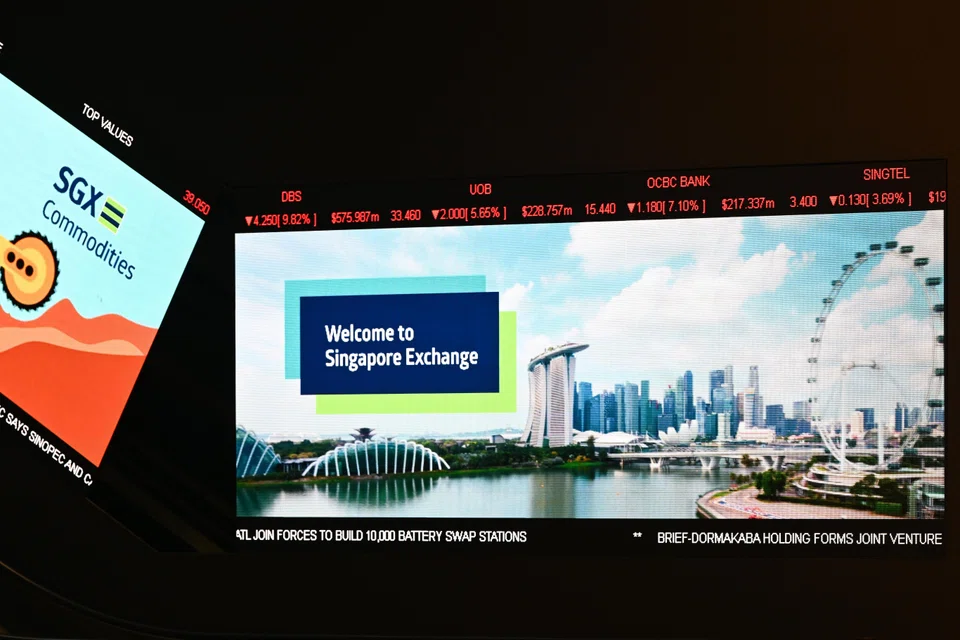
[SINGAPORE] There has been much buzz regarding the Singapore Exchange’s (SGX) move to roll out a new dual-listing bridge with Nasdaq.
Are there lessons from a similar tie-up with the New York Stock Exchange (NYSE) announced years back, which failed to attract any issuers?
The SGX-NYSE dual-listing plans were announced in July 2022, as part of a broad memorandum of understanding (MOU) signed between the two exchanges.
The two parties agreed to collaborate on the dual listing of companies on both exchanges and work together on a few key areas, such as identifying and developing new environmental, social and governance products, supporting product development across the exchanges and exploring new exchange-traded fund products.
But the dual listing with the world’s biggest stock exchange – with a valuation of more than US$30 trillion – never took off.
For one, market conditions at the time were quite different, with some industry watchers describing Singapore’s equity market as moribund.
This is a sharp contrast to today, when there is renewed vibrancy since 2025 brought on by successive announcements tied to the Equity Market Development Programme.
Robson Lee, partner at Kennedys Law, said: “The state of the Singapore market was disappointing then, (investors) and market participants were not looking at it as a remote possibility.”
Chan Yew Kiang, head of EY Asean’s IPO practice, noted that the overall macro environment back then was also not ideal for initial public offerings (IPOs), as interest rates were rising and economies were recovering from the impact of the pandemic.
“Geopolitical events had created significant uncertainties that muted interest for IPOs from companies and appetite from investors,” he added.
Global and US IPO volumes had fallen sharply in 2022, noted Jimmy Seet, partner at the capital markets practice at PWC Singapore. IPO volumes would remain muted through 2023 to 2024, which reduced the urgency among companies to pursue listings – let alone dual listings.
This is not to say the collaboration did not make sense.
Seet noted that carmaker Nio carried out its secondary listing on SGX in May 2022, having been listed on NYSE since September 2018. Nio cited reasons such as accessing an Asian investor pool as well as setting up a research and development centre in Singapore for its move. The company continues to be listed on both exchanges, suggesting that it still sees advantages from having this dual presence.
The global equity markets are now markedly different from those in 2022. They have staged a robust recovery, with major indices reaching new highs after prolonged pressure from tariffs, interest rates and rising debt concerns. This rebound has been supported by easing financial conditions, moderating inflation in some regions and declining market volatility.
There is renewed interest from companies to list on the SGX, judging by the pipeline of more than 30 IPOs announced by the exchange in 2025. Kennedys’ Lee noted that he is seeing an increase in customer interest in listing here.
“These companies were previously considering private equity or other listing venues,” he added.
Other hurdles
Structural issues, however, also hampered the SGX-NYSE plans. The arrangement lacked a clear framework and remained largely aspirational as it was part of a broad MOU.
The lack of moves to equalise or make listing rules and timings consistent across SGX and NYSE, combined with the high costs of listing in the US, might also have deterred some IPO hopefuls, noted Chan.
This contrasts with the SGX-Nasdaq initiative, which was accompanied by the authorities signalling the intent for regulatory and legislative changes to facilitate a dual listing ahead of the public consultation in January this year.
Chan added: “In particular, regulatory reforms and initiatives by the SGX to remove hurdles that had previously made it challenging for companies to list on both exchanges simultaneously would be helpful to encourage interest.”
Then, there are also the differing profiles of companies that would list on NYSE versus on the Nasdaq. NYSE listees tend to be established companies that have less incentive to dual list, noted Seet.
Nasdaq’s listees, on the other hand, tend to be growth-oriented companies that are more likely to see value in participating in a structured cross-border listing framework such as the SGX-Nasdaq dual-listing bridge.
Seet said: “With the SGX-Nasdaq announcement coinciding with several revitalisation measures introduced by the Equity Market Review Group, I remain cautiously optimistic that this framework will generate significantly more interest.”
TRENDING NOW

Philippine power giant First Gen rebuffs foreign offers, plans up to US$2.6 billion in expansion
Vietnam’s data-centre investment rush faces reality check on power and site constraints

Singapore should prepare for prolonged haze until November, says Grace Fu

Is stagflation returning? That mostly depends on the Iran war

