

Share of perps in bond issues hits 6-year low as demand, yields dip
Pandemic has crimped growth outlook for many Singapore firms; cheaper funding widely available; investors also wary of defaults

Singapore
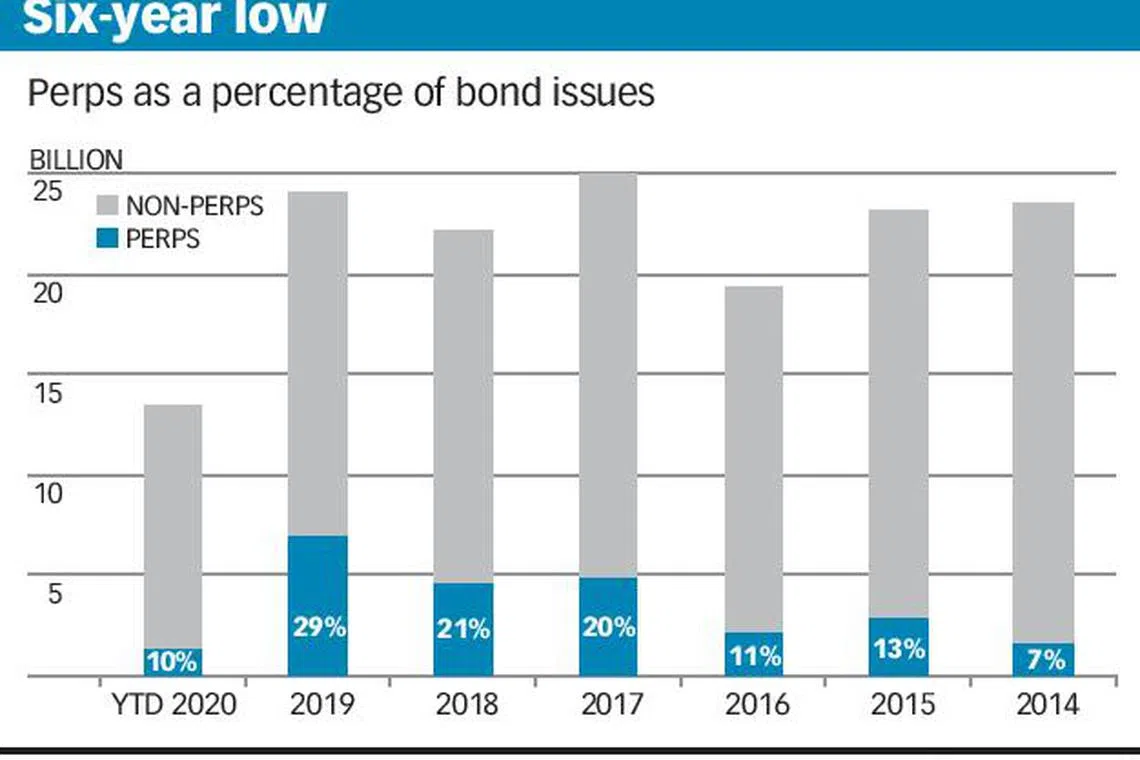
PERPETUAL bond (perp) issuances have fallen to a six-year low as a percentage of total bond issuances in the Singapore market, making up just 10 per cent of the total market share year to date compared to close to 30 per cent in 2019.
Over the last decade, perp issuances have comprised about 16 per cent of total bond issuances in Singapore.
Data from DBS as at Sept 25, 2020 showed that just S$1.4 billion has been raised from seven perp issuances so far this year, versus S$7.1 billion raised via 20 perp issuances in the whole of 2019.
Market watchers polled by The Business Times said the decline could be due to lower need for financing in general as Covid-19 has blunted the growth outlook for many firms, as well as an abundance of other cheaper forms of funding. At the same time, there has been a pullback in demand by investors who have grown wary of defaults especially from high-yield issuers.
Wong Hong Wei, credit research analyst at OCBC Global Treasury Research and Strategy, said that issuances last year were anchored by private banks. Last year they took up more than half of the total issuances in a number of deals. This year, however, the take-up rate by private banks has fallen.
Perps are also increasingly uneconomical for companies. Both Ascott Reit and Wing Tai Properties this year chose to miss the call of their perpetuals after spreads widened significantly due to Covid-19.
Mr Wong said it was only recently that spreads have compressed back to near pre-Covid levels, which could prompt issuers to issue perps again.
At the same time, the stronger companies have the option of and seem to prefer bank loans.
For a good part of this year, OCBC was cautious on perp issuances. It believed that more issuers were likely to treat perps as equity-like instruments and choose not to exercise their calls in order to retain a larger liquidity and equity cushion.
The bank only recently turned neutral on perps, saying that these non-call risks have reduced and issuers are now able to refinance at similar initial spreads or cheaper. It believes that as long as interest rates and spreads remain suppressed globally, interest in Singapore dollar-denominated perps will be supported.
To be sure, the whole bond issuance market has shrunk 37 per cent this year. Only S$13.4 billion had been raised as at Sept 25, 2020, compared to S$21.2 billion for the corresponding year-ago period. But perps showed a far more severe drop of 78 per cent.
The whole of 2019 saw S$24.1 worth of bond issuances in total.
Clifford Lee, DBS Bank's head of fixed income, attributes the weaker fundraising to the disruption caused by Covid-19, which turned issuers cautious in the volatile market.
"Not just in Singapore, but in all the G3 countries across Asia, you see that high-yield issuance has come down, and the market has become dominated by investment-grade issuances. The market has turned more risk averse as a result of the volatility, and that is understandable."
Perps are considered to be higher risk instruments than plain vanilla bonds because they have no legal maturity date.
Perp issuers here tend to be financial institutions looking to replenish capital to meet capital adequacy ratios, real estate investment trusts trying not to bust their leverage limits, and Temasek-linked corporates.
Perp investors, on the other hand, tend to be institutions such as insurance companies and fund managers, as well as private banking clients. This is because many issues have a minimum denomination size of S$250,000. Higher-yield issuances would also appeal more to private banking clients than institutions.
TRENDING NOW

Simba admits exceeding spectrum limits amid failed M1 deal; parent company Tuas’ full-year profit surges 277%

‘Our bread and butter’: Family-run Loo’s Hainanese Curry Rice hands reins to third generation

StarHub, Keppel confirm talks over potential M1 deal

Grab executives buy back shares after stock hits 3-year low on Atome deal

