

Shelving S$5 billion office redevelopment plan proved ‘wise’ as geopolitical risks mount: OCBC chairman
The lender instead allocates half that amount to a two-year capital return plan

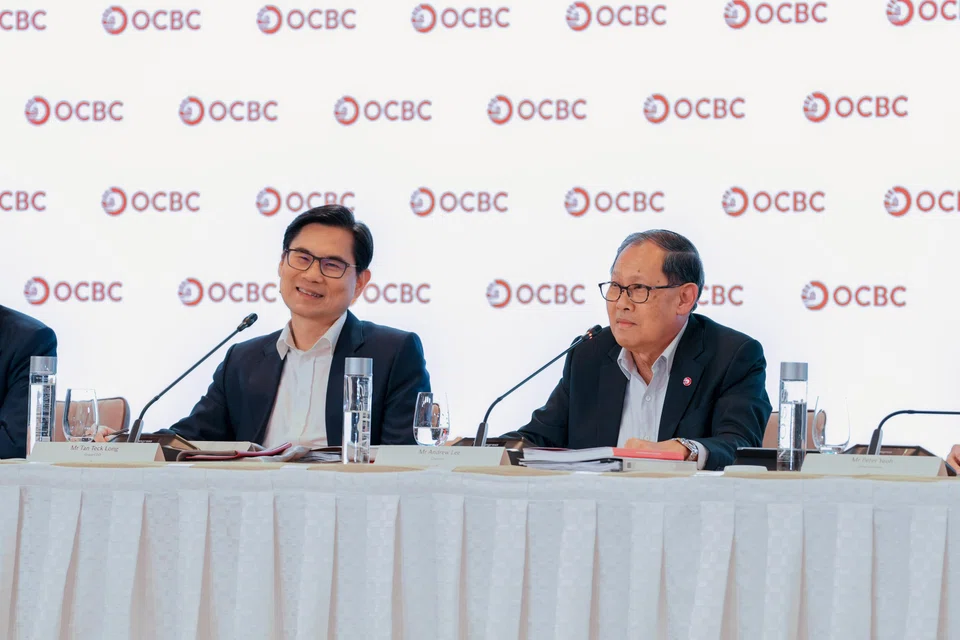
[SINGAPORE] The board decision by OCBC to defer a planned S$5 billion redevelopment of its landmark Chulia Street properties was, in hindsight, a “wise” decision given uncertainties stemming from the current geopolitical landscape, chairman Andrew Lee said on Thursday (Apr 16).
“The whole development would have cost us S$5 billion, and if we had gone ahead, if we are meeting this storm (now), we will be very, very challenged,” said Lee at the bank’s annual general meeting (AGM) held at the Sands Expo and Convention Centre before more than 1,800 shareholders.
The remarks come as uncertainties from the Iran conflict continue to weigh on business sentiment.
In April 2024, The Business Times first reported that South-east Asia’s second-largest lender was studying a redevelopment of its properties at 63 and 65 Chulia Street – home to the bank’s OCBC Centre headquarters – as well as 18 Church Street, in Singapore’s central business district.
Rather than committing S$5 billion to redevelopment works, the bank instead allocated half that amount – S$2.5 billion – to a two-year capital return plan comprising special dividends and share buybacks, Lee noted.
First announced in February 2025, the programme returned a special dividend equivalent to 10 per cent of group net profit for the 2024 and 2025 financial years, lifting the lender’s payout ratio to 60 per cent for both years. OCBC is aiming to complete the programme by FY2026.
From the current financial year, the bank will revert to its long-term capital return framework of a 50 per cent dividend payout ratio, in line with remarks made by group chief executive officer Tan Teck Long at the fourth-quarter earnings briefing in February, Lee said.
Returning to the 50 per cent payout ratio, instead of the higher 60 per cent level in the previous two financial years, means OCBC is “reserving the provisions necessary if we need to sail into a storm”, added Lee.
The lender’s 2025 bid to privatise Great Eastern, of which it owns 93.7 per cent, was akin to “taking in cargo that fits in nicely into the ship”, although it ultimately failed.

Lee also categorically ruled out a third attempt to privatise Great Eastern.
Meanwhile, he noted that OCBC’s exposure to the Middle East stands at about 2 to 3 per cent of total loans, and the bank has also been conducting stress tests to assess possible second and third-order effects.
Regional outlook
Tan, who was attending his first AGM as group chief executive after taking over from Helen Wong on Jan 1, also addressed shareholder queries.
OCBC has no direct exposure to private credit funds and does not expect any material issues to emerge from stresses in that market in the United States, he said, in response to a shareholder query.
Several other questions centred on Indonesia, including how recent outlook downgrades by ratings agencies could affect the bank’s operations there.
Tan noted that OCBC has operated in Indonesia for more than 80 years, and that the country remains South-east Asia’s largest economy.
By geography, Indonesia accounted for 5 per cent of the group’s S$341 billion loan book as at Dec 31, 2025, compared with 8 per cent in Malaysia, 21 per cent in Greater China and 44 per cent in Singapore.
“South-east Asia is actually a pretty good place to be in relative to the rest of the world,” said Tan, citing the Russia-Ukraine war in Europe and the ongoing conflict in the Middle East.
He added: “We do know this place very well – there will always be short-term ups and downs in the markets which we operate in, but because of our insights and capabilities, where people see risk, we see opportunities.”
Resolutions passed at Thursday’s AGM included one to re-elect Lee as a director on the board.
Shares of OCBC closed 1 per cent, or S$0.22, lower at S$22.66 on Thursday. Year to date, the counter is up 14.2 per cent.
Decoding Asia newsletter: your guide to navigating Asia in a new global order. Sign up here to get Decoding Asia newsletter. Delivered to your inbox. Free.
Copyright SPH Media. All rights reserved.
TRENDING NOW

DBS, OCBC, UOB rout lops billions off STI as inflation, rate concerns spook investors

Grab CEO’s wife Chloe Tong on life with Anthony Tan and finding her purpose

OCBC sheds S$8 billion in value as shares close nearly 6% down; analysts cautious on banks

Deal between tycoon friends sparks scrutiny of Philippine power sector

