

Should investors answer SIA's call for more cash?
The airline group may have to issue more than 3.47b new shares when all its MCBs mature in 2030

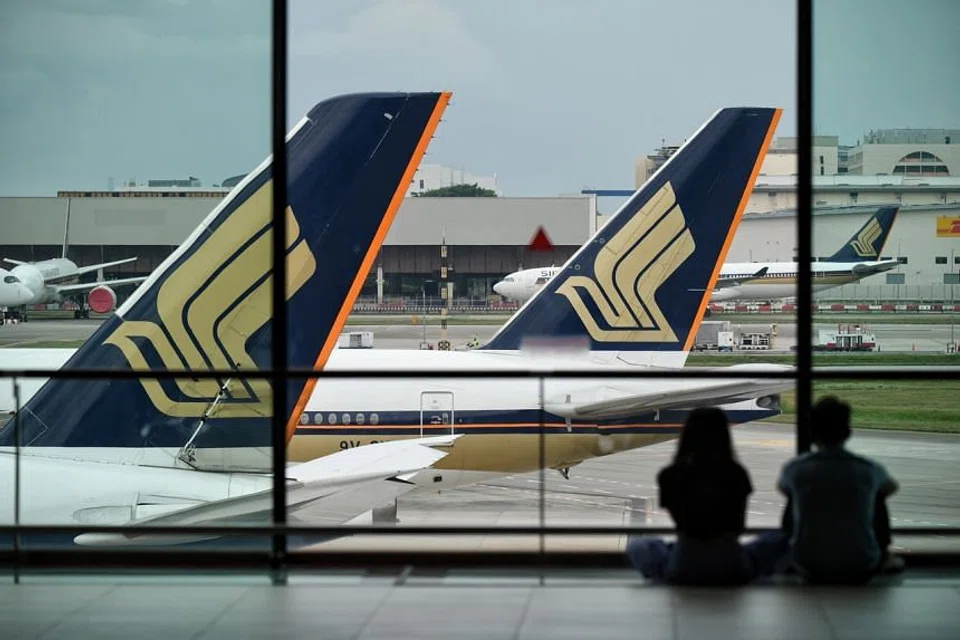
WHEN Singapore Airlines offered its shareholders the first S$3.5 billion tranche of mandatory convertible bonds (MCBs) last year there were few takers other than Temasek Holdings.
Even SIA's chairman Peter Seah and its CEO Goh Choon Phong allowed their provisional allotments to lapse.
As a result, Temasek ended up holding 95.9 per cent of those MCBs even though it owned less than 56 per cent of SIA.
By contrast, the 1.78 billion new shares SIA simultaneously offered its shareholders at a deeply discounted price of S$3 each were more than fully taken up.
With hindsight, shareholders of SIA had the right instincts. Shares in SIA closed Friday at S$4.77, while the MCBs closed less than one per cent above par.
Now, SIA is tapping its shareholders for a further S$6.2 billion by issuing the second tranche of its MCBs.
Last week, the airline group said these additional MCBs will be offered to its shareholders on the basis of 209 MCBs for every 100 shares they hold. Temasek has once again pledged to take up its own entitlement as well as any unwanted issuance.
The terms of the second tranche of MCBs are substantively the same as those of the first tranche. They offer a zero coupon and are redeemable semi-annually - only at the option of SIA - at prices calculated to deliver an annual yield-to-call of 4 to 6 per cent.
At maturity, the accreted value of the second tranche of MCBs will be converted to new SIA shares at a conversion price initially set at S$4.84 - same as the first tranche. Both tranches of MCBs mature on June 8, 2030.
Given these similarities, it stands to reason that the second tranche of MCBs will probably not be any more popular with investors than the first tranche, and that Temasek is likely to end up owning almost all of it.
What exactly is the problem with the MCBs? Besides providing no current income, they offer limited upside potential for very significant downside risk.
If SIA's business comes roaring back and its stock soars, the MCBs could end up being quickly redeemed at prices that leave investors with returns of as little as 4 to 5 per cent per annum.
On the other hand, if SIA never recovers and its stock price tanks, the MCBs could end up being converted into worthless shares at maturity.
There are, in my view, much better ways to earn an annual return of 4 to 5 per cent in the market. Meanwhile, investors wanting to specifically express a bullish view on SIA could just buy its shares instead.
Purpose of the MCBs
While the MCBs will probably not appeal to many investors, they are exactly what SIA needs right now in order to bridge the collapse in international air travel caused by the Covid-19 pandemic.
For starters, the MCBs are treated as equity on SIA's balance sheet. This strengthens the group's capacity to take on additional debt.
The MCBs are redeemable semi-annually, which provides SIA with the flexibility to quickly adjust its capital structure when international borders reopen.
Most importantly, the dilutive impact of the MCBs is so far beyond the horizon of most equity investors that it may well be ignored for the next few years.
Certainly, the dilutive impact of SIA's rights issue of new shares and MCBs last year, which raised a total of S$8.8 billion, did not stop its share price from advancing more than 40 per cent since the end of October last year, amid anticipation that Covid-19 vaccines will soon make international travel possible again.
If anything, the capital raising last year may have reassured investors that the group would be spared any serious financial stress despite having to halt most of its flights.
For FY2021 ended March 31, SIA reported a net loss of S$4.27 billion driven by a slump in operating performance as well as non-cash impairment charges. Revenue sank more than 76 per cent to S$3.82 billion.
SIA nevertheless ended FY2021 with a gearing ratio of 0.9 times, versus 1.27 times at the end FY2020.
With the issue of a further S$6.2 billion worth of MCBs, backed by Temasek, it seems unlikely that SIA will face any serious financial risks in the year ahead, even if a significant recovery in international air travel remains elusive.
Looming dilution?
Of course, shareholders of SIA looking beyond the next three to five years should consider the impact all the MCBs will eventually have on the company.
Come 2030, the accreted value of the first tranche of the MCBs would be S$6.31 billion while the accreted value of second tranche would hit S$10.52 billion. Assuming the conversion price remains at S$4.84, SIA would have to issue more than 3.47 billion new shares to pay off the MCB holders.
SIA currently has almost 2.98 billion shares in issue (including treasury shares). And, before the rights issue of 1.78 billion new shares last year, it had just under 1.2 billion outstanding shares.
SIA could redeem some of the MCBs in the years ahead, thus lowering the number of shares that will be issued in 2030. Some analysts are choosing to treat a proportion of the MCBs as debt rather than equity on SIA's balance sheet precisely on the view that SIA will eventually redeem some of the MCBs with borrowings.
Still, SIA faces an enormous challenge to overcome the dilutive impact of the MCBs. Even before Covid-19 came along, SIA was struggling in the face of intense competition and volatile fuel costs. During the 10-year period to FY2019, SIA's return on equity averaged just 4.6 per cent.
One reason for optimism is that SIA has now integrated its full-service as well as low-cost carrier businesses under just two brands: SIA and Scoot. This could enable the group to entrench its competitive position in both fields, while also reaping some economies of scale.
SIA will probably have to do a lot more than just run its operations more efficiently though. While airlines are famously tough businesses, they have created fortunes over the past century for maverick risk takers, from Howard Hughes to Tony Fernandes, who were intent on offering travellers an exciting new proposition.
SIA was itself something of a rule breaker in its heyday, turning its in-flight cabins into a theatre of competition rather than conformity.
If SIA is to make Temasek's investment in its survival really pay off, it has to be ready to do more than just welcome passengers back when international borders reopen. Working together with Changi Airport, it needs to offer a post-pandemic flying experience like no other.
- For more analysis and insight on market trends and corporate issues, listen to the Mark To Market podcast at bt.sg/mark2mkt
TRENDING NOW
Singapore tech stocks plunge as Nasdaq bloodbath spills into region

S$3 billion money laundering case: Rare Pateks and Rolexes, diamond-covered Hermes and more head to auction
OCBC Q3 profit rises 3% to S$2.04 billion, slightly above expectations

From legacy to launch: Francis Yeoh and Yeoh Pei Xien on family unity and YTL’s next‑gen ventures

