

SIA S$1.12b in the red for Q1; analysts see FY21 loss of S$1.83b
Singapore
SINGAPORE Airlines (SIA) swung into a net loss of S$1.12 billion for its first quarter ended June 30, 2020, compared to a net profit of S$111 million a year ago, due to its weaker operating performance and financial impact of S$127 million from the liquidation of low-cost airline NokScoot.
The latter mostly comprised the non-cash impairment of seven Boeing 777 aircraft which had been leased to NokScoot and the group's share of related costs.
Group revenue fell 79.3 per cent to S$851 million due to the sharp drop in passenger flown revenue, partially offset by improvements in cargo flown revenue. Passenger carriage fell by 99.4 per cent for Singapore Airlines, 99.8 per cent for SilkAir, and 99.9 per cent for Scoot year-on-year, as air travel "evaporated" globally, it said.
But the airfreight capacity crunch, coupled with strong demand for urgent movements of personal protective equipment, pharmaceuticals and fresh foods, led to a significant improvement in its cargo load factor. SIA also deployed passenger aircraft on cargo missions to boost cargo capacity.
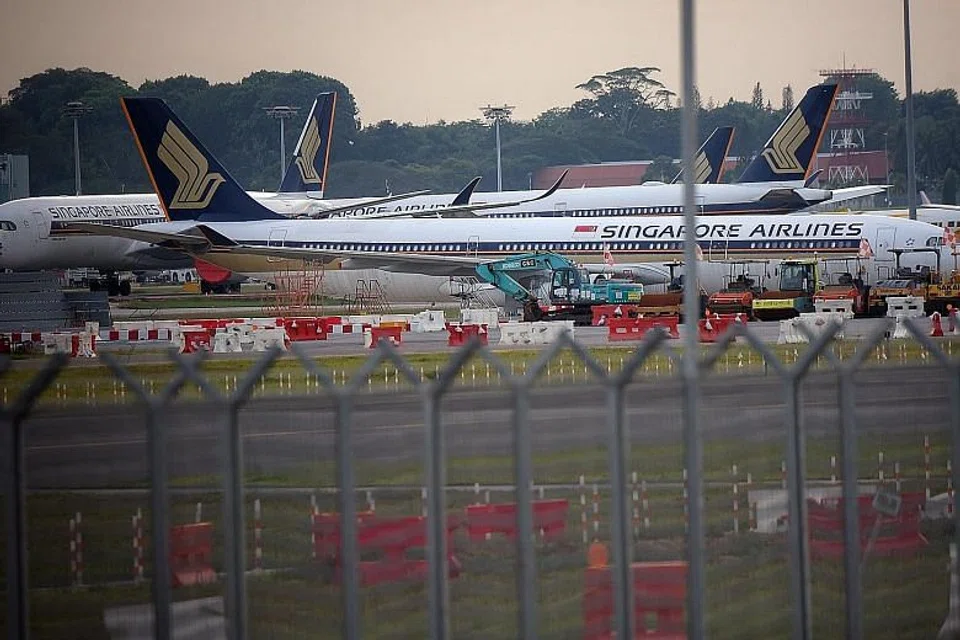
Currently, of a group fleet of 220 aircraft, 32 are deployed on passenger services, seven freighters are operational, while 33 have been deployed on cargo-only services. Some 119 aircraft are parked at Singapore Changi Airport and another 29 aircraft stored in Alice Springs.
For the quarter, group expenditure fell 51.6 per cent to S$1.89 billion due to lower net fuel cost and non-fuel expenditure, but this was partially offset by fuel hedging losses on contracts which matured in the quarter.
"A further downward adjustment to the expected rate of capacity recovery led to a reduction in expected fuel consumption, causing the group to recognise additional ineffective hedges. Mark-to-market losses of S$464 million on ineffective fuel hedges have been recognised this quarter," it said.
In the quarter, SIA scaled back operations due to border closures but retained services to key cities to bring customers home. It maintained a "skeletal" network to initially connect Singapore with 14 key metros globally, before subsequently increasing this to 24 by the end of the quarter. SilkAir and Scoot also operated minimal networks before adding more services later on.
Since June 8, when the first Fast- Lane arrangement was established between Singapore and selected cities in China, more transit restrictions have been lifted and there has also been partial resumption of transfers via Changi Airport. The group's network has since increased from 18 destinations in April to 32 destinations including Singapore by the end of June. SIA said that it will step up the frequencies of selected routes should demand pick up in the coming months.
The group continues to engage aircraft manufacturers to negotiate adjustments to the delivery stream of existing aircraft orders and the schedule of progress payments to reduce near-term cash outflows. "We have reached an agreement with Airbus on some of these matters and discussions with Boeing are ongoing. This will help to moderate fleet growth in the near term," it said.
SIA said that the recovery trajectory in international air travel is slower than it had initially expected, with industry forecasts expecting that it will take two to four years for passenger traffic to return to pre-pandemic levels.
SIA believes that its passenger capacity may reach less than half of its pre-Covid-19 levels by the end of FY21. It also projects for passenger capacity to recover to just 7 per cent compared to pre-Covid-19 levels by the end of the second quarter.
It is reviewing its fleet size and mix and expects to incur a material impairment of the carrying values of its older generation aircraft, particularly the A380 aircraft which would account for about S$1 billion.
In the meantime, it expects to sustain its cargo load factors amid the constrained global airfreight capacity, due to the significantly lower bellyhold cargo capacity worldwide.
The integration of SilkAir into SIA also remains on track, as it transitions its SilkAir narrowbody operations to SIA, starting with the 737-800 aircraft in Q4 FY21. This move is expected to yield economies of scale for SIA.
Consensus Bloomberg estimates are projecting for SIA to post a net loss of about S$1.83 billion for FY21, compared to a net loss of S$212 million in FY20 - its first annual loss in its 48-year history.
DBS Group Research, which kept its "hold" rating on the stock with a 12-month target price of S$3.75, said that with six vaccine candidates already in clinical trials, there is cautious optimism that a vaccine can be developed by early 2021, paving the way for international air travel to recover.
It projects that SIA's recent S$8.8 billion fundraising exercise will enable its net debt-to-equity ratio to drop from 0.9 time as at end-FY20 to just 0.1 time at the end of FY21, assuming the mandatory convertible bonds are accounted for as equity. This will give SIA ample liquidity to ride through the crisis, it said.
SIA shares closed S$0.04 or 1.1 per cent lower at S$3.53.
TRENDING NOW

Grab CEO’s wife Chloe Tong on life with Anthony Tan and finding her purpose

Brokers maintain ‘buy’ on CDL despite investor reservations over strategic review

Deal between tycoon friends sparks scrutiny of Philippine power sector

Hwa Seng Builder, two China companies win S$1.2 billion Tuas Road Viaduct phase two contracts

